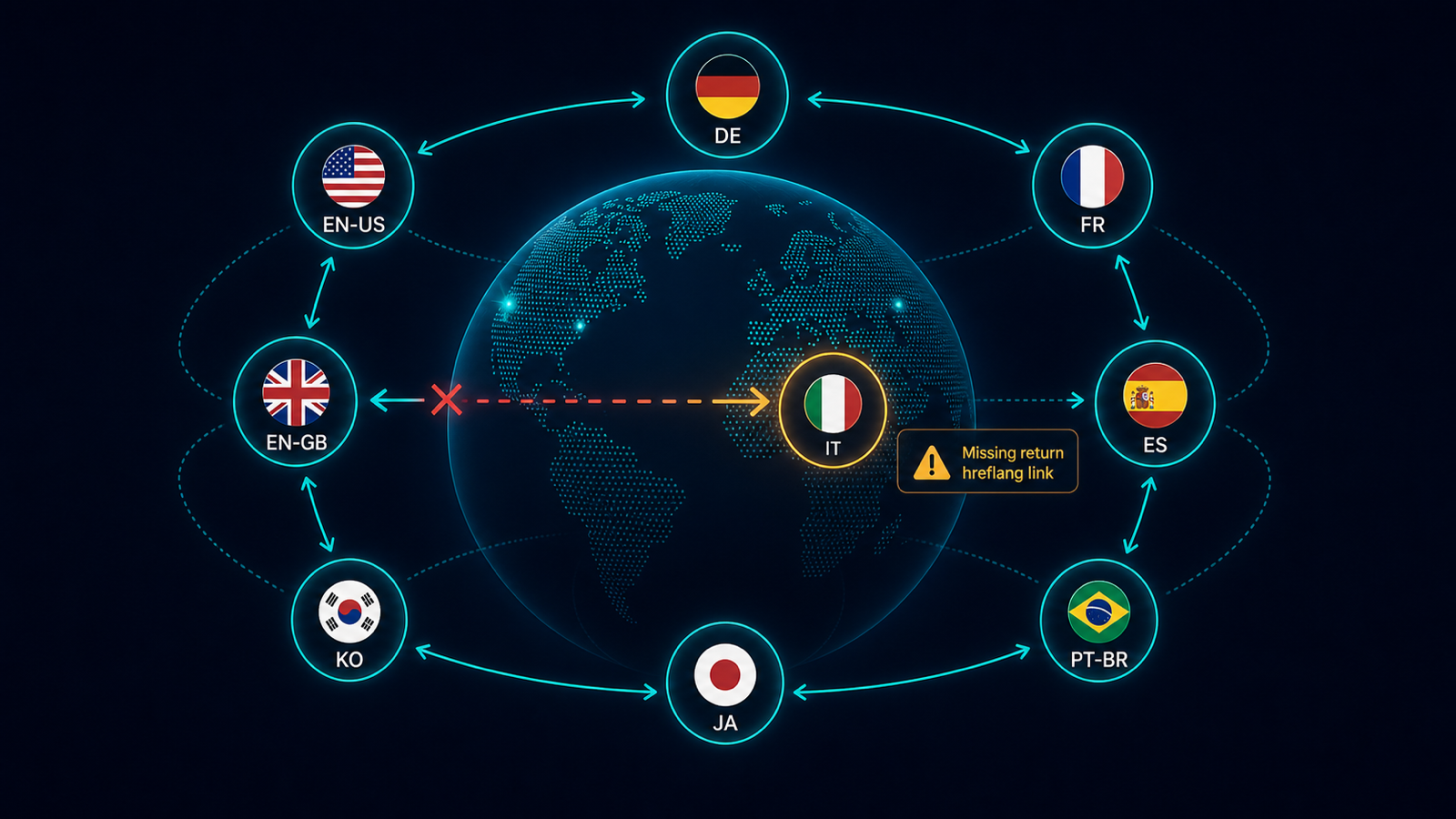
You launch Italian (it-IT) for a 200-URL cluster.
Engineering ships 200 new Italian pages and updates the hreflang block on the English source pages.
Except they missed 18 of them.
For those 18, the Italian page declares its English peer, but the English page does not declare the Italian peer back.
Google sees a one-way cluster and silently downgrades the entire 200-URL Italian rollout.
This is the dedicated monitoring setup that catches the missing return tags before the launch goes live.
What goes wrong in a new-locale rollout
- Translators ship new locale pages on time; the engineering ticket to update hreflang on existing pages is a separate workstream.
- Hreflang blocks live in templates, headers, or sitemaps — and some product types use different templates.
- Edge-case URLs (legacy pages, A/B test pages, locale-specific landing pages) are excluded from the bulk update.
- Sitemap-level hreflang and HTML-level hreflang get mixed, breaking the cluster Google computes.
2-UA setup for the launch window
- Run a full-site crawl extracting hreflang. The parser captures hreflang from HTML, HTTP headers, and sitemap entries in one normalized view.
- Export the hreflang inventory to XLSX. For each URL in the English source cluster, confirm that the new
it-ITalternate is declared. - Apply the reverse check: for each Italian URL, confirm that it declares the English source (
en-usoren) back. Missing return tags are the typical failure. - Add the top 20 English source URLs from the new locale's cluster to Tracked URLs with field tracking on hreflang. Any future template edit that drops or alters the cluster fires an alert.
- Re-crawl after each fix release to confirm the cluster closure.
The signal you wait for during launch week
A clean cluster shows up in 2-UA as a symmetric matrix:
every English URL declares the Italian peer; every Italian URL declares the English peer.
A missing return tag appears as a one-way arrow in the hreflang report —
the English page does not include hreflang="it-IT" pointing at its Italian counterpart,
even though the Italian page correctly points at the English source.
Launch-week response playbook
- Export the asymmetric URL pairs to XLSX. Engineering needs the exact list, not a description.
- Identify the template or page class the missing URLs share. The fix is almost always a one-line template patch, not 18 individual edits.
- Validate the fix on a single page first. Crawl that one URL through 2-UA to confirm the cluster closed.
- Ship the template patch across the affected URLs.
- Recrawl the full English source cluster and confirm symmetric closure before submitting the Italian sitemap to GSC.
Three patterns that produce broken locale clusters
- Template inheritance gaps — the main product template was updated, but a legacy product template was missed.
- Sitemap-based hreflang on new locale, HTML-based on old — mixing sources within one cluster confuses Google and can be ignored entirely.
- x-default missing or pointing wrong — easy to overlook; without x-default, users in unmapped locales see a randomly-chosen URL in search results.
Use the free SEO page audit to confirm hreflang on a single representative URL, then run a full-site crawl inside a project to map the entire locale cluster.