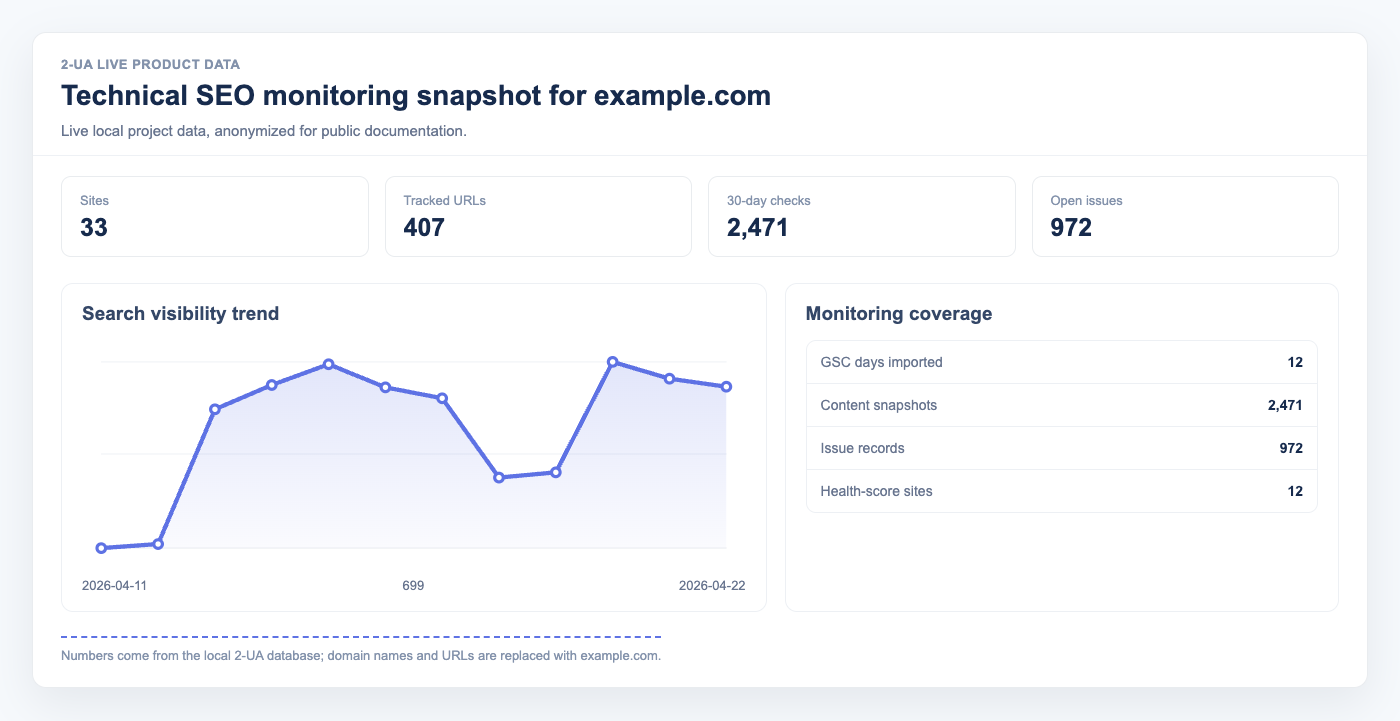
Most SEO teams do not fail because they lack tools. They fail because monitoring is fragmented: one tool for uptime, another for crawling, another for performance, and no shared prioritization model. A strong technical SEO workflow needs one operating rhythm.
What a stable workflow should include
- A verified site project with ownership confirmation and baseline settings.
- Tracked URLs for business-critical pages with expected status and redirect behavior.
- Scheduled crawling with mobile/desktop context and repeatable filters.
- Daily/weekly trend views for response time, PageSpeed, W3C, and sitemap coverage.
- Alerting in team channels so issues are not trapped inside dashboards.
How to run this in 2-UA
- Add your site and enable the checks that match your risk profile.
- Configure notifications and alert policy to reduce noise from minor changes.
- Add tracked URLs for templates that drive revenue, traffic, or lead flow.
- Create crawl jobs for full-site, URL-list, or sitemap-based audits.
- Use change impact and health score to prioritize engineering work.
Why this converts better than ad-hoc audits
A one-off crawl finds issues. A monitoring workflow prevents regressions. That difference is what stakeholders pay for, especially in multi-team organizations. If you are setting this up for the first time, start with a free crawl, then move to full monitoring when the process is stable.