noindex to product pages. At 10:14, the new canonical builder points paginated pages to an error URL. None of those failures appears in rankings yet. By the time organic traffic makes the damage obvious, crawlers and users have already consumed the broken output.
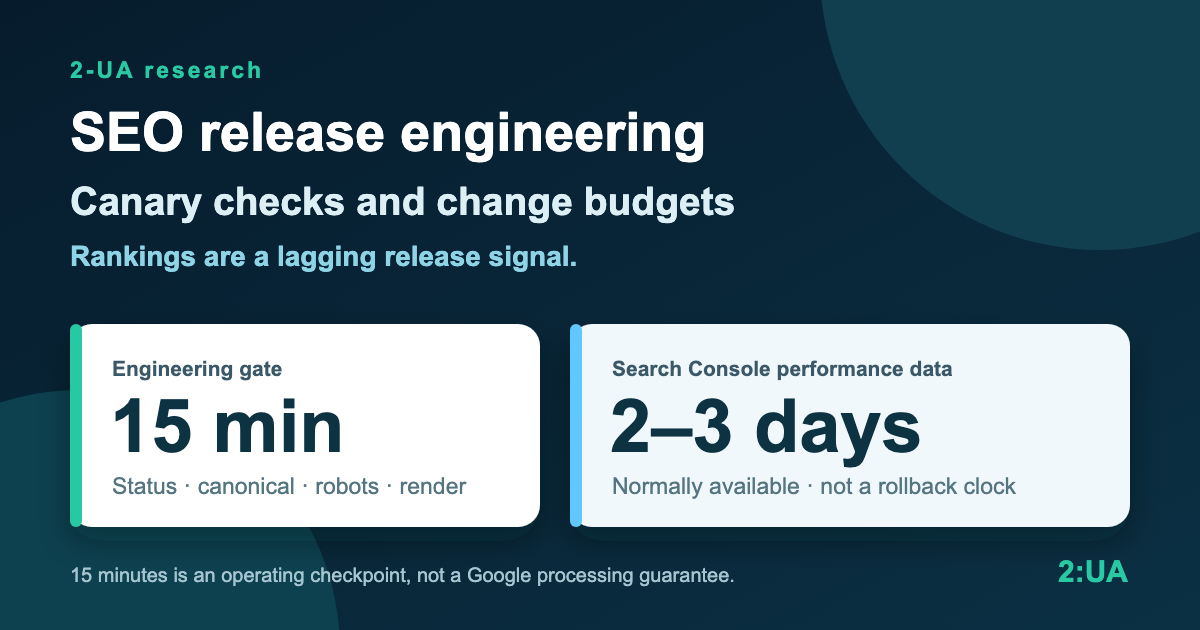
SEO release engineering closes that gap. It treats crawlable output as part of the production contract, limits the first exposure when the architecture allows it, and decides in advance which observable failure will pause or reverse a rollout. The first 15 minutes are not a promise that Google will crawl, index, or rank anything. They are the period in which your own systems can answer a narrower and more useful question: did this release change the technical facts we intended to preserve?
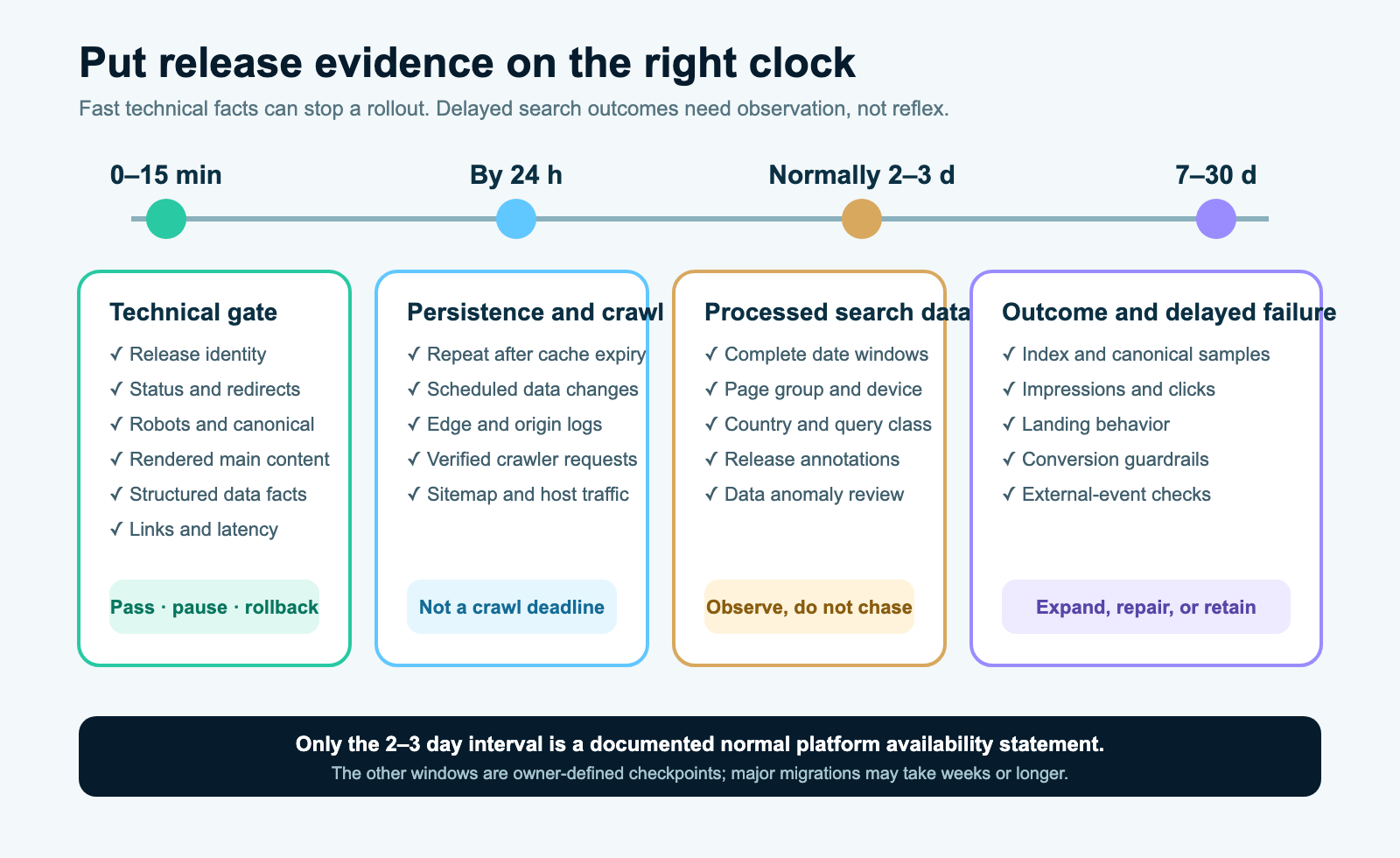
That boundary matters. Google says Search Console performance data is normally available in two to three days, while significant site moves can take weeks or longer as URLs are recrawled and reprocessed.3, 7 Rankings are therefore a lagging release signal. Status codes, redirect targets, canonical URLs, robots directives, rendered content, structured data, internal links, and response latency are available much sooner. A release process should use each signal on the clock where it can support a decision.
This guide provides a release contract, a canary URL selector, a change-budget model, a rollback matrix, a worked release, and a 30-day measurement plan. It is based on primary sources read on October 4, 2026. Where the sources do not define a threshold—especially the 15-minute gate—the framework labels the threshold as an operating choice rather than a platform fact.
The answer in one minute
- Define the release unit. Name the code, configuration, template, data, infrastructure, and URL populations that can change.
- Use “canary” precisely. A canary is a partial, time-limited production exposure evaluated against a control. A URL list checked after a global rollout is a smoke-test cohort.
- Budget blast radius and time. Decide how many valuable URLs or requests may be exposed, for how long, and which failure ends the experiment.
- Test invariants in the first 15 minutes. Verify response, redirect, canonical, robots, rendered main content, structured data, links, and latency on the changed population and an unchanged control.
- Rollback on attributable technical failure. A new
noindex, wrong canonical, broken redirect, empty render, or severe error/latency regression can justify an immediate reversal. - Do not rollback on early rankings. Search Console is delayed, search results vary, and crawling is asynchronous. Early search movement cannot reliably attribute the release.
- Keep later evidence on a separate clock. Use logs and repeated fetches for crawl access, Search Console for delayed search performance, and analytics for user and conversion outcomes.
- Release one coherent change. Google’s site-move guidance recommends smaller steps where practical and changing one major thing at a time.3
What an SEO canary is—and is not
The Google SRE Workbook defines canarying as a partial and time-limited deployment of a change, followed by an evaluation that decides whether rollout should proceed. The changed population is the canary; the unchanged population is the control. The method limits exposure while real production inputs reveal defects that test environments miss.1
Applied to SEO, the unit might be a subset of application instances, a feature-flagged URL cohort, one locale, one directory, one template family, or a percentage of production requests. The comparison must isolate the candidate output from the known-good output. If a template is deployed everywhere and an operator checks ten URLs, those URLs are useful smoke tests, but they are not a canary deployment: every production URL was already exposed.
This distinction prevents a dangerous ritual. A team selects “representative URLs,” deploys globally, sees that the samples pass, and claims the blast radius was controlled. It was not. Sampling can improve detection; only partial exposure limits impact. When partial exposure is impossible, be honest about the architecture and compensate with pre-production parity checks, a reversible switch, smaller change scope, and faster rollback.
Three canary patterns
| Pattern | Isolation | Useful for | Main trap |
|---|---|---|---|
| Traffic canary | A small request share reaches the new application version. | Server errors, latency, rendering, cache, and dependency behavior. | The same URL can vary between versions, confusing deterministic crawler checks unless routing is controlled. |
| URL-cohort canary | A fixed, declared set of URLs or templates receives the change. | Template, metadata, navigation, structured-data, and content changes. | The cohort may not represent long-tail states, locales, inventory, or shared dependencies. |
| Section migration | One stable site section moves before the rest. | URL or platform migrations where infrastructure permits a smaller first move. | Google explicitly warns that a section may not represent the full move.3 |
A/B testing and canarying overlap but answer different decisions. A product experiment asks whether a variation improves an outcome. A release canary asks whether a candidate is safe enough to expand. Google’s website-testing guidance still matters: do not cloak, preserve canonical intent across alternate URLs, use temporary rather than permanent redirects for temporary tests, and remove test residue when the experiment ends.5 Those rules protect search consistency; they do not turn a deployment safety check into a ranking experiment.
Write the release contract before launch
A release contract is a one-page decision record completed before production changes. It removes threshold negotiation from the incident itself. The contract should be small enough to use and specific enough that two operators reach the same decision from the same evidence.
1. State the change and the non-change
List every mechanism that can alter crawlable output: code, CMS fields, template includes, edge rules, redirects, rendering, feature flags, data migrations, CDN configuration, DNS, and third-party dependencies. Then list what must remain stable. “Redesign product cards” is too vague. “Change product-card markup and lazy-loading behavior; preserve URL, HTTP status, canonical, robots, H1, visible price, availability, Product JSON-LD, primary links, and mobile/desktop content parity” is testable.
2. Name the populations
Record the canary assignment, control assignment, exclusions, and routing method. Freeze the lists or the assignment rule. If inventory churn can move URLs between states, record the state at release time. A control that silently receives the candidate is not a control; a canary that includes only the easiest pages is not representative evidence.
3. Define pass, pause, and rollback
A pass permits the next ramp stage. A pause stops expansion while the current exposure remains bounded. A rollback restores the known-good artifact or disables the change. Put observable predicates beside each action: “rollback if any indexable canary URL gains noindex,” not “rollback if SEO looks bad.” Include an owner and a maximum decision time.
4. Preserve release identity
Every fetch, screenshot, log slice, and alert should resolve to a release identifier and timestamp. Record the previous known-good version as well. Without identity, an operator may compare cached output to the candidate, mix two edge states, or roll back the application while leaving a database, CDN, or CMS change active.
5. Choose evidence systems before the incident
Synthetic fetches prove what a chosen client received. Rendered checks prove what a browser executed. Origin or CDN logs prove requests. Analytics proves measured user behavior under its collection rules. Search Console reports Google Search performance after processing and delay. The Search Status Dashboard reports broad platform events, not one site’s release health.6, 7, 11 No single dashboard covers the whole causal chain.
Set a change budget, not a confidence slogan
“Low risk” is not a budget. A change budget specifies how much exposure, duration, and uncertainty the owner accepts before new evidence is required. It borrows the decision discipline of SRE error budgets without pretending that an SEO metric is an SLO. Google’s example error-budget policy allows normal releases while the service meets its SLO and halts ordinary releases when a preceding four-week budget is exhausted.2 The reusable idea is the pre-agreed policy, not its exact threshold.
A practical SEO change budget
Track four independent quantities:
- Exposure: the share of eligible URLs, requests, templates, locales, or revenue-weighted landings receiving the candidate.
- Maximum credible harm: the worst technical failure that could reach that population, such as total unavailability, deindexing directives, wrong redirects, missing primary content, or degraded checkout.
- Detection time: the maximum time between exposure and a reliable owner-controlled signal.
- Recovery time: the time to restore every changed layer and confirm known-good output.
Do not collapse those values into a fake universal score. Keep the denominator visible. Five percent of URLs is not five percent of organic value if the cohort contains the homepage and every highest-revenue category. Five percent of requests may say little about a bug that affects a rare locale or logged-out mobile render. Build the budget around the failure surface you can actually isolate.
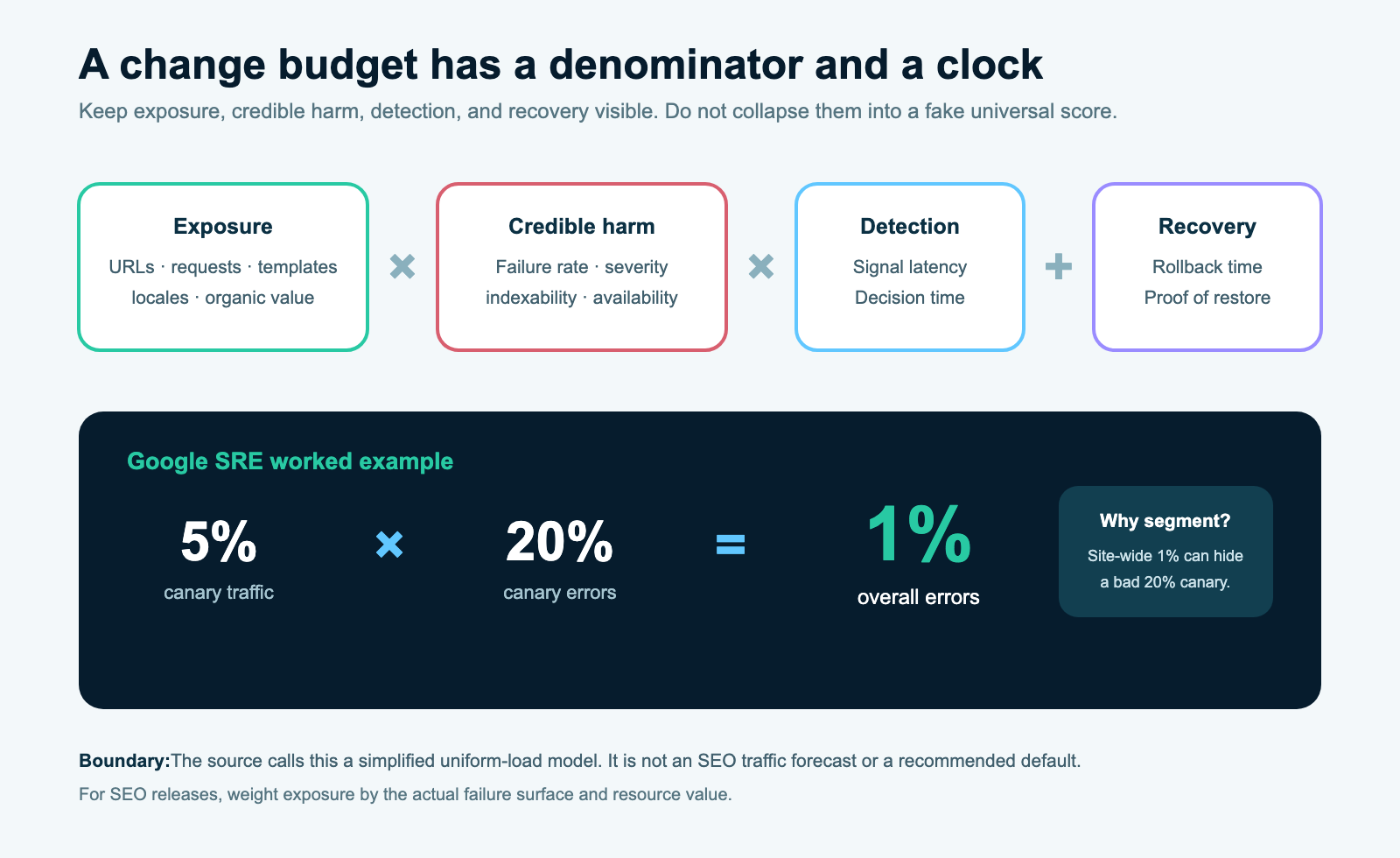
5% × 20% = 1% overall errors. The source explicitly notes uniform-load and model assumptions. For SEO, weight exposure by the resource and failure surface rather than importing the percentage as a default.
The budget should shrink when attribution is weak, rollback is slow, shared state can contaminate the control, or the release combines several independently risky changes. It can expand after repeated clean canaries demonstrate stable telemetry and recovery. That is earned operational confidence, not confidence inferred from a staging pass.
Select canary URLs by coverage, value, and failure surface
A canary set is not a list of “top pages.” It is a compact test design. The list must expose the code paths and data states most likely to fail while keeping the initial business impact tolerable. Start with a coverage matrix, not traffic rank.
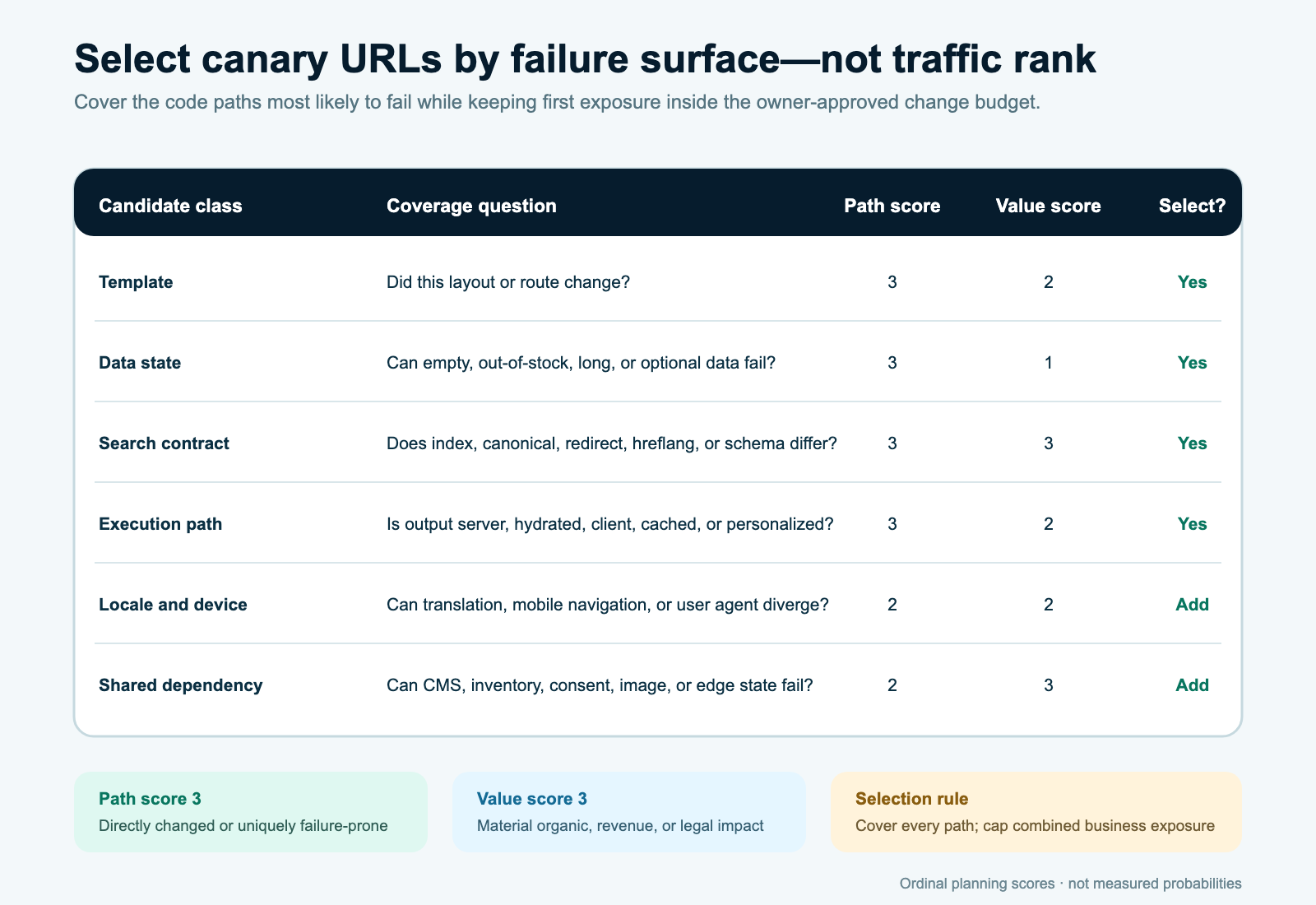
Cover six dimensions
- Template: homepage, category, product, article, location, pagination, faceted results, and other changed layouts.
- Data state: in stock, out of stock, no results, long title, missing optional media, variant-heavy, paginated, translated, and user-generated content.
- Business value: high-organic-entry, high-conversion, high-margin, campaign, and legally sensitive pages.
- Search contract: indexable, intentionally non-indexable, canonicalized duplicate, redirected legacy URL, hreflang member, and structured-data eligible page.
- Execution path: server-rendered, hydrated, client-routed, cached, uncached, edge-personalized, desktop, and mobile.
- Dependency: CMS, search service, inventory API, translation layer, image service, consent manager, and edge configuration.
Include an unchanged control for each material class. The control needs the same measurement path and similar baseline behavior. Comparing a high-traffic product canary with a low-traffic editorial control confounds template, demand, caching, and dependency differences. Google SRE emphasizes representative, attributable metrics and warns that shared failure domains can move canary and control together.1
A small site may need only six to twelve URLs if those URLs cover every template and state. A marketplace may need hundreds or a rule-based cohort because templates, sellers, locales, inventory states, and edge regions multiply. The goal is not a fashionable sample size. It is enough observations to encounter the relevant paths while the exposure remains acceptable.
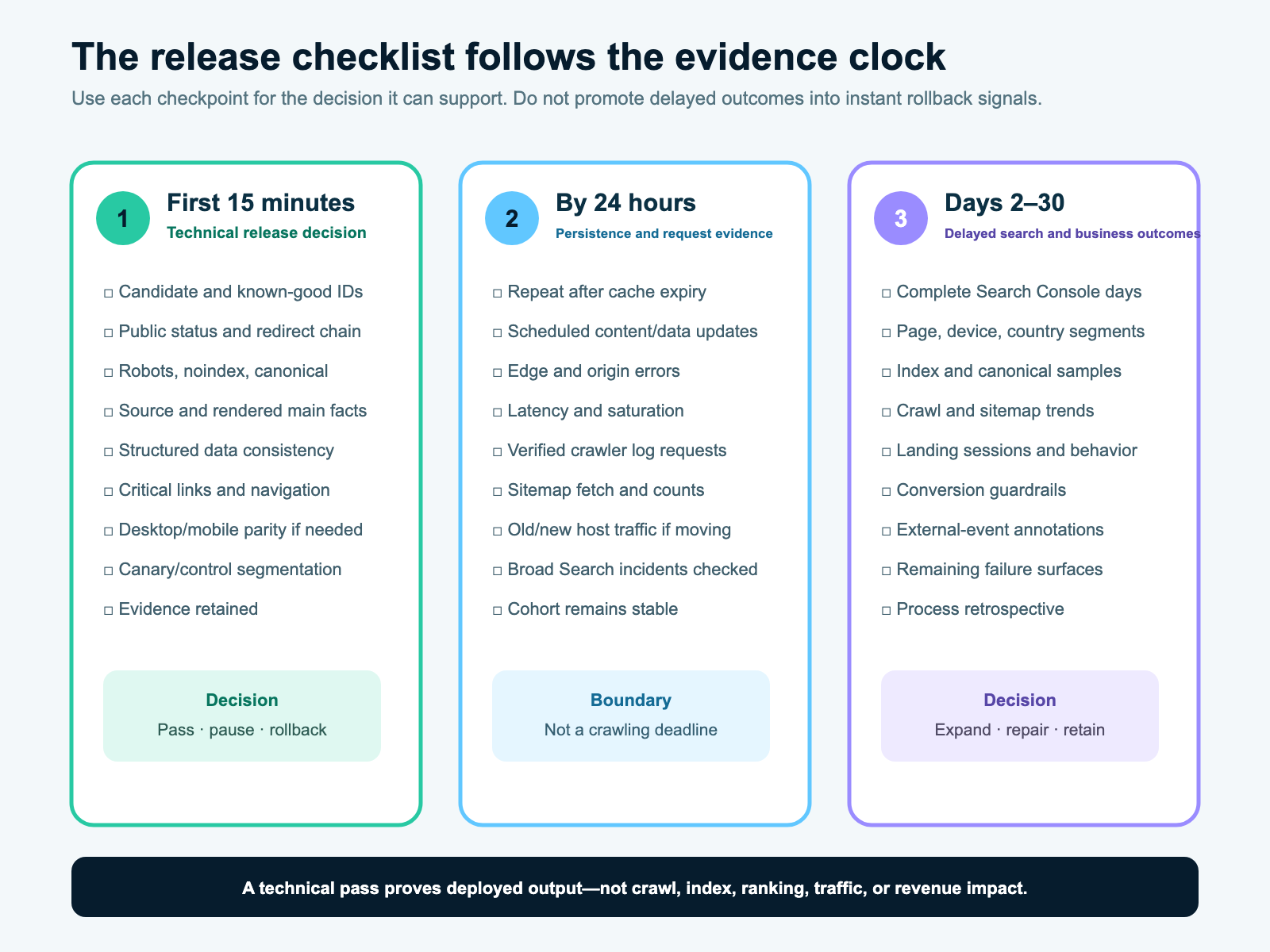
The first 15 minutes: fast technical evidence
Fifteen minutes is useful because it forces a decision while the deployment context is fresh and rollback is still cheap. It is not sacred. A low-traffic asynchronous render may need longer; a global noindex leak deserves a response in seconds. Calibrate the gate to request volume, cache behavior, batch duration, and recovery time. The rule is that the window must contain enough owner-controlled evidence for the declared technical risks.
Minute 0–2: prove release identity and reachability
- Record deployment completion, candidate version, feature-flag state, database or content migration state, and previous known-good version.
- Fetch canary and control through the public path, not only the origin. Record resolved host, protocol, status, redirect chain, headers, response time, and cache state.
- Confirm the expected population receives the candidate and the control does not.
- Fail immediately on an unexpected 5xx, authentication wall, redirect loop, cross-domain target, certificate error, or widespread timeout.
Minute 2–5: verify crawl controls and URL identity
- Compare
robots.txt, meta robots, andX-Robots-Tagwith the contract. RFC 9309 defines the standard matching and access behavior for/robots.txt; product-specific extensions still require search-engine documentation.9 - Resolve every redirect to its intended final URL and compare old-to-new mappings.
- Verify canonical targets are absolute where expected, return success, and represent duplicate or superset content. RFC 6596 warns against canonical error targets and chains.10
- Check hreflang return relationships, alternate mobile annotations if used, and sitemap membership where the release changes them.
Minute 5–10: verify meaning after rendering
- Compare source and rendered title, main heading, primary content, critical links, canonical, robots directives, and structured data.
- Assert minimum content facts, not brittle full-page hashes. A timestamp or recommendation carousel should not fail the release; a missing product name, price, availability, or primary link should.
- Run desktop and mobile when code, navigation, content, lazy loading, or edge behavior can differ by user agent.
- Exercise empty, error, and edge data states. A happy-path page cannot detect a 200 “not found” render.
Minute 10–15: compare, decide, and freeze evidence
- Compare canary and control error rate, latency, content assertions, and output changes by release identity.
- Review every planned difference and every unplanned difference. A changed byte is not automatically a defect; an unexplained crawl-control change is not acceptable.
- Pass, pause, or rollback using the predeclared matrix. Do not renegotiate a severe threshold because the deploy was difficult.
- Store response evidence, rendered screenshots, extracted facts, timestamps, versions, and operator decision for later incident reconstruction.
Overall service dashboards can hide a small canary. In Google SRE’s worked example, a canary serving 20% errors to 5% of traffic contributes only 1% errors overall. Segmenting metrics by candidate and control reveals the defect.1 The same principle applies to SEO checks: aggregate “site health” can stay green while one changed template loses its canonical or main content.
The next 24 hours and 30 days
Passing the 15-minute gate means the release satisfies its immediate technical contract. It does not mean Google has crawled the pages, selected their canonicals, indexed their output, or preserved traffic. Later evidence must be observed without retroactively pretending it was available at launch.
By 24 hours: confirm persistence and request evidence
- Repeat canary and control checks across cache expiry, scheduled content updates, inventory transitions, and at least one low-traffic period.
- Review edge and origin errors, latency, saturation, and cache-key behavior by release version or cohort.
- Inspect verified crawler requests in server or CDN logs when exact URL-level crawl evidence is required. Google notes that Search Console does not provide path-filterable crawl history; crawl and index state remain different questions.11
- Check sitemap fetches, submitted URL counts, redirect targets, and old/new host request distribution where relevant.
- Recheck the Search Status Dashboard for widespread Search incidents, but do not treat a clear dashboard as proof that the local release is healthy.6
The 24-hour checkpoint is not a crawl deadline. Most sites should not expect same-day crawling of every changed URL, and logs prove requests rather than indexing. The checkpoint asks whether the release remains technically stable and whether any early external observations contradict the contract.
At two to three days: read Search Console cautiously
Google says Search Console performance data is normally available in two to three days. “Normally” is not an SLA, and the data is processed, aggregated, privacy-filtered, and subject to report-specific limits.7 Use equal, complete date windows and annotate the release. Segment by page group, device, country, query class, and search appearance when the release affected them. Do not compare a partial recent day with a complete historical day.
At seven to thirty days: evaluate outcomes and delayed failures
- Track index coverage, Google-selected versus declared canonical samples, crawl demand, impressions, clicks, landing sessions, conversions, and support or revenue guardrails from the systems that own them.
- Compare canary and control or the predeclared baseline without changing the cohort after seeing outcomes.
- Check for external explanations: seasonality, promotions, demand shifts, competitor changes, algorithm updates, Search data anomalies, and unrelated releases.
- Expand only when the release contract continues to hold and the remaining population does not introduce an untested failure surface.
Google says a misplaced noindex may cause a slower traffic decline because the page must be crawled, while site moves can fluctuate for weeks as URLs are recrawled and reindexed.3, 8 That is why delayed monitoring matters—and why delayed traffic should not replace the immediate technical gate.
A rollback matrix that separates defects from noise
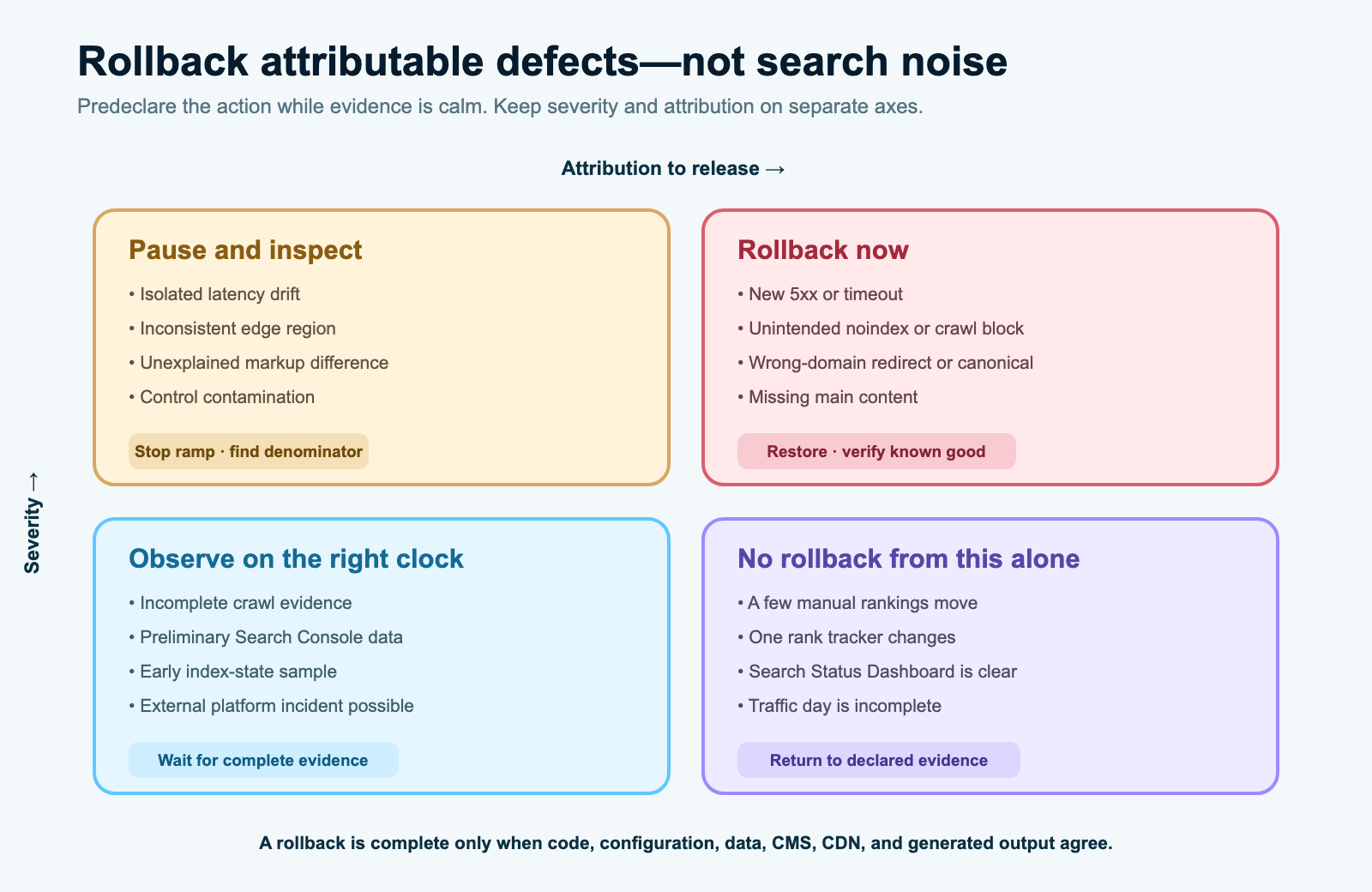
| Evidence | Action | Why | Confirmation after action |
|---|---|---|---|
New 5xx/timeout, global crawl block, unintended noindex, wrong-domain redirect or canonical, missing main content |
Rollback now | Severe, attributable, owner-controlled contract failure. | Known-good version serves intended output through the public path; dependent data/config is also restored. |
| Unexpected but non-destructive markup difference, isolated latency drift, inconsistent edge region, unclear control contamination | Pause ramp | The evidence is technical but attribution or severity is incomplete. | Root cause, affected denominator, and safe next stage are documented. |
| Normal output plus incomplete crawl, preliminary Search Console data, isolated ranking movement | Observe | Search processing and reporting are asynchronous; attribution is weak. | Use complete windows, logs, inspection samples, and external-event checks. |
| A few manual searches move, a rank tracker changes, or the Search Status Dashboard is clear | No decision alone | The signal is variable, delayed, personalized, scoped, or unable to clear local defects. | Return to the declared evidence lane and denominator. |
Rollback must itself be engineered. A code revert that leaves an irreversible data migration, CDN rule, generated sitemap, or CMS value active is not recovery. Test the reversal path before the release, name the person authorized to use it, and set a maximum recovery time. If a change cannot be reversed, reduce its first scope and strengthen shadow validation.
Worked example: a product-template release
Consider a fictional retailer with 120,000 product URLs across six locales. A release changes product-page rendering, canonical construction, lazy-loaded images, and Product structured data. The team initially proposes a global deployment because staging passed.
Step 1: reduce the change
Canonical construction and rendering change together, so a failure would be hard to isolate. The team separates canonical logic into its own release. The first release now changes server-rendered product markup, image loading, and structured data while preserving URL identity and crawl controls. This follows the “one major thing at a time” logic in Google’s site-move guidance, even though the change is not a site move.3
Step 2: define the canary cohort
The team assigns 600 product URLs—0.5% of inventory—to the candidate using a deterministic product-ID flag. The cohort spans six locales, desktop and mobile output, in-stock and out-of-stock states, products with and without optional images, variant-heavy pages, and both cached and uncached paths. It includes valuable pages but caps the share of organic product landings in the cohort at an owner-approved amount. A matched 600-URL control stays on the known-good template.
Step 3: write the contract
The pass conditions require the intended release identifier on every canary response; no increase in 5xx responses; latency inside the service’s existing guardrail; unchanged status, final URL, canonical, robots directives, H1, visible product name, price, availability, primary navigation, and indexable-state logic; valid Product JSON-LD with matching price and availability; and equivalent desktop/mobile facts. Any candidate-only noindex, blank main content, wrong canonical host, or price mismatch triggers rollback. Minor image-order changes pause the ramp for inspection.
Step 4: run the clock
At minute four, all transport checks pass. At minute eight, three out-of-stock canary pages render the Product JSON-LD availability as InStock while the visible page says “Out of stock.” The control does not. Overall site dashboards remain green because only three pages exhibit the semantic mismatch. The release fails its explicit data-consistency invariant and rolls back before expansion.
The team fixes a serializer fallback, reruns staging parity, and starts a new canary rather than continuing the contaminated release. The second canary passes the 15-minute gate, stays stable across 24 hours of inventory updates, and then expands in stages. Search Console performance is annotated and reviewed only after complete data becomes available. No ranking claim is attached to the technical pass.
What made the incident cheap
- The changed population was real and bounded.
- The cohort contained the failure state rather than only popular happy paths.
- The invariant compared visible content and structured data, not only HTTP status.
- The control used the same products and measurement path except for the candidate.
- The rollback threshold existed before the mismatch appeared.
- The team did not wait for Google or customers to discover the contradiction.
Migrations, hosting moves, and global surfaces
Some releases cannot be isolated by URL. DNS, TLS, CDN routing, robots.txt, sitemap indexes, and shared canonical logic can affect the whole site. Calling a ten-URL test a canary does not make those global surfaces partial. Use the strongest isolation the architecture supports.
Hosting changes
Google recommends copying and testing the new site, checking that Googlebot can access the new infrastructure, monitoring old and new server logs, checking DNS propagation across providers, and shutting down the old host only after traffic has moved.4 A practical canary may route a small traffic percentage or a controlled hostname to the new stack before the DNS cutover. Once DNS changes globally, keep both infrastructures observable and reversible until caches expire and request evidence confirms the transition.
URL migrations
Build and test the URL map before launch. Verify redirect destinations, canonical annotations, robots directives, deleted-resource responses, sitemaps, and Search Console properties. Google recommends moving a stable section first when practical but cautions that the section may not represent the complete move. It also says there are no fixed crawl frequencies and that migration processing occurs per URL.3
Global crawl controls
Treat a robots.txt or site-wide noindex change as a high-blast-radius configuration release. Validate syntax, matching, user-agent groups, rendered headers, and expected allow/disallow examples before the switch. RFC 9309 specifies standard group and path matching, while a search engine’s documentation governs its extensions and operational behavior.9 Prefer a reviewable generated artifact and an atomic, reversible publish over a manual edit in production.
The strongest counterposition
The strongest objection is that SEO does not support meaningful canaries. Crawlers arrive asynchronously; a sample may not be crawled; templates share links and canonical clusters; search outcomes are noisy; and rolling back after Google sees one state may introduce another state. A green sample can create false confidence while the long tail fails.
That objection defeats a weak version of the practice: checking a handful of top URLs after a global deployment and watching rankings. It does not defeat bounded technical canarying. The release gate is not trying to estimate a ranking effect. It is testing owner-controlled facts under real production conditions while exposure is limited. The control helps attribute application errors, latency, render failures, directives, and content differences. Repeated checks expose cache and data-state failures. The coverage matrix makes missing states visible instead of claiming completeness.
The objection still sets real boundaries. A URL cohort cannot isolate global DNS or robots behavior. A small section may not generalize to a whole migration. Shared backends can contaminate control and canary. Low request volume may not support a 15-minute statistical comparison. Rollback can create extra crawl states. Therefore the correct conclusion is conditional: use a true canary where the release unit can be isolated; use smoke tests and guarded rollback where it cannot; and reserve search-outcome interpretation for later, adequately observed evidence.
Small-site, large-platform, and product boundaries
For a small site
Do not build a deployment platform that costs more than the risk it controls. Maintain a versioned checklist, a six-to-twelve-URL smoke cohort covering every template, automated HTTP and rendered assertions, a known-good artifact, and one person authorized to revert. If feature flags are available, apply the change to one low-blast-radius section first. If traffic is too low for a canary comparison, use deterministic assertions and extend observation across cache and scheduled-update cycles.
For a large platform
Segment by release version, template, locale, device, edge region, seller or tenant class, cache state, and critical dependency. Automate cohort assignment, exposure verification, ramp stages, metric comparisons, and evidence retention. Prevent overlapping canaries from contaminating signals. Use absolute service guardrails as well as canary-control differences because shared failures can move both populations together. Maintain a release registry so later crawl and search observations can be joined to exact exposure history.
Where 2-UA fits—and where it does not
2-UA can support the technical evidence lane with expected-status monitoring, page-change alerts, source and rendered checks, desktop/mobile comparisons, crawl evidence, and release-oriented monitoring such as SEO Release Guard. It can help preserve what a monitored page returned before and after a change. It is not a deployment orchestrator, traffic splitter, feature-flag platform, CDN or origin log warehouse, Search Console replacement, RUM system, conversion analytics tool, or automatic proof that Google indexed a page. Canary routing, release identity, server logs, business outcomes, and rollback execution remain the owner’s responsibility.
What the evidence does not show
- No cited source proves that a 15-minute workflow prevents every traffic incident or quantifies an SEO incident reduction.
- The 15-minute gate is an editorial operating framework for fast technical facts, not a Google crawl, indexing, reporting, or ranking guarantee.
- Google’s platform guidance is authoritative for documented Google behavior but is not an independent causal evaluation of release practices.
- The SRE canary chapter is practitioner guidance with a simplified worked example, not an SEO-specific randomized study.
- A passing sample does not prove correctness across every URL, locale, state, device, region, dependency, or crawler visit.
- Server logs prove requests, not indexing. Search Console proves processed platform observations, not a raw event ledger. Rankings do not uniquely identify a release effect.
- A clear Search Status Dashboard does not exclude a site-specific failure, because the dashboard focuses on widespread issues.
- Rollback can be harmful when it is slow, partial, irreversible, or triggered by noisy outcomes rather than an attributable defect.
A 30-day release measurement plan
This week: build the release contract
- Inventory release mechanisms and identify which can be partially exposed.
- Choose one upcoming change and separate unrelated code, content, migration, infrastructure, and experiment work.
- Create a canary or smoke-test cohort from template, data-state, value, search-contract, execution-path, and dependency coverage.
- Define invariants, pass/pause/rollback predicates, owner, release identity, known-good version, and maximum recovery time.
- Automate public-path HTTP and rendered checks for desktop and mobile where output can differ.
- Dry-run rollback and confirm that code, configuration, data, CDN, CMS, and generated assets return to a consistent version.
Days 1–7: calibrate fast signals
- Run the 15-minute gate on each release and record detection time, false alarms, missed states, and operator decision time.
- Repeat checks after cache expiry and scheduled data changes.
- Compare candidate and control by version instead of relying on site-wide aggregates.
- Add a test only when a real or credible failure escaped the existing contract; remove noisy checks that never change a decision.
- Annotate Search Console, analytics, incident, and deployment timelines without using incomplete search data for rollback.
Days 8–30: measure the process, not only the site
- Track the share of releases with a complete contract, verified control, tested rollback, and retained evidence.
- Measure time to detect, time to decide, time to recover, canary false-positive rate, escaped defects, and repeated failure classes.
- Review delayed crawl, index, Search Console, analytics, and conversion evidence on complete windows with external-event annotations.
- Expand canary exposure only when the remaining population does not introduce untested states or dependencies.
- Reduce release scope or extend the gate when the same class of defect escapes, attribution is weak, or rollback exceeds the budget.
Change course when the process fails
Shrink the next release when the control is contaminated, the cohort misses a material state, the alert cannot identify the affected denominator, or recovery is slower than the declared budget. Replace a metric when it produces repeated false positives or cannot be tied to user-perceivable or search-contract harm. Stop calling the method a canary when the change is global. Most importantly, separate “the release is technically correct” from “the release improved organic performance.” They are different claims with different evidence clocks.
Implementation checklist
- Name the candidate, known-good version, exact release unit, and every changed layer.
- List crawlable and user-visible facts that must remain unchanged.
- Decide whether partial exposure is real; otherwise label the cohort a smoke test.
- Freeze canary, control, exclusions, routing, and exposure denominator.
- Cover every changed template, data state, locale, device path, cache path, and dependency.
- Weight business-critical URLs without placing all valuable traffic in the first cohort.
- Set pass, pause, rollback, owner, and maximum decision and recovery times.
- Verify public-path status, redirect chain, headers, latency, cache, and release identity.
- Verify robots,
noindex, canonical, hreflang, sitemap, and structured-data invariants. - Compare source and rendered main content, links, and essential facts on desktop and mobile where relevant.
- Segment candidate and control telemetry; do not hide a small cohort in site-wide averages.
- Retain responses, extracted facts, screenshots, logs, timestamps, and the operator decision.
- Confirm rollback restores code, configuration, data, CMS, CDN, and generated artifacts consistently.
- Use logs for exact request evidence, Search Console for delayed search evidence, and analytics for user outcomes.
- Check broad Search incidents without using the status dashboard to clear a local deployment.
- Observe complete windows for 30 days and document external events and unrelated releases.
- Change thresholds only through a retrospective, not during the release they govern.
Sources
- Warner, Alec, and Štěpán Davidovič, with Alex Hidalgo, Betsy Beyer, Kyle Smith, and Matt Duftler. Canarying releases. The Site Reliability Workbook, Google; accessed October 4, 2026.
- Thurgood, Steven. Example error budget policy. Google SRE Workbook, February 19, 2018; accessed October 4, 2026.
- Google Search Central. How to move a site. Updated December 10, 2025; accessed October 4, 2026.
- Google Search Central. Changing your web hosting and SEO. Updated December 10, 2025; accessed October 4, 2026.
- Google Search Central. Minimize A/B testing impact in Google Search. Updated December 10, 2025; accessed October 4, 2026.
- Google Search Central. Using the Google Search Status Dashboard. Updated December 10, 2025; accessed October 4, 2026.
- Google Search Console Help. About Search Console data. Accessed October 4, 2026.
- Google Search Central. Debugging drops in Google Search traffic. Accessed October 4, 2026.
- Koster, Martijn, Gary Illyes, Henner Zeller, and Lizzi Sassman. RFC 9309: Robots Exclusion Protocol. IETF Proposed Standard, September 2022.
- Ohye, Maile, and Joachim Kupke. RFC 6596: The Canonical Link Relation. IETF Informational RFC, April 2012.
- Google Search Central. Troubleshoot crawling errors. Accessed October 4, 2026.