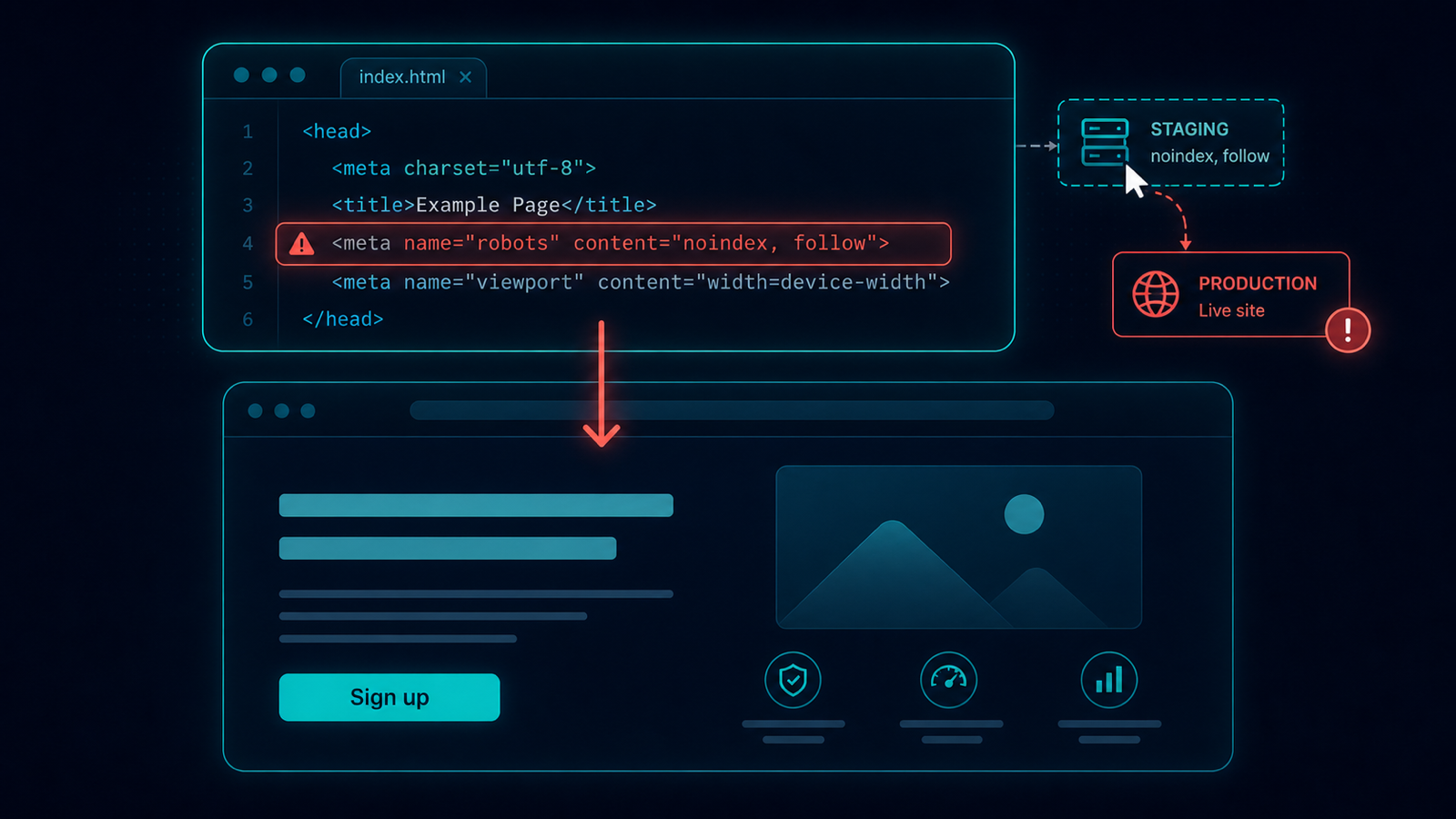
A junior engineer syncs staging configuration onto production at 17:48 on a Friday.
Among the changes is a one-line environment variable that controls a conditional <meta name="robots" content="noindex">.
On staging that line is correct; on production it is now wrong.
Your homepage, pricing page, and signup landing all ship the noindex meta.
By Monday morning, Google has dropped impressions on the affected URLs by 70%.
Recovery takes a week.
The fix you want is to catch that meta tag flip within minutes of deploy, not after the weekend.
This is the dedicated tracked-URL setup that does it.
Why this failure mode is special
- It produces no HTTP error. Status is 200. Response time is normal.
- It does not appear in functional QA. The page renders the same to humans.
- It often passes code review because the change is "no-op on staging" — true in staging, false in prod.
- It hits exactly the pages with the highest opportunity cost: the conversion stack (landing, pricing, signup, top product pages).
2-UA setup for conversion-stack deploy safety
- Identify your conversion stack URLs. Typically: homepage, pricing page, primary product pages, signup landing, and any paid-traffic landing pages.
- Add each to Tracked URLs individually — these get explicit, named monitoring, not bulk treatment.
- For each URL set: Expected status 200, Field tracking:
meta robots,X-Robots-Tagresponse header,canonical. - Tag the URL set as
conversion-stack. The tag-level weekly digest gives one health number for the whole group. - Set the check cadence aggressively: every 10 minutes for status, every 30 minutes for full field parsing. The cost is trivial; the upside is catching the regression within one alert window of deploy.
The signal you wait for
Any of three diff types fires an immediate alert:
meta robotsvalue changes from absent (orindex, follow) to anything containingnoindex.X-Robots-Tagresponse header introducesnoindexwhere it was previously absent.canonicalchanges to point at a different URL than the page itself (a different but related deploy-safety bug).
Five-minute response playbook
- Open the 2-UA snapshot diff for the affected URL. Confirm the new meta or header value.
- Correlate with the deploy log. Which release shipped immediately before the alert? Almost always within the past hour.
- Revert the deploy. Do not try to patch forward — the cost of an extended noindex window is higher than the cost of a clean revert.
- After the revert ships, recrawl the affected URLs to confirm the meta and headers are restored.
- Open the affected URLs in GSC's URL Inspection tool and click "Request Indexing" for each. Recovery accelerates from days to hours when you push the recrawl explicitly.
Three configuration patterns that produce noindex leaks
- Environment-conditional meta tags —
is correct only as long asAPP_ENVis set correctly on every box. - SEO plugins with "noindex archive" defaults — a plugin update resets your "archives are indexable" choice back to its default of noindex.
- CDN-injected X-Robots-Tag — a Cloudflare Worker or origin shield rule that adds the header for non-production hostnames; misconfigured rule scope leaks into prod.
Add your conversion-stack URLs to Tracked URLs today and tag them so the next deploy never quietly removes you from the index. Use the free SEO page audit right now to confirm none of those pages currently carry a noindex.