A marketing team has one engineering week available. One proposal is to add every plausible schema type to hundreds of pages because an AI-search vendor says JSON-LD is a “direct feed” into answer engines. The other is to fix stale product availability, contradictory organization names, missing author pages, weak internal links, and a sitemap that lies about modification dates. Choosing the first proposal can produce a beautiful validation report while leaving the facts that search and answer systems actually encounter inconsistent.
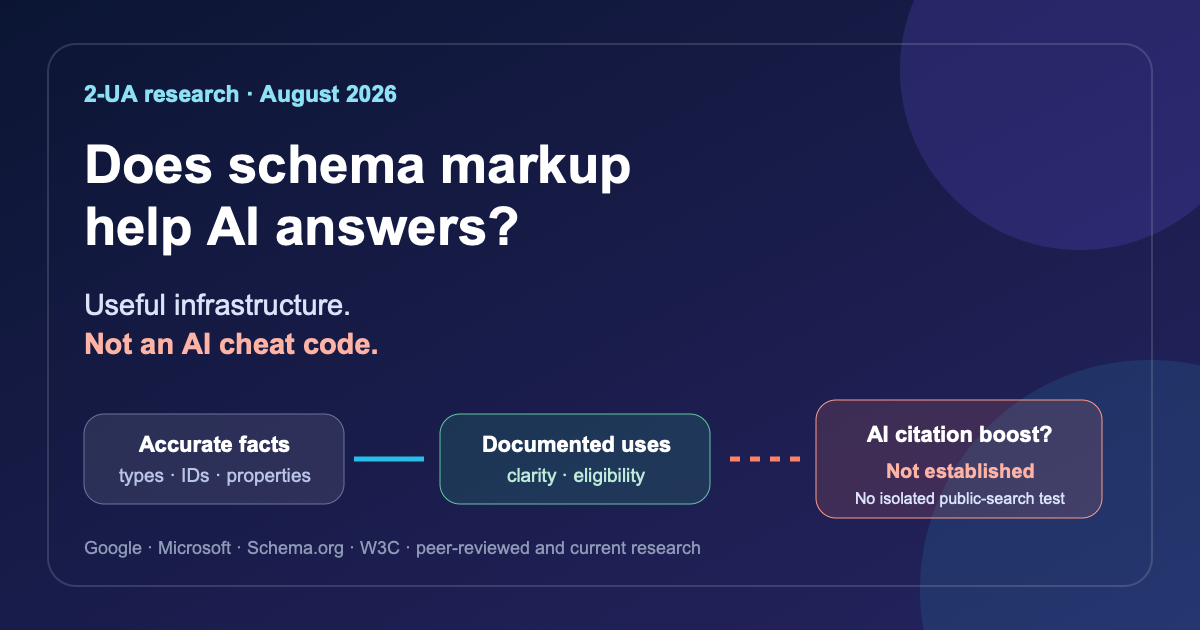
That is the expensive decision behind the schema debate. The question is not whether machines can use structured data. They clearly can. The useful question is narrower: which outcomes are documented, which are plausible, and which are still unproven? After reviewing current Google, Microsoft, Schema.org, W3C, and research sources, the defensible answer is a layered one. Schema earns its place when it makes important, visible facts explicit and maintainable or qualifies a page for a documented consumer. It does not earn an unlimited backlog simply because the output is machine-readable.
Start with the claim, not the markup
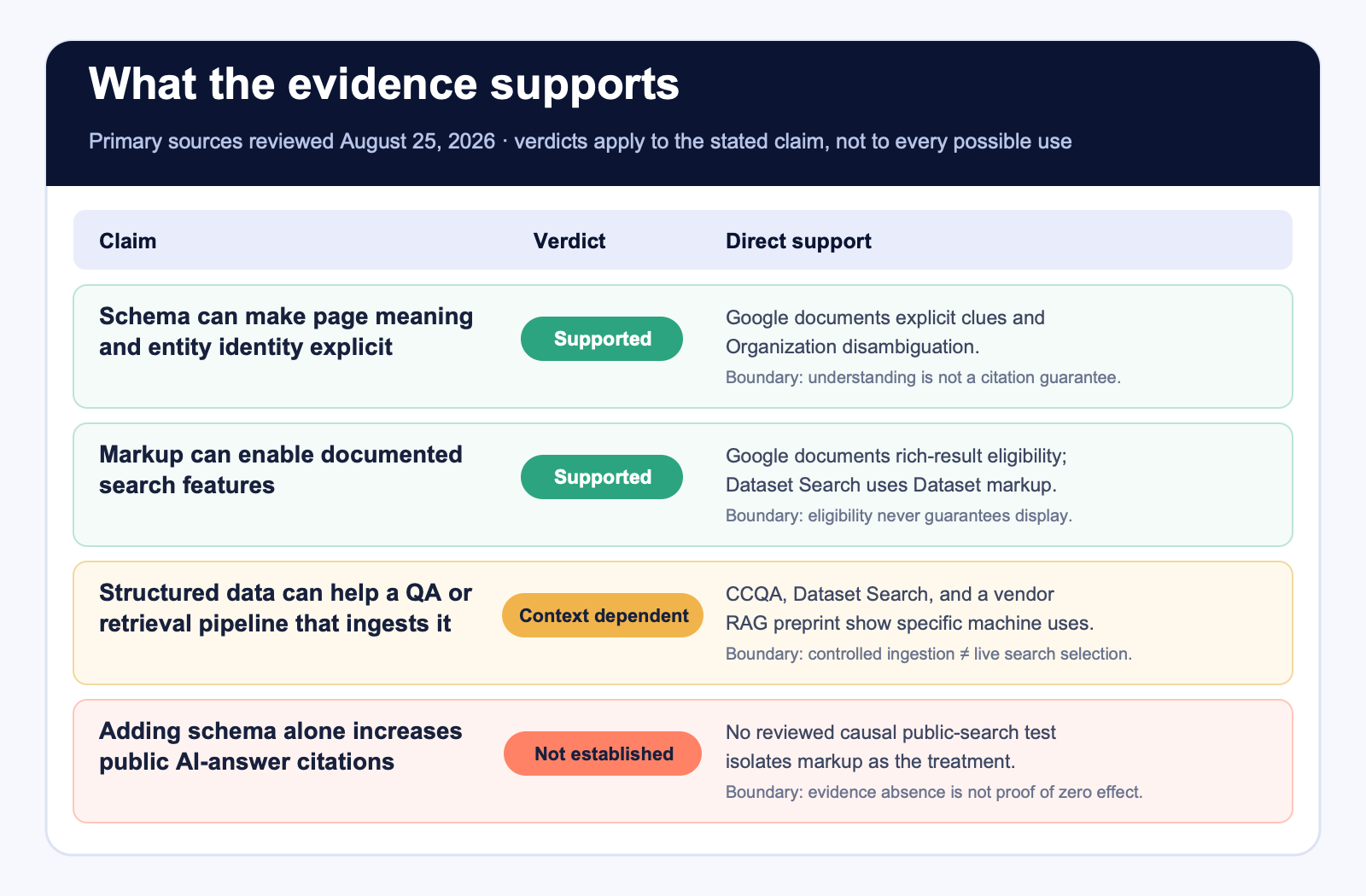
“Schema helps AI” is too vague to test. It may refer to at least four different claims. First, a shared vocabulary can describe an organization, product, article, person, offer, event, or dataset. Second, a platform can parse those descriptions for a documented search feature or entity task. Third, a model or retrieval system can use structured information after a developer has deliberately placed it in a training or retrieval pipeline. Fourth, publishing schema on an otherwise unchanged web page can cause a public answer engine to select, rank, or cite that page more often.
The first three claims have direct support in specific settings. The fourth is the claim most often sold as “AI SEO,” and it is the one for which the reviewed evidence is absent. Absence of evidence is not proof that the effect is exactly zero. It is a reason to size the investment according to demonstrated benefits and measure AI visibility separately instead of promising an uplift in advance.
What Google actually supports
Google’s current site-owner guidance for AI Overviews and AI Mode is unusually direct. A supporting page must be indexed and eligible to appear in Google Search with a snippet. There are no additional technical requirements. Google tells publishers to keep structured data consistent with the visible page, but says they do not need new machine-readable files, AI text files, or special schema.org markup to appear in these AI features.1
This rules out the strongest version of the “AI schema” pitch: there is no Google-documented secret type that unlocks AI Overviews or AI Mode. It does not make ordinary structured data useless. Google’s structured-data introduction says markup supplies explicit clues about page meaning and can be used to understand information about people, books, companies, and other things. Its Organization documentation is more specific: organization markup can help Google understand administrative details and disambiguate an organization, while certain properties can influence logos, knowledge panels, merchant panels, and brand profiles.24
Those are real benefits, but notice their boundaries. “Can help disambiguate an organization” is not “raises the organization’s citation rate in AI answers.” “Eligible for a rich result” is not “guaranteed to receive that result.” Google’s policies say valid structured data does not guarantee display. A structured-data manual action removes rich-result eligibility but does not affect how the page ranks in web search. Markup must be relevant, current, visible to users, and representative of the page.3
Google also retired several lesser-used structured-data displays in 2025 and explicitly said the change did not affect page ranking. The markup could still be used outside Google Search, but a once-supported appearance was not a permanent contract.12 This is why a schema backlog should begin with current consumer documentation and business value, not with the size of the Schema.org vocabulary.
What Microsoft’s named guidance supports—and leaves open
Microsoft’s pivotal webmaster guidance for AI-powered search focuses on the stage before answer generation: discovery, crawling, indexing, and
freshness. Bing recommends complete XML sitemaps, truthful lastmod values, IndexNow for timely URL changes, and monitoring in Bing
Webmaster Tools. It says accurate freshness can influence how quickly updates are reflected in search results and AI-generated answers. It also
states that no tool guarantees when or how content will appear in an AI-generated result.5
That page does not make a schema.org citation claim. This silence must be interpreted carefully. It is not proof that Bing never parses schema. Microsoft helped found Schema.org, and many search experiences consume structured data. It is evidence that the specific, first-party AI-search action list supplied to webmasters is about getting accurate pages discovered and refreshed, not installing an “AI answer” schema package.
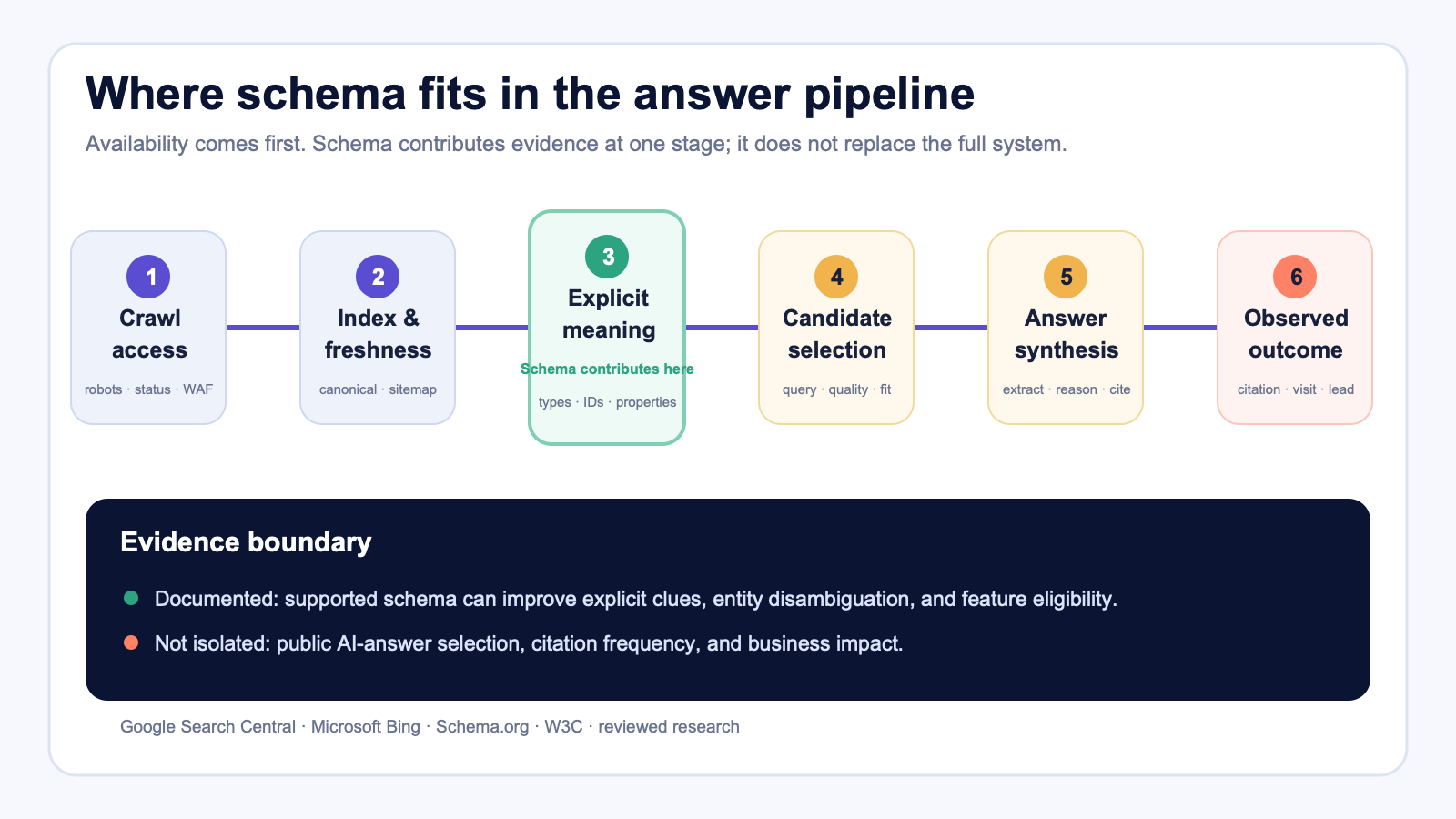
The operational lesson is valuable for every platform: a perfect Product object on a URL that is blocked, stale, non-canonical, or
absent from the index cannot solve the upstream failure. Discovery and eligibility precede understanding; understanding precedes selection;
selection precedes answer construction. Schema can contribute in the middle of this chain, but it does not replace the rest of it.
What Schema.org is—and what it cannot promise
Schema.org version 30.0 is a large, stable vocabulary for describing types, properties, and relationships. Its data model is derived from RDF concepts and can be serialized with JSON-LD, Microdata, or RDFa. Schema.org’s own documentation says it is not a universal ontology. It takes a pragmatic, flexible approach to conformance, and it expects consumers to decide what they support.6
JSON-LD is also often given powers it does not claim. The W3C Recommendation defines a JSON-based way to serialize linked data as a labeled, directed graph. Its goals include compatibility with JSON systems, expressiveness, and interoperability.7 It does not specify how Google, Bing, OpenAI, Perplexity, or any other consumer ranks pages. A valid serialization proves that a graph can be parsed according to the standard. It does not prove that a particular field is supported, trusted, indexed, or used in an answer.
Keep three layers separate in technical reviews:
- Vocabulary: Schema.org defines the names and relationships available to publishers.
- Encoding: JSON-LD, Microdata, or RDFa expresses those statements in page code.
- Consumer behavior: a search engine, marketplace, assistant, or internal system decides what to extract, validate, combine, and expose.
This distinction prevents a common audit error. A validator can confirm vocabulary and encoding. Only consumer documentation and observed consumer behavior can confirm the third layer.
Research proves machine utility, not a universal visibility boost
Research gives several strong demonstrations of structured data being useful after a system chooses to consume it. The most instructive studies also show why that utility cannot be converted into a public-search ranking claim.
Schema annotations can become training data
The peer-reviewed CCQA paper extracted approximately 130 million unfiltered question-answer pairs—about 55 million unique pairs—from 13 Common
Crawl snapshots. The extraction relied on schema.org/Question annotations instead of question-mark heuristics. The resulting corpus
was used for in-domain pre-training and produced improvements in several zero-shot, low-resource, and dense-retrieval evaluations, although the
fully fine-tuned results were mixed across tasks and models.8
This is powerful evidence of machine reuse. It demonstrates that consistent annotations can make web content extractable at enormous scale. It does not compare the live visibility of two otherwise identical pages. The marked pages supplied material to a research dataset; they were not shown to receive more citations in an answer product. The paper also retained duplicates for its reported lower-bound experiment, used a 400-pair human pilot that evaluated sensibility rather than factual accuracy, and warns about web bias and hallucinated answers.
A consumer may trust the markup—but verify the page
Google Dataset Search offers an equally useful counterweight. In the peer-reviewed “Dataset or not?” study, Schema.org was described as core enabling infrastructure for the vertical search engine, yet markup alone was too noisy to accept at face value. The researchers built a classifier using page content and metadata over a 223,000-page labeled set from about 4,500 hosts, then applied it to a corpus of more than 600 million pages with minimum Dataset markup.9
Excluding the ten largest non-dataset outlier hosts, the study estimated that 61% of hosts and 84% of pages carrying Dataset markup did not actually
describe dataset pages. Those numbers apply to Dataset markup in that corpus—not to all schema types. Their importance is conceptual:
a mature consumer used the markup as an important signal and still corroborated it against names, descriptions, prominent page terms, and other
evidence. Machine-readable does not automatically mean true.
Markup is common enough to create a base-rate problem
Web Data Commons extracted structured triples from 1,245,622,627 of 2,391,039,772 parsed HTML pages in its October 2024 Common Crawl corpus: 52.1% when recalculated from the report's displayed counts. (The adjacent percentage says 51.25%, which does not match those counts.) Those pages came from 16,525,070 of 37,447,141 pay-level domains, or 44.13%. Embedded JSON-LD alone appeared on more than 833 million URLs.10
Therefore, a vendor chart showing that “most cited pages have schema” is not an effect estimate. Popular CMSs, ecommerce systems, established publishers, and technically mature sites are more likely to have both markup and other qualities that can influence discovery or selection. A fair test needs comparable pages, a clear treatment date, unchanged content where possible, repeated answer sampling, and a predeclared outcome. Otherwise, schema may be a passenger on a high-quality site rather than the cause of its visibility.
A 2026 preprint tests JSON-LD directly—but not live search
A WordLift-affiliated 2026 preprint ran 349 template-generated queries across four WordLift-managed domains and seven retrieval conditions, producing 2,439 valid evaluations. In the authors’ flat-text Vertex AI pipeline, adding JSON-LD to HTML produced a small accuracy effect (Cohen’s d = 0.18) and no completeness effect after the reported multiple-comparison correction. Much larger gains came from “enhanced entity pages” that made related knowledge-graph facts and navigation visible.11
The preprint is useful because it contradicts the simplistic idea that a hidden JSON-LD block is always a high-impact RAG input. It is not evidence about Google or Bing ranking. Eighty-two percent of plain HTML documents and 88% of JSON-LD documents exceeded the pipeline’s approximate 20,000-character embedding limit, often truncating the JSON-LD block. Enhanced pages added information materialized from related entities, so presentation and information content were not isolated. Ground truth came from the same knowledge graph, Gemini-family models participated in generation and evaluation, and there was no human calibration subset or live search outcome. The correct label is vendor preprint with a controlled RAG result, not “proof schema increases AI visibility.”
The strongest counterargument
The strongest reasonable counterposition is straightforward: Google and Bing already maintain structured-data parsers and knowledge systems; their AI experiences build on search infrastructure; therefore accurate schema probably can influence some internal understanding or eligibility step even when the companies do not publish a separate “schema weight.” That argument is plausible. Google explicitly documents structured data as an understanding and disambiguation aid, and research shows that structured representations can be useful when systems ingest them.
The problem is the jump from can be consumed to will increase citations. Public answer systems combine crawling, indexing, query interpretation, source retrieval, quality systems, entity resolution, freshness, answer generation, and interface decisions. A signal can improve one internal representation without changing which link appears. It can also qualify a page for a conventional feature while having no independent effect in an AI answer. Until a platform discloses the use or a credible experiment isolates the treatment, the right business posture is neither “schema is useless” nor “schema is an AI ranking factor.” It is implement for supported and operational value; test any additional visibility hypothesis.
Prioritize schema by consumer and failure cost
Do not start with “Which schema types can we add?” Start with four questions: Which visible facts change a user decision? Which consumer documents support for those facts? What happens when the machine representation drifts? Can the implementation stay synchronized with the same source of truth as the page?
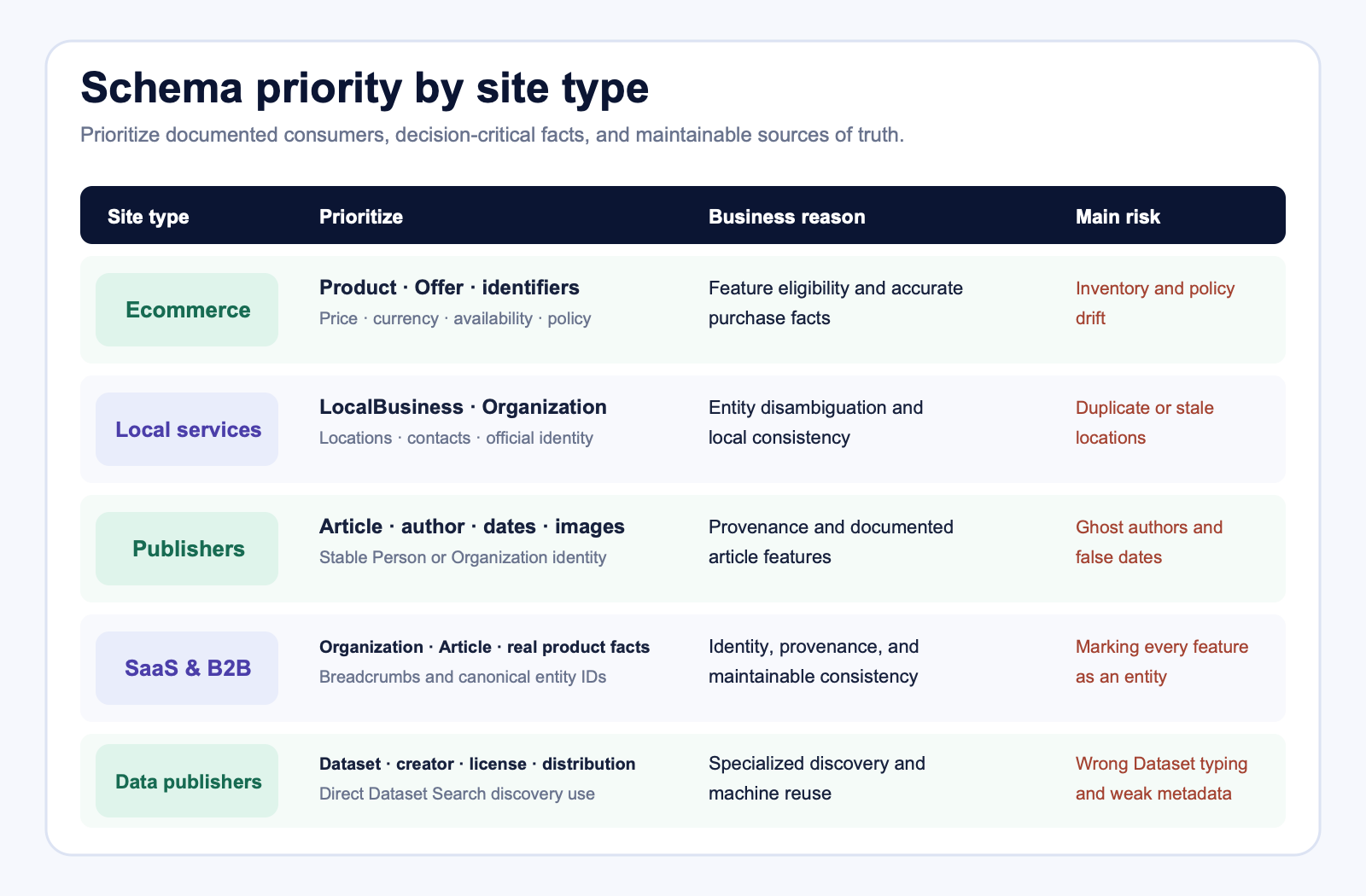
For ecommerce, accurate Product, Offer, price, currency, availability, identifiers, shipping, and return-policy data can
support documented search and merchant experiences. The value comes from correct inventory and eligibility, not from repeating marketing copy in
JSON-LD. For a local or service business, consistent Organization or LocalBusiness identity, official URLs, contact details, locations, and
identifiers help reduce ambiguity. For publishers, Article or NewsArticle metadata, authorship, dates, images, and stable author or organization
identities can make provenance explicit. For dataset publishers, Dataset markup has a direct, documented discovery consumer in Google Dataset
Search—while the Dataset Search research also shows why truthful typing matters.
SaaS and B2B sites should resist creating a giant graph solely because the vocabulary allows it. Organization identity, genuinely applicable software or product facts, article provenance, and breadcrumbs are usually more maintainable than marking every feature paragraph as a separate entity. Any site can benefit from a coherent identity graph and supported breadcrumbs, but low-change, unsupported, or duplicative markup belongs behind data correctness, crawlability, visible evidence, and content maintenance.
Small sites and enterprise sites need different operating models
A small site does not need an enterprise knowledge-graph program to publish useful structured data. One correct Organization or LocalBusiness node, stable identity, accurate page-level types, and a handful of high-value templates can cover the documented use cases. The owner should prefer a simple server-rendered JSON-LD block sourced from the same fields as the page. If a plugin generates dozens of nodes that nobody can explain or maintain, the apparent sophistication is a liability. The small-site test is: can one person verify the critical facts after a price, address, author, or policy change?
Enterprise sites face a different failure mode. The schema syntax may be correct in every template while organization IDs fragment across brands, regional catalogs disagree on product identifiers, localization drops required fields, and client-side rendering races with crawlers. They need ownership, contracts, and observability: a documented graph model, source-system mapping, stable identifier policy, template tests, sampled rendered audits, and change alerts. That is data governance, not a one-time SEO ticket.
Both boundaries lead to the same principle: match the system to the maintenance risk. A five-page consultancy should not build an ontology platform. A million-SKU marketplace should not trust hand-edited snippets. Neither should add low-value types until decision-critical facts remain accurate at the scale they already operate.
Five schema projects to deprioritize
First, deprioritize unsupported types added only because they exist on Schema.org. The vocabulary is deliberately broader than any one consumer’s feature set. Second, deprioritize markup that repeats generic copy without identifying an entity, relationship, offer, provenance fact, or supported feature. More triples are not automatically more information.
Third, stop generating hidden claims that the page does not show. This is both a trust problem and a direct conflict with Google’s quality guidance. Fourth, avoid replacing visible answer design with FAQ markup. A concise, evidenced answer that helps a reader can stand on its own; an FAQ node does not make thin or duplicated content more useful, and consumer support for specific appearances can narrow or disappear. Fifth, do not build a citation dashboard that records only whether cited pages contain schema. Without the untreated base rate, page quality, authority, CMS, and query mix, the number is descriptive—not an estimate of schema’s effect.
These exclusions protect conversion work as well as editorial integrity. Engineering time saved from speculative graph expansion can fix the inventory mismatch that loses a sale, the author ambiguity that weakens trust, the blocked page that cannot be retrieved, or the unsupported claim that makes an answer unsafe to repeat.
A worked example: the validator passes while the implementation fails
Consider a retailer selling a weatherproof field jacket. The visible page says the current price is $89, size medium is out of stock, delivery is
three to five days, and returns are accepted for 30 days. The JSON-LD was generated by an old theme component and says $79, InStock,
next-day delivery, and 60-day returns. The Rich Results Test reports valid syntax because all required fields exist.
Adding more properties would make this implementation worse. The correct sequence is:
- Choose the inventory and policy services as the source of truth for both visible content and JSON-LD.
- Give the product a stable
@idand use the same verified SKU, GTIN, brand, currency, and canonical URL everywhere. - Render price, availability, delivery, and return facts from shared data rather than two independent templates.
- Validate syntax, then compare every decision-critical field with the visible page and the rendered response seen by a crawler.
- Monitor changes and sampling errors after release, because inventory drift can recur even when launch QA passes.
The finished markup may improve eligibility and give consumers a cleaner machine-readable representation. The team should not report “AI visibility increased” until an AI-answer measurement actually changes beyond its normal variation. The implementation win is already real: one consistent source of truth, fewer contradictory facts, documented feature readiness, and lower maintenance risk.
The implementation and validation checklist
Use this checklist as a release gate. A green validator is one row, not the final verdict.
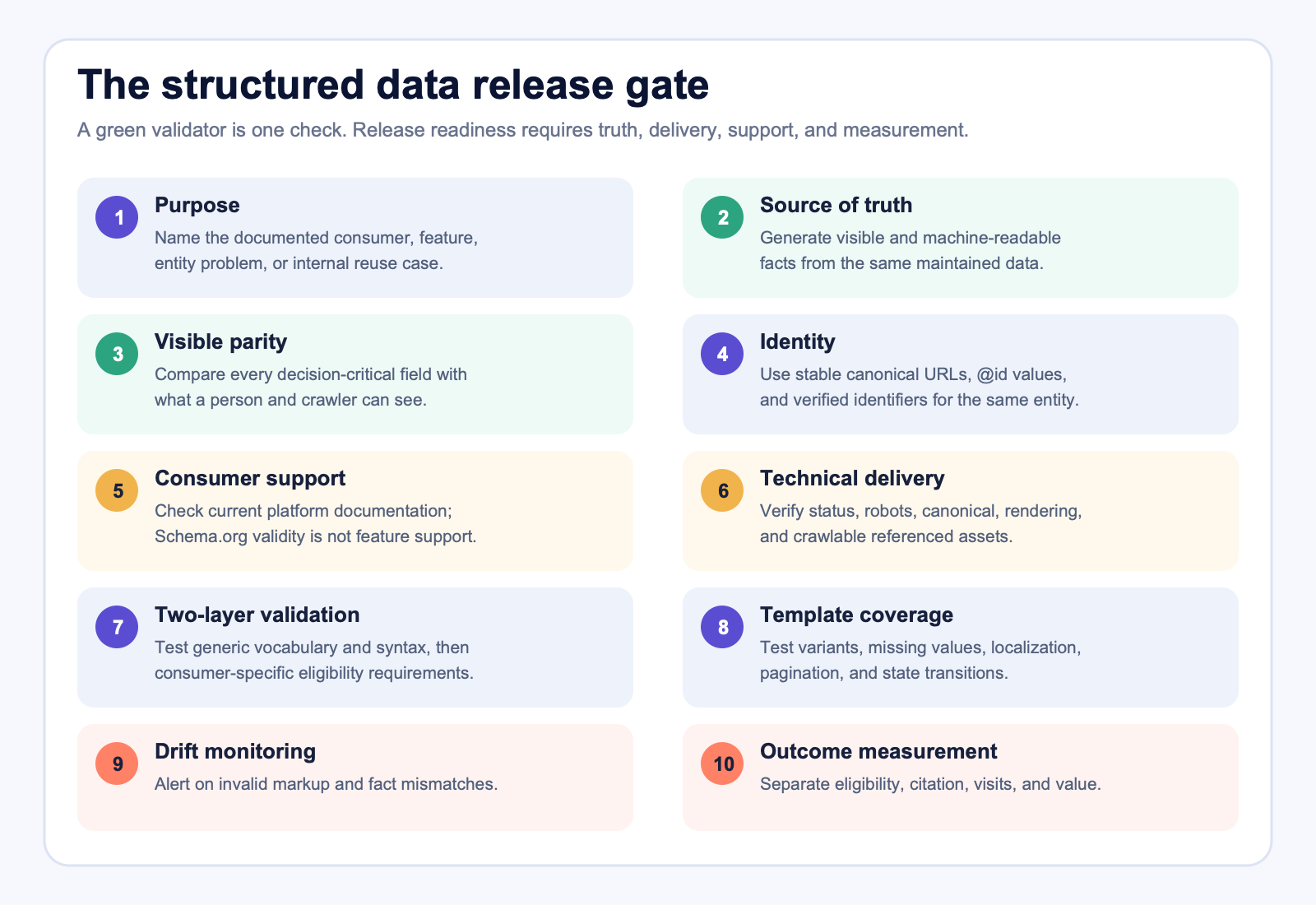
- Name the purpose. Record the documented consumer, feature, entity problem, or internal reuse case. “AI SEO” is not specific enough.
- Use a shared source of truth. Generate visible and machine-readable facts from the same product, content, identity, or policy data.
- Match visible content. Do not hide claims, reviews, offers, authors, or FAQs only in markup.
- Resolve identity deliberately. Use stable canonical URLs and
@idvalues; add external identifiers only when they identify the same real entity. - Check consumer documentation. Schema.org validity does not mean Google, Bing, a marketplace, or another consumer supports the type or field.
- Preserve crawl and index eligibility. Verify status, robots directives, canonicalization, rendered HTML, and access to referenced image or entity URLs.
- Validate both layers. Use a generic schema validator for vocabulary and syntax, then a consumer-specific tool for documented feature requirements.
- Test templates, not samples. Cover missing values, variants, pagination, localization, currency, availability transitions, and canonical duplicates.
- Monitor drift. Alert on invalid markup and on differences between visible facts, structured fields, feeds, and upstream data.
- Measure the promised outcome. Track feature eligibility separately from impressions, clicks, citations, answer claims, leads, and revenue.
A 30-day measurement template
Schema implementation can be evaluated without pretending that every movement is causal. Create a measurement sheet with one row per template or page cohort and the following fields:
| Layer | Metric | Evidence captured | Decision rule |
|---|---|---|---|
| Delivery | Valid, rendered, crawlable coverage | URLs passing generic and consumer-specific tests | Fix delivery before interpreting visibility |
| Consistency | Visible-to-markup parity | Price, availability, dates, authors, identity, policies | Release only when critical mismatches are zero |
| Search feature | Eligible and observed appearances | Search Console reports and manual consumer checks | Continue types that produce maintained value |
| AI answers | Selection, citation, claim accuracy | Repeated prompt panel with platform, date, locale, and raw answer | Call movement directional only after it exceeds the baseline noise floor |
| Business | Qualified visits, leads, revenue, support reduction | First-party analytics and CRM outcomes | Expand only when the expected value exceeds maintenance cost |
During days 1–7, capture a pre-release baseline: validity, visible parity, index status, documented search appearances, and repeated AI prompts for the relevant entities or products. Record the full answer, cited URLs, factual claims, platform, locale, account state where relevant, and time. A single prompt is not a baseline.
During days 8–14, release a small, representative cohort. Avoid rewriting the content, changing internal links, and adding schema at the same time if the objective is to isolate markup. Where a clean holdout is safe, keep comparable pages unchanged. If operations require multiple changes, document them and evaluate the package as a package rather than attributing everything to schema.
During days 15–30, monitor delivery and repeat the same prompt panel. Compare results with pre-release variation and the unchanged cohort. A new rich-result appearance can be attributed to structured-data eligibility more confidently than a fluctuating AI citation. A citation movement is observational unless the design controls other changes, sampling noise, platform updates, seasonality, and page differences.
Before the test, write the decision rule. Example: “Keep and scale this implementation if at least 98% of eligible pages remain valid and consistent, documented search appearances increase without conversion loss, and maintenance consumes fewer than four hours per month. Treat AI-citation movement as exploratory unless it exceeds the unchanged panel’s 95th percentile and repeats in two collection windows.” The thresholds are an editorial example, not a universal standard; choose values that match the decision and risk.
What to do this week
- Inventory consumers and claims. For every current schema type, record why it exists, the visible facts it represents, and the documented consumer.
- Fix contradictions first. Compare organization names, canonical URLs, prices, availability, dates, authors, ratings, and policies across HTML, JSON-LD, feeds, and profiles.
- Prioritize one high-value template. Choose a product, local-business, article, event, job, or dataset template with a supported use and measurable failure cost.
- Connect one source of truth. Remove hand-maintained duplication for the critical fields before expanding the graph.
- Create the 30-day baseline. Capture technical, search-feature, AI-answer, and business outcomes as separate layers.
- Delete unsupported promises from the roadmap. Replace “increase AI rankings” with the outcome the implementation can actually be judged against.
What the evidence does not show
- No reviewed source establishes schema markup as an independent, general ranking factor for public AI answers.
- No reviewed controlled experiment shows that adding schema alone causes an otherwise unchanged page to receive more Google AI Overview, Google AI Mode, Bing Copilot, ChatGPT, or Perplexity citations.
- Google’s statement that structured data can help understanding does not disclose a citation weight or guarantee any AI-feature inclusion.
- Microsoft’s sitemap and freshness guidance does not establish a schema.org effect, and its omission of schema is not proof that Bing never parses it.
- CCQA shows that annotations can build a QA training corpus; it does not show that the annotated source pages gain live visibility.
- The Dataset Search error rates apply to Dataset markup in one large corpus, not to every schema type or every consumer.
- The WordLift study is a vendor-affiliated preprint in a controlled RAG stack, not a public-search experiment; its enhanced condition also added materialized information.
- A validator pass proves neither factual parity nor indexing, feature display, citation, answer influence, traffic, or revenue.
- A correlation between schema presence and citations cannot isolate schema from CMS quality, authority, content, crawlability, or site maturity.
The decision
Implement schema when it gives a documented consumer accurate facts, reduces entity ambiguity, enables a valuable search appearance, or creates a maintainable machine-readable layer shared with visible content. Prioritize the types closest to revenue, user decisions, and costly data drift. Keep crawlability, indexing, canonicalization, internal discovery, and visible evidence ahead of speculative graph expansion.
Do not sell schema as an AI ranking switch. Measure delivery, consistency, feature eligibility, AI answer selection, claim accuracy, and business results as separate outcomes. If future platform documentation or credible controlled research establishes a direct effect, change the investment based on that evidence. Until then, the most accurate summary is also the most useful one: schema is valuable infrastructure—not an AI cheat code.
Primary references
- Google Search Central, “AI features and your website”, last updated December 10, 2025; accessed August 25, 2026.
- Google Search Central, “Introduction to structured data markup in Google Search”, last updated December 10, 2025; accessed August 25, 2026.
- Google Search Central, “General structured data guidelines”, last updated July 10, 2026; accessed August 25, 2026.
- Google Search Central, “Organization structured data”, last updated April 15, 2026; accessed August 25, 2026.
- Fabrice Canel and Krishna Madhavan, “Keeping Content Discoverable with Sitemaps in AI Powered Search”, Microsoft Bing, July 31, 2025.
- Schema.org documentation, including the data model and version 30.0, March 19, 2026.
- W3C, “JSON-LD 1.1: A JSON-based serialization for linked data”, W3C Recommendation, July 16, 2020.
- Patrick Huber et al., “CCQA: A New Web-Scale Question Answering Dataset for Model Pre-Training”, Findings of NAACL 2022, pp. 2402–2420.
- Tarfah Alrashed et al., “Dataset or Not? A Study on the Veracity of Semantic Markup for Dataset Pages”, ISWC 2021.
- Web Data Commons, “RDFa, Microdata, Embedded JSON-LD, and Microformats Data Sets — October 2024”, released January 2025.
- Andrea Volpini et al., “Structured Linked Data as a Memory Layer for Agent-Orchestrated Retrieval”, WordLift-affiliated arXiv preprint v1, March 11, 2026.
- Google Search Central, “Simplifying the search results page”, June 12, 2025.