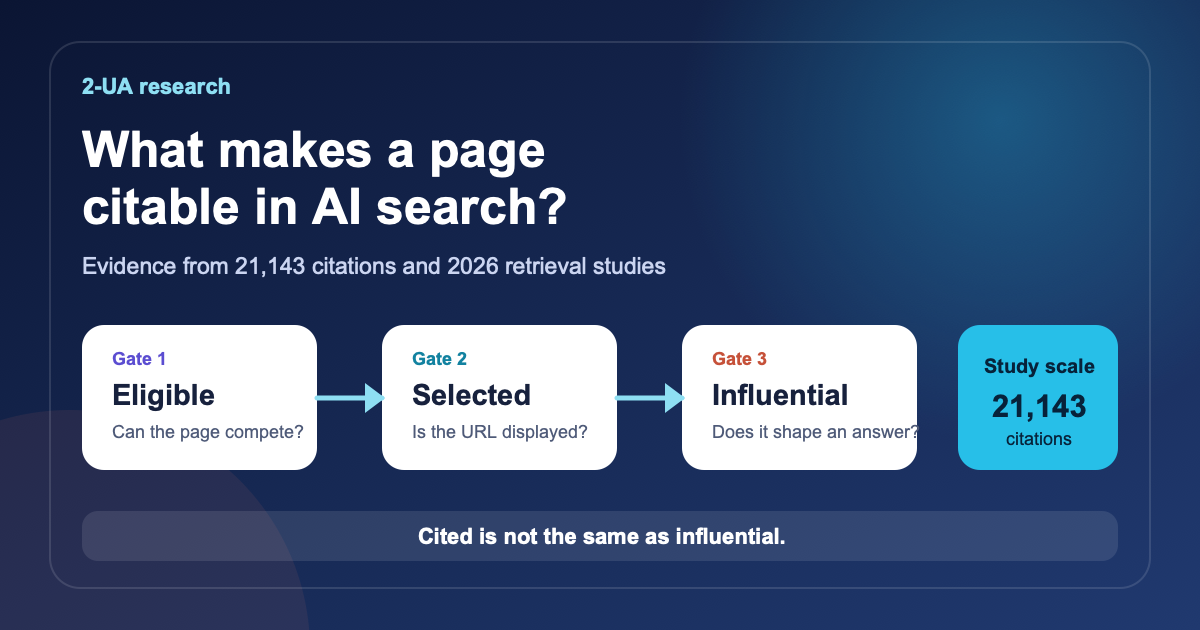
A content team can spend a month turning every page into short answers, adding FAQ blocks, and stretching articles to an arbitrary word count—and still learn nothing about why an AI answer chose one source over another. The expensive mistake is treating “citable” as a writing template. Current evidence describes at least three separate gates: a page must be available to retrieval, selected as a source, and useful enough to shape the generated answer. A formatting change can help one gate, do nothing at another, and reduce trust if it produces thin or unsupported copy.
The largest study in this review analyzed 21,143 valid search-layer citations across ChatGPT, Google AI Overview/Gemini, and Perplexity. It is useful because it distinguishes citation selection from what the authors call citation absorption: whether a cited page appears to contribute language, evidence, or structure to the answer.1 It is also an arXiv preprint built around a constructed influence score, designed prompts, a static platform snapshot, and successfully fetched pages. Those limitations are not fine print. They determine what the numbers can support.
The answer in one minute
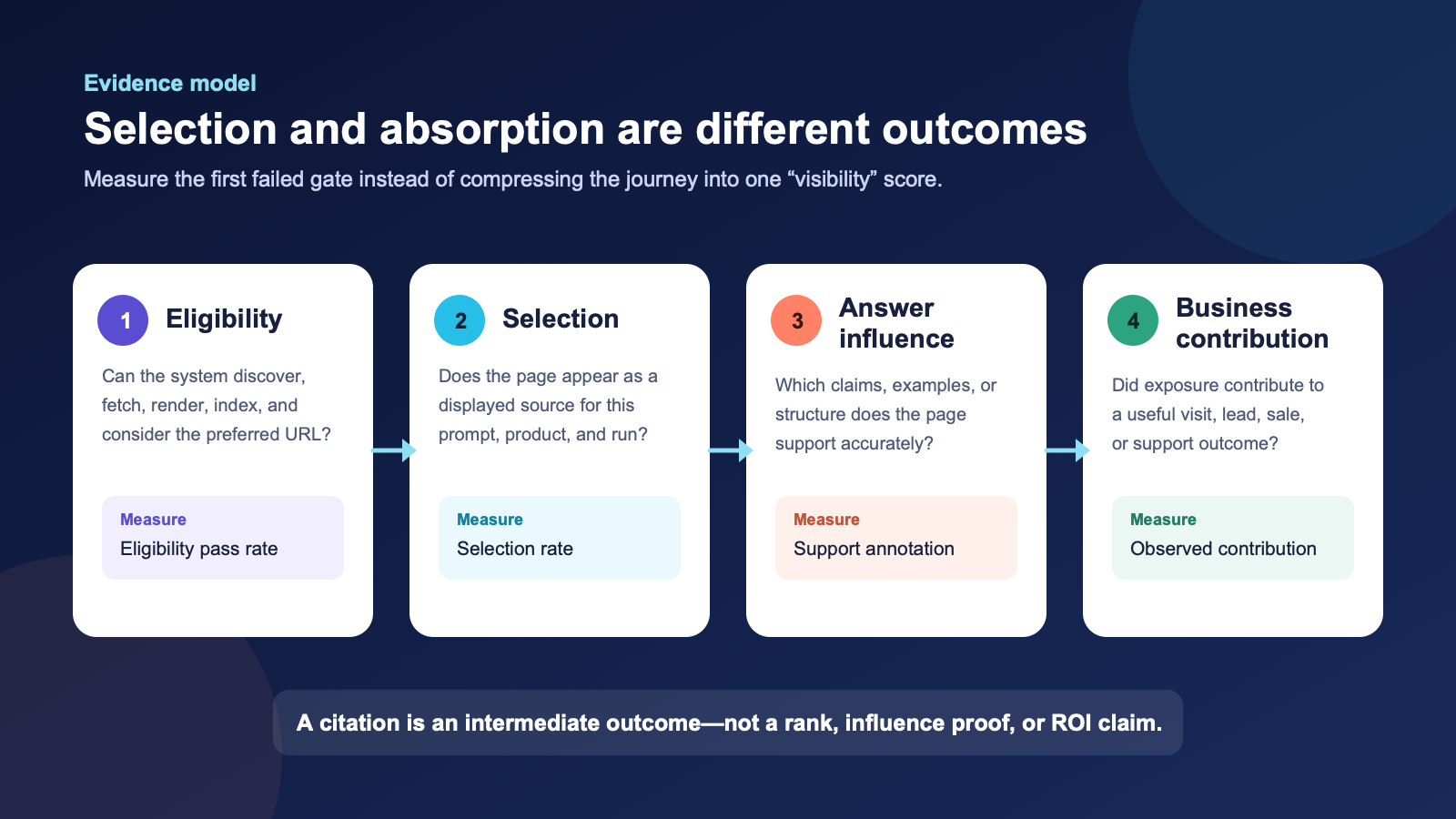
- Being cited is not the same as shaping the answer. Track source selection and answer influence separately; Bing’s own citation report explicitly says a citation count does not indicate ranking, authority, placement, or a page’s role in an answer.
- Eligibility comes first. A blocked, non-indexable, duplicate, stale, or badly rendered page cannot reliably compete, however polished its paragraphs are.
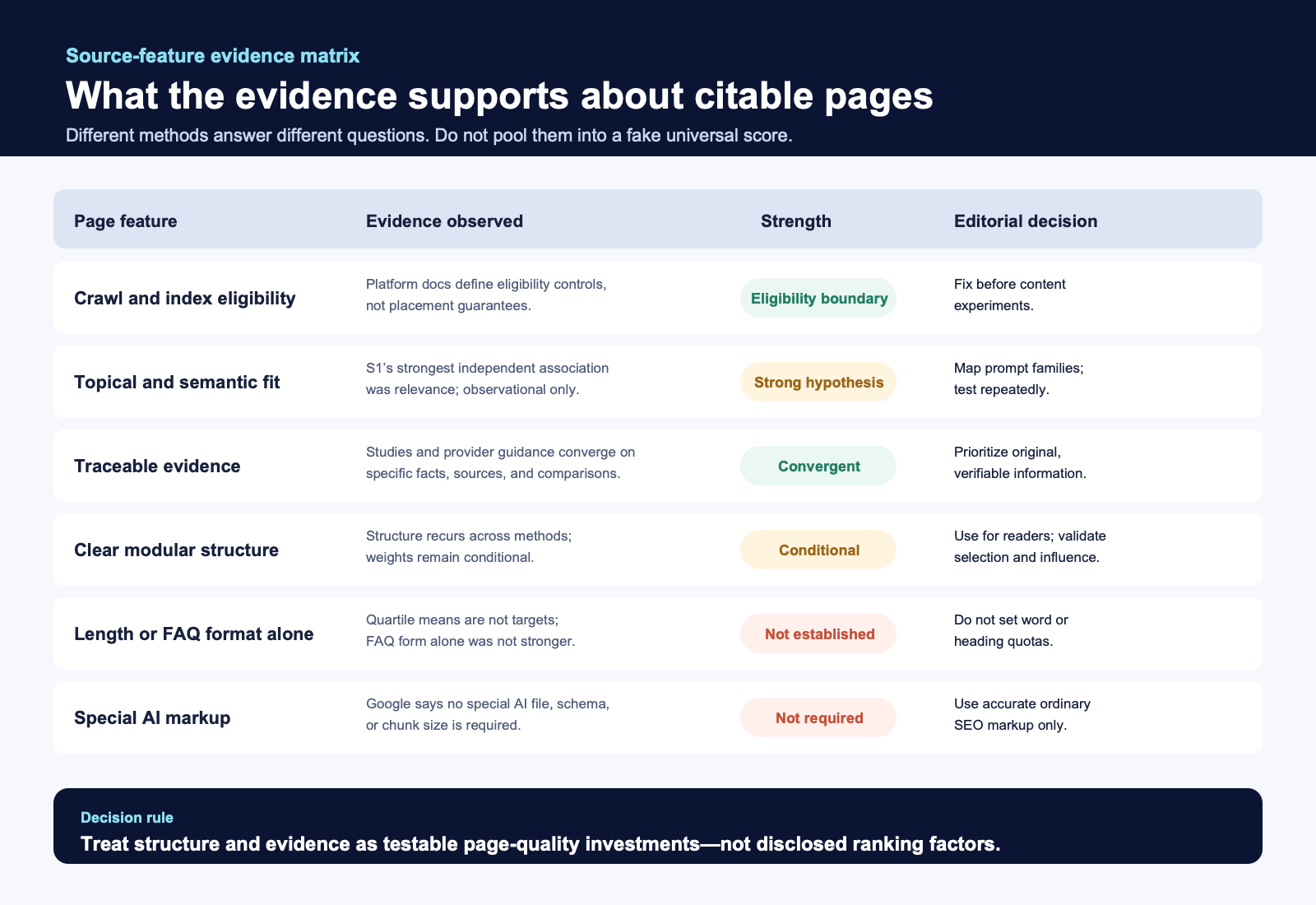
- Semantic fit is more defensible than a magic format. The 21,143-citation preprint associated its influence proxy most strongly with relevance and answer-page similarity, while a controlled ACL study found that multi-feature page planning outperformed isolated rewrites after retrieval.
- Evidence needs a usable container. Clear scope, descriptive headings, explicit definitions, comparisons, numbers, procedures, and limitations give both people and retrieval systems answer-ready material.
- Do not manufacture “AI bait.” Google says there is no required chunk size, ideal page length, special AI markup, or need to rewrite content for AI systems. Unique, useful, people-first information remains the safer long-term investment.
1. Start with the right unit of measurement
“Did our URL appear?” is a valid question, but it is not the whole visibility problem. One URL can sit in a source tray without supporting a central claim. Another can supply the definition, comparison, or numerical evidence that organizes several sentences. A third can influence a user who never clicks, while a fourth receives a referral but contributes little to the answer. Calling all four outcomes “citations” hides the work the page actually performed.
Use four distinct measures. Eligibility asks whether the system can discover, fetch, index, render, and consider the page. Selection asks whether the URL appears as a displayed source for a defined prompt and run. Answer influence asks which claims, language, examples, or structure in the answer are supported by that page. Business contribution asks whether the exposure produced a useful visit, assisted demand, lead, sale, subscription, or support deflection. The first three are content and retrieval outcomes. The fourth is the reason the work exists.
Microsoft’s Bing AI Performance preview illustrates the boundary. It reports total citations, cited pages, sampled grounding queries, page-level activity, and trends. Its documentation warns that these aggregates do not reveal placement, importance, authority, ranking, or the role a page played in one answer.7 A dashboard can therefore report rising citations while the brand’s evidence is peripheral, inaccurate, or commercially irrelevant. That is not a reason to discard the metric. It is a reason to name it correctly.
2. What the 21,143-citation study actually found
Zhang, He, and Yao analyzed a public dataset built from 602 controlled prompts. The cleaned search layer contained 21,143 valid citations. The feature table contained 23,745 citation-level rows, of which 18,151 pages were fetched successfully for the absorption analysis. The prompt set covered ChatGPT, Google AI Overview/Gemini, and Perplexity, with main experiments plus style, Chinese-English, and scenario contrasts. This is a substantial observational snapshot, not a random sample of all user activity.
Citation breadth varied sharply. The reported means were 6.88 citations per observed ChatGPT prompt, 12.06 for Google, and 16.35 for Perplexity. The paper’s mean influence proxy moved in the other direction: 0.2713 for fetched ChatGPT citations, 0.0584 for Google, and 0.0646 for Perplexity. That does not prove ChatGPT sources were objectively “better.” The score combines repeated references, first position, paragraph coverage, TF-IDF similarity, and n-gram overlap. Products also differ in answer length, citation display, parsing, retrieval, and source count. The defensible conclusion is narrower: breadth and the constructed depth measure diverged, so counting sources alone lost information.
The top quartile of pages by that proxy was much more substantial and structured than the bottom quartile: 1,943.30 versus 169.82 words, 10.59 versus 0.85 headings, 47.49 versus 8.34 paragraphs, and list density of 0.428 versus 0.048. Semantic measures separated the groups too. The strongest reported independent correlation was the LLM relevance score at 0.4322, followed by answer-citation embedding similarity at 0.3561, LLM-rated content quality at 0.2917, and question-citation similarity at 0.2548.
These are associations, not instructions to make every page 1,943 words long or add exactly eleven headings. Longer, better organized pages may simply contain more complete information. High-quality editorial work may cause both structure and influence. The influence formula itself may reward properties correlated with length. The authors explicitly say their data cannot establish that adding one feature causes future citation gains.
Evidence genres produced another useful hypothesis. Pages marked as containing numbers or statistics had a mean proxy score of 0.1171 versus 0.0725 without them; definitions were 0.1252 versus 0.0795; comparisons were 0.1389 versus 0.0894; how-to content was 0.1296 versus 0.0918; and code was 0.1747 versus 0.0988. Q&A formatting was the negative case: 0.0947 versus 0.1005. The result does not prove FAQs are harmful. It says a question mark and short answer are not substitutes for useful evidence.
3. The other 2026 studies narrow the claim
Peer review confirms that retrieval and citation are separate observations
Kakimov and colleagues audited Google AI Overview citations for 2,597 Overview-triggering YMYL queries derived from MS MARCO. They collected 251,163 top-100 retrieval events and 39,673 citation events. Just over half of the citation events—20,917, or 52.72%—were not present in the collected top-100 organic list for the same query.2 That does not expose Google’s internal candidate set, but it shows why classic rank alone cannot explain the displayed citation pool.
The paper’s main question was provenance. Detector-labelled AI documents were over-represented in citations relative to retrieval presence. Do not turn that into “AI-written pages are preferred.” The study was observational, limited to YMYL queries that triggered AI Overviews, and relied on an automated detector. It also received support through a partnership with Originality.ai, whose detector supplied the labels. The finding is valuable as an audit result, not a writing recommendation and certainly not a trust verdict.
Cross-engine evidence shows that the source set moves
Kirsten and colleagues compared Google organic search with five generative systems over 4,706 English queries in the United States and Germany. In their July/August and September 2025 collections, Google AI Overview shared only 18% of source URLs across the two periods, compared with 45% for organic search. In repeated ternary questions at temperature zero, 9% to 27% of answers changed polarity within five minutes, depending on the engine.3 The source and answer are samples from a moving system, even when the page is unchanged.
This instability changes reporting. A single screenshot cannot establish a durable rank. A citation loss cannot automatically be attributed to an edit. A win on one exact prompt can disappear under a paraphrase, location change, product update, or second execution. Citable-page work needs a fixed prompt panel, repeated runs, recorded product context, and a noise threshold before anyone claims improvement.
Controlled optimization works only after a crucial assumption
Liu and Xu’s peer-reviewed FeatGEO study offers stronger experimental control. It represented pages through thirteen structural, content, and language features, then optimized citation visibility and quality across a controlled RAG pipeline. On GEO-Bench, its feature-level method beat the unmodified generated-page baseline across GPT-4o-mini, Gemini 2.5 Flash, and Qwen-plus answer generators. Statistics and cited sources had the largest positive visibility contributions in its ablation, while isolated text-level heuristics were inconsistent.4
The crucial assumption is that the advertiser page was already inserted beside five retrieved pages. The study optimizes conditional citation, not upstream discovery or end-to-end web selection. Quality was judged by LLMs, and the content and answer pipeline were model-generated. This is evidence that multi-feature information design can matter inside a bounded candidate set. It is not evidence that an extra statistics section will make a production system retrieve a page it currently ignores.
4. Use the CITED framework, not a citation-factor checklist
A checklist implies every item has a fixed weight. The evidence does not support that. CITED is a diagnostic sequence: fix the earliest failed gate, then test the next one. It works for a three-person SaaS team because it starts with one important page, and it scales to publishers because each stage can be measured across templates and topic groups.
- C — Crawlable and canonical: the preferred URL returns a stable success response, exposes the main content in rendered HTML, is not blocked from the relevant search agent, is indexable where required, has a self-consistent canonical, and is internally discoverable.
- I — Intent-aligned: the page has a bounded subject and directly serves the task behind the prompt family—definition, comparison, procedure, evaluation, or decision—not merely the exact keywords in one prompt.
- T — Traceable: consequential claims have named sources, dates, denominators, methods, and visible limitations. Original data explains how it was collected. First-hand experience distinguishes observation from inference.
- E — Extractable: descriptive headings, short claim-led paragraphs, labelled tables, definitions, steps, and comparisons make evidence understandable when a reader enters mid-page or a system retrieves one passage.
- D — Distinctive: the page contributes something the next ten summaries do not: original data, a real workflow, a transparent calculation, expert judgment, a tested example, a primary-source synthesis, or a useful tool.
The order matters. If a JavaScript failure leaves the main comparison absent from rendered HTML, polishing its prose is premature. If the page is available but misses the user task, adding schema will not create topical fit. If the page fits but repeats commodity claims without evidence, formatting only makes the emptiness easier to parse. If the evidence is strong but buried under vague headings, structural work becomes rational.
5. Anatomy of a citable page
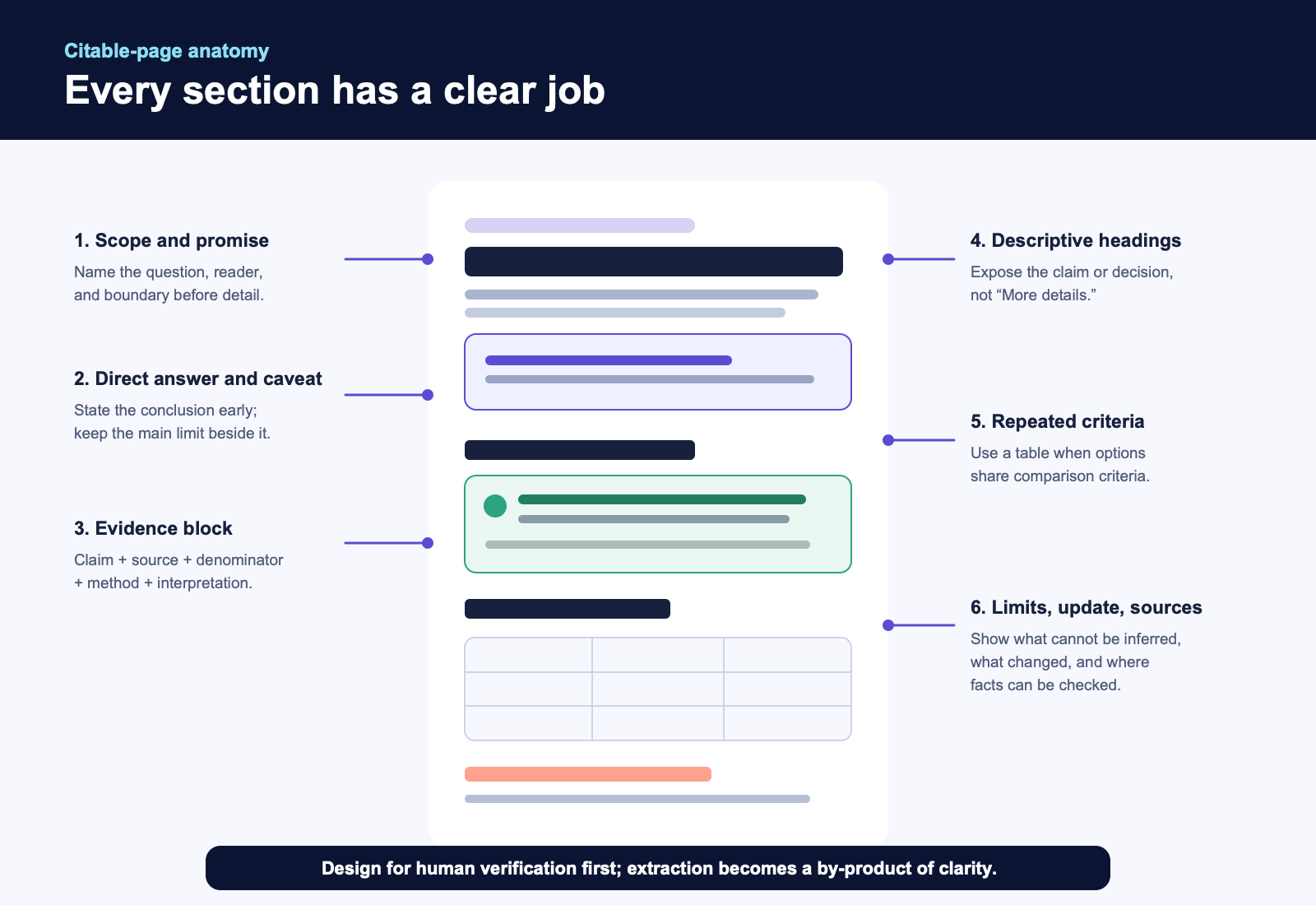
Start with a one-sentence scope statement: what question the page answers, for whom, and under what boundary. Follow it with a compact answer that a person can evaluate before committing to the full article. This is not an “AI summary” block. It is a reader contract. It should state the conclusion and the most important caveat, not tease a conclusion hidden 2,000 words later.
Build the body around real subproblems. A descriptive heading such as “Cost at 100,000 monthly requests” exposes a usable unit. “More details” does not. Under each heading, lead with one claim, then give evidence, interpretation, and boundary. When a number matters, place its denominator, period, geography, and source close enough that it survives extraction. When comparing options, use the same criteria for every option. When explaining a procedure, state prerequisites, steps, expected result, and failure conditions.
Add an evidence-limitations section before the conclusion. This is commercially useful, not academic decoration. It tells a buyer where the recommendation is safe, prevents a model or reader from generalizing a narrow study, and differentiates a serious source from a recycled list of certainties. For volatile subjects, show the last substantive update and what changed. Freshness should reflect content change, not a date that a CMS rewrites every day.
Keep important facts in HTML. Microsoft recommends not placing core information only in images or PDFs because the extra extraction step can reduce reliability.8 Graphics should explain relationships and retain accessible alternative text; they should not be the sole home of the data. Use structured data where it accurately describes the visible page and supports ordinary search features, but do not invent an AI-only schema. Google’s July 2026 guide says no special schema or AI text file is required for its generative search features. 5
6. A worked before-and-after evidence block
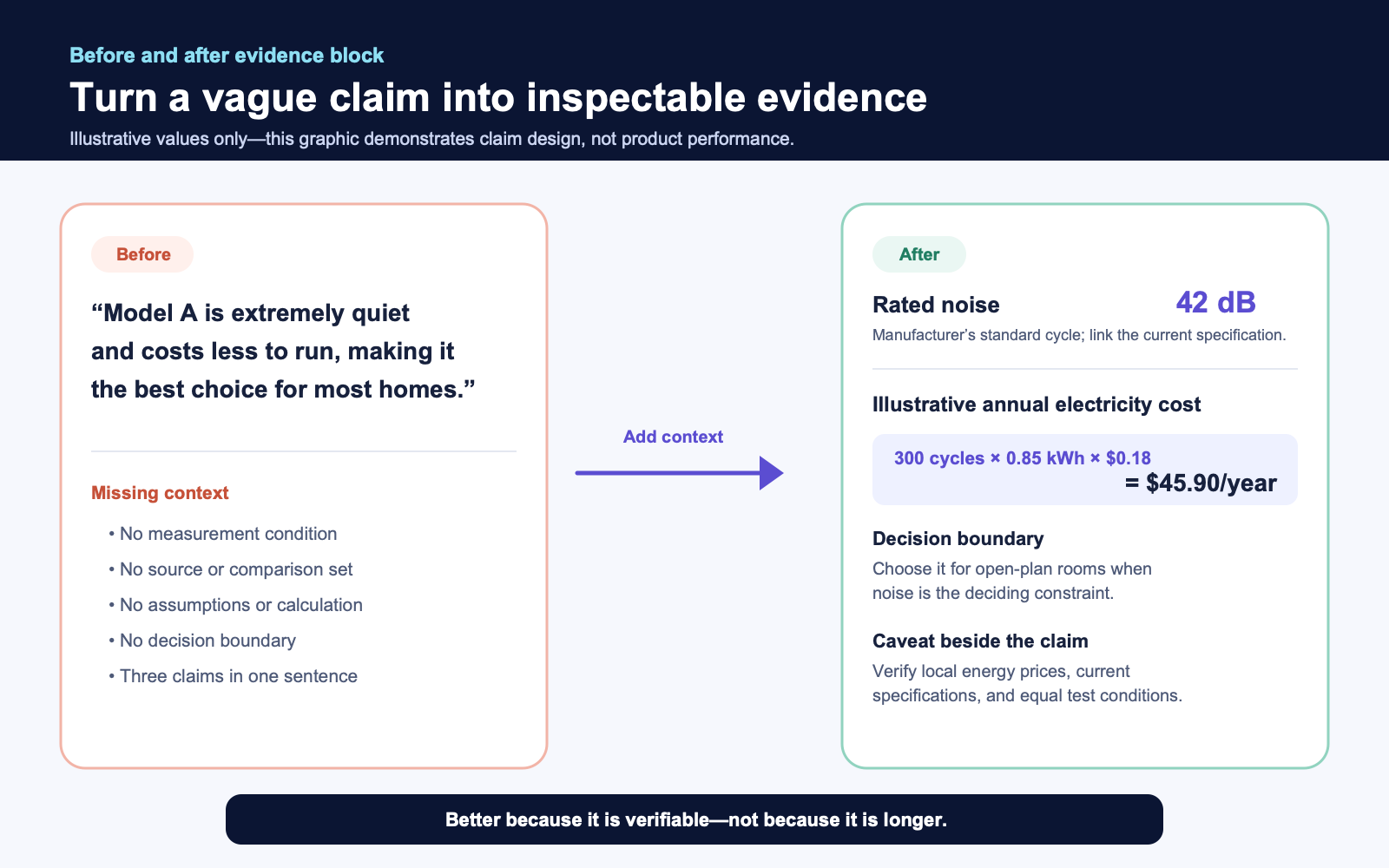
Imagine an appliance comparison page with this sentence: “Model A is extremely quiet and costs less to run, making it the best choice for most homes.” It contains three claims—noise, operating cost, and overall recommendation—but gives no measurement conditions, comparison set, date, source, or decision boundary. A system can repeat it, but neither a reader nor an editor can verify it.
A stronger block might say: “At the manufacturer’s standard cycle, Model A is rated at 42 dB. In our illustrative comparison using 300 cycles per year, 0.85 kWh per cycle, and electricity at $0.18/kWh, annual electricity cost is $45.90. Choose it for open-plan rooms when noise is the deciding constraint; verify local energy prices and current model specifications before purchase.” Below that, show the formula, link the current specification sheet, state the comparison date, and list the alternatives measured under the same assumptions.
The rewrite is not stronger because it is longer. It separates observations from a recommendation, names assumptions, and exposes a reusable calculation. If the page has first-party test data, publish the protocol: room, distance, cycle, meter, sample count, exclusions, and raw results. If it relies only on manufacturer data, say so. Traceability is a quality feature even when no AI system ever cites the page.
7. The implementation checklist
Eligibility and delivery
- Fetch the preferred URL as an anonymous visitor and as each relevant documented search crawler where your infrastructure supports safe verification.
- Confirm a stable 200 response, final canonical URL, index/snippet eligibility, render parity, and the same essential content on mobile and desktop.
- Remove accidental duplicate URLs or make the canonical and internal-link signals consistent. Keep the XML sitemap’s `lastmod` honest.
- Ensure the main answer, comparison, and evidence are visible in HTML without requiring authentication, a blocked script, or a user interaction.
- Allow only the search agents that advance the page’s business purpose. OpenAI and Perplexity both document dedicated search crawlers; access creates eligibility, not a citation guarantee.910
Information and evidence
- Write one explicit scope sentence and one direct answer containing the main caveat.
- Map the page to a prompt family: definitions, comparisons, procedures, risks, costs, evidence, and decisions. Do not build a near-duplicate page for every paraphrase.
- Turn vague adjectives into measurable claims. Attach denominator, method, period, geography, and source where those details affect interpretation.
- Prefer primary documents and original data. Explain how first-party data was collected, cleaned, and calculated.
- Add a fair counterexample or boundary. A page that only supports one predetermined conclusion is less useful for a complex decision.
Structure and reader experience
- Use descriptive sentence-case headings that tell the reader what decision or claim follows.
- Give each paragraph one job. Keep the subject explicit so a sentence still makes sense when encountered outside its original scroll position.
- Use a table for repeated criteria, a numbered list for order, and bullets for parallel items. Do not turn every sentence into a list.
- Place important qualifications beside the claim, then summarize broader evidence limitations in a dedicated section.
- Make charts data-bearing, label illustrative numbers, include legible captions and alt text, and repeat essential values in the surrounding HTML.
Commercial usefulness
- Define the next useful action for the reader: verify a page, compare a plan, run a calculation, request an audit, or start monitoring.
- Keep the call to action consistent with the evidence. Do not turn an informational conclusion into an unsupported product promise.
- Measure whether cited prompt families are relevant to customers who can pay, not merely whether the brand appears for high-volume trivia.
8. A 30-day measurement template
Before editing, select a small panel: five to ten commercially relevant prompt families, three to five natural paraphrases per family, and the AI surfaces your audience actually uses. Include definition, comparison, how-to, objection, and decision prompts where appropriate. Record country, language, logged-in state if relevant, product or model label, date, and run number. Do not mix new prompts into the baseline after seeing results.
Choose one target page and one matched control page. The target receives the evidence and structure improvement; the control stays unchanged unless accuracy or safety requires an edit. Avoid changing crawl policy, canonicalization, page template, title, content, and internal links on the same day. If everything moves, the team cannot diagnose the result.
- Days 1–3 — establish eligibility: record response, canonical, indexability, rendered content, relevant crawler policy, sitemap state, and last substantive update. Fix blockers before judging content.
- Days 4–7 — collect the baseline: execute each prompt multiple times. Record whether search occurred, every displayed source, source order where visible, claims supported by the target, unsupported mentions, and referrals.
- Days 8–10 — annotate influence: for each answer claim, label the target as direct support, partial support, background only, or absent. Use two reviewers for a small sample and reconcile disagreements before scaling.
- Days 11–14 — revise one bottleneck: if eligibility fails, fix delivery. If selection fails despite eligibility, improve intent fit, distinctiveness, and internal discovery. If selection occurs but influence is weak, improve the evidence block and its context.
- Days 15–21 — wait and repeat: allow recrawling, then run the same panel and schedule. Keep the control page and prompt definitions unchanged.
- Days 22–30 — decide: compare repeated selection rate, source breadth, annotated influence, support accuracy, referrals, conversions, and the unchanged control. Report uncertainty and the smallest effect the sample could realistically reveal.
| Metric | Definition | Do not call it |
|---|---|---|
| Eligibility pass rate | Share of target URLs that pass declared fetch, render, canonical, and index/snippet checks | AI ranking |
| Selection rate | Runs containing the target URL as a displayed source ÷ eligible runs | Share of voice without the prompt/run denominator |
| Answer support rate | Material answer claims directly supported by the page ÷ material claims reviewed | Model attention |
| Accurate influence rate | Runs where the page supports a central claim accurately ÷ eligible runs | Causal business impact |
| Business contribution | Observed referrals, assisted demand, qualified actions, and revenue kept separate by attribution strength | Incremental ROI without an experiment |
Define a change threshold before the follow-up. For a small site, “three more citations” is usually noise. A reasonable decision rule might require a repeated selection-rate increase across two prompt families, no reduction in support accuracy, no corresponding movement on the control, and at least one commercially relevant outcome. The exact threshold depends on run count and baseline. If the sample is too small, extend the window and say “insufficient evidence.”
9. The strongest counterposition
The strongest reasonable objection is that none of this page engineering matters because authority, index access, proprietary retrieval, and model behavior dominate. The 21,143-citation snapshot shows concentrated source types and high-authority domains. The cross-engine study shows large source volatility. FeatGEO assumes the page is already in a six-document candidate set. A small business cannot manufacture Wikipedia’s recognition or force a commercial engine to retrieve its page.
That objection is mostly right about guarantees and wrong about the decision. A small site should not imitate a mega-domain or promise a citation. It can still publish the original comparison, local data, tested workflow, pricing evidence, product specification, or expert explanation that a broader source does not have. It can make that evidence discoverable, accurate, and reusable. These actions improve the page for customers and classic search even if AI citations do not change. The correct investment test is therefore not “Will this hack the model?” It is “Does this make a commercially important page more useful and more measurable under uncertainty?”
Small-site and enterprise boundaries
A small site does not need an enterprise observability stack to apply the framework. One owner can maintain a spreadsheet with prompt, run date, surface, displayed sources, supported claim, referral, and outcome. Review five prompt families twice a month, annotate a small number of answers, and invest only in pages tied to a sale, signup, renewal, or meaningful support reduction. Sparse data is expected. The discipline is to preserve denominators and avoid converting absence into a diagnosis.
An enterprise publisher has a different failure mode: scale can hide weak definitions. A million automated prompt runs are not useful if the prompts drift, product context is missing, citations are deduplicated inconsistently, or an “influence” score rewards the same overlaps it later claims to explain. Version the panel, keep raw answers and source URLs where terms permit, separate country and language, log template releases, and sample human support annotations. Report results by page type and decision journey, not only as one domain-wide visibility score.
When to change course
Tighten the technical path immediately when the preferred URL is blocked, non-canonical, missing essential rendered content, or serving materially different evidence across devices. Rework the page when repeated selection is low but eligibility is clean and competing sources answer a commercially important subproblem with clearer original evidence. Improve support accuracy when the page is cited but the answer overstates, detaches, or misreads its claim. In that case, shorten the claim, move the caveat beside it, and make units and scope explicit.
Stop optimizing a prompt family when citations rise but the topic has no credible customer value, or when the necessary rewrite makes the page less accurate, less readable, or less distinctive. Keep a well-performing page stable when post-edit movement remains inside the observed noise range. Escalate to a controlled experiment only when the expected commercial value can justify the run volume, annotation cost, and engineering effort. “No decision yet” is a valid outcome; it is more useful than shipping another unsupported rule.
10. What the evidence does not show
Claims this guide does not support
- “A page needs 2,000 words or eleven headings.” S1 reports quartile means, not causal thresholds, and Google says there is no ideal length.
- “Adding statistics increases citations by 61.55%.” That number is a relative difference in S1’s mean influence proxy, not a randomized citation lift.
- “FAQs hurt AI visibility.” S1 found slightly lower mean proxy influence for Q&A-labelled pages; taxonomy, depth, quality, and domain mix can confound the result.
- “AI-generated writing is favored by Google.” S2 observes detector-labelled provenance associations in a selected sample; it does not manipulate authorship or establish quality.
- “Schema, `llms.txt`, or tiny content chunks unlock Google AI features.” Google’s current guide explicitly rejects special AI markup and chunking requirements.
- “Allowing a crawler guarantees selection.” OpenAI and Perplexity describe search eligibility controls, not a placement promise.
- “One citation check measures rank.” S3 documents substantial source and answer instability across engines and repeated runs.
- “Citation growth proves ROI.” Selection, accurate answer influence, visits, assisted demand, and causal incrementality are different measures.
11. What to do this week
- Choose one page with a revenue path. Start with a comparison, high-intent guide, product reference, or original research page—not the entire site.
- Write the prompt panel before the rewrite. Include realistic paraphrases and record the platform context.
- Run the CITED audit. Stop at the earliest failed gate and fix only that bottleneck first.
- Build one evidence block. Replace one vague consequential claim with a traceable number, definition, comparison, procedure, or first-hand observation plus its boundary.
- Improve the semantic skeleton. Replace vague headings, align title/H1/scope, and make the central answer visible in rendered HTML.
- Record the baseline and control. Capture selection, answer support, accuracy, referrals, and conversions separately.
- Schedule the day-15 and day-30 reruns. Do not declare victory from the first post-edit answer.
A citable page is not a page written for a machine. It is a page whose purpose is unmistakable, whose evidence survives removal from its original context, and whose claims are useful enough to support a real answer. Current research makes that a defensible design hypothesis—not a guarantee. The practical advantage comes from keeping the gates and metrics separate: make the page eligible, improve its fit and evidence, observe whether it is selected, audit whether it shapes the answer accurately, and only then connect the result to business value.
Primary references
- Zhang, He, and Yao, “From Citation Selection to Citation Absorption: A Measurement Framework for Generative Engine Optimization Across AI Search Platforms”, arXiv preprint v2, April 29, 2026.
- Kakimov et al., “Auditing Citation Behavior in AI-Generated Search Summaries: A Framework and a Case Study of Google AI Overviews”, PMLR 318, 2026.
- Kirsten et al., “Characterizing Web Search in the Age of Generative AI”, Findings of ACL 2026.
- Liu and Xu, “Think Before Writing: Feature-Level Multi-Objective Optimization for Generative Citation Visibility”, ACL 2026.
- Google Search Central, “Optimizing your website for generative AI features on Google Search”, updated July 10, 2026.
- Google Search Central, “AI features and your website”, updated December 10, 2025.
- Microsoft Bing, “Introducing AI Performance in Bing Webmaster Tools Public Preview”, February 10, 2026.
- Microsoft Bing, “Optimizing Your Content for Inclusion in AI Search Answers”, October 8, 2025.
- OpenAI, “Overview of OpenAI Crawlers”, accessed August 18, 2026.
- Perplexity, “Perplexity Crawlers”, accessed August 18, 2026.