Your security team wants to block “AI bots.” Your growth team wants citations in ChatGPT, Claude, and Perplexity. Your legal team wants training opt-outs. If those requests become one broad WAF rule, you can satisfy all three teams on paper and still make the wrong business decision: stop search discovery, leave user-triggered retrieval untouched, and mistake a voluntary crawl preference for access control.
The useful answer in 2026 is not “allow AI” or “block AI.” It is to assign a purpose to each documented agent, choose a policy for that purpose, and enforce the policy at the correct layer. OpenAI and Anthropic now publish separate agents for model-oriented collection, search, and user actions. Perplexity documents search and user agents separately. Google-Extended is different again: it is a control token applied to content Google already fetches, not a distinct user agent you can identify in an access log.
The answer in one minute
- Do not block by the word “AI.” Classify each agent as training, search/indexing, user-triggered retrieval, or unknown automation.
- A sensible starting policy for many commercial sites is: block documented training collection unless it has a clear value exchange; allow search agents on public, indexable content; decide separately whether user-triggered agents may fetch it.
- Do not block Googlebot to opt out of Gemini training. Google says `Google-Extended` controls specified Gemini training and grounding uses without affecting Google Search inclusion or ranking.
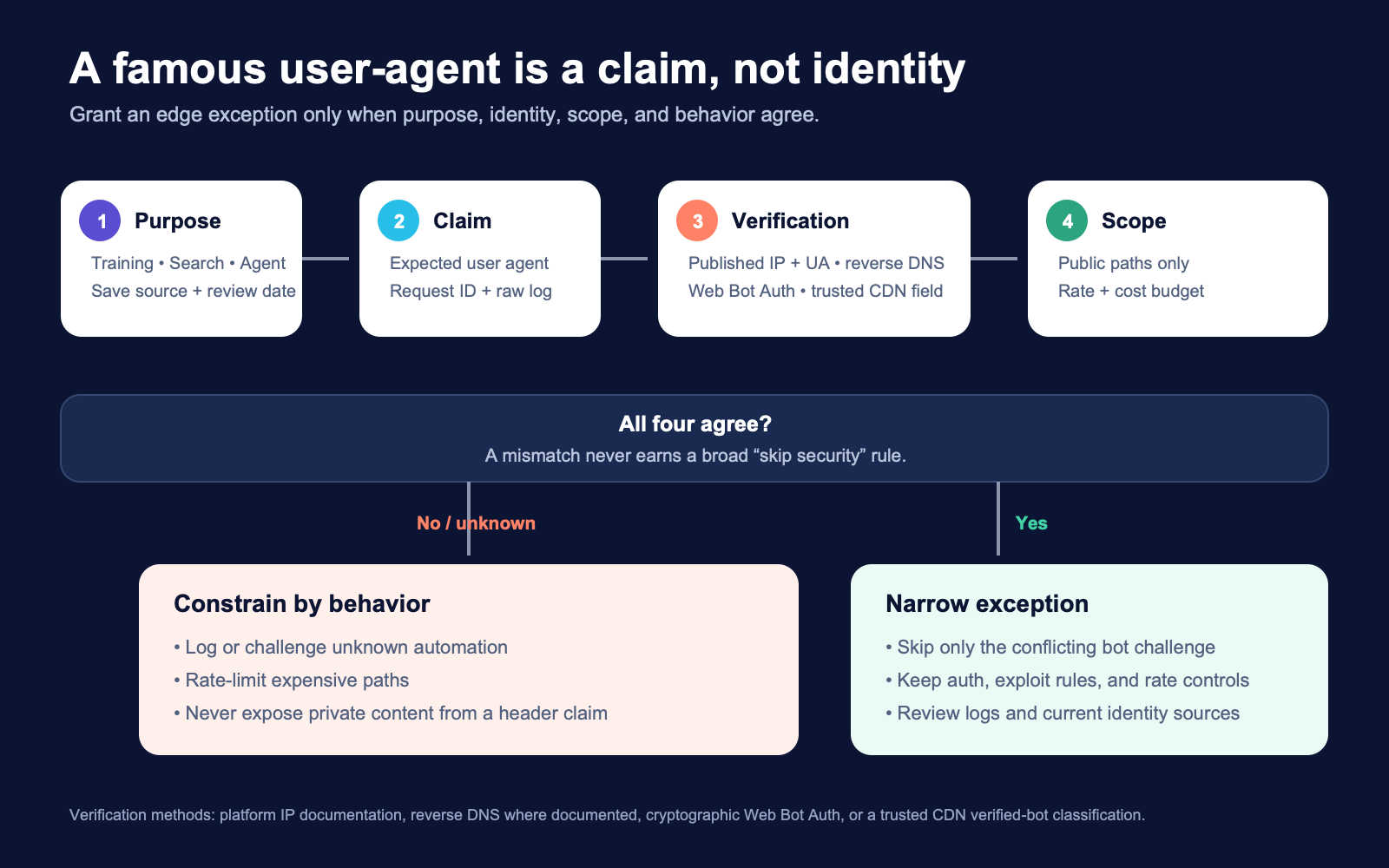
- Do not trust a user-agent string as identity. Verify published IP ranges, reverse DNS, signed-agent evidence, or a trusted CDN classification before granting a WAF exception.
- Use `robots.txt` for preference and WAF/authentication for enforcement. RFC 9309 explicitly says the protocol is not access authorization.
1. The costly mistake is treating every AI request as the same request
A crawler policy is a portfolio of decisions. A training crawler may collect public pages for future model development. A search crawler may build or refresh an index used to cite and link to your pages. A user-triggered agent may fetch one page because a person asked a question. A conventional search crawler may feed both classic and AI-enhanced search experiences. An unidentified browser-like requester may be an assistant, a scraper, a monitoring service, or an attacker. Those activities create different benefits, costs, and control requirements.
That distinction changes the default question. Instead of asking, “Should we block GPTBot, ClaudeBot, Google-Extended, and PerplexityBot?” ask four narrower questions:
- Training: do we want this content eligible for documented model-development collection?
- Search discovery: do we want the platform to index, retrieve, cite, or link to this public content?
- User action: do we want an agent to fetch this URL when a person explicitly requests it?
- Security and cost: can we verify the requester, constrain its rate, and keep it away from non-public or expensive paths?
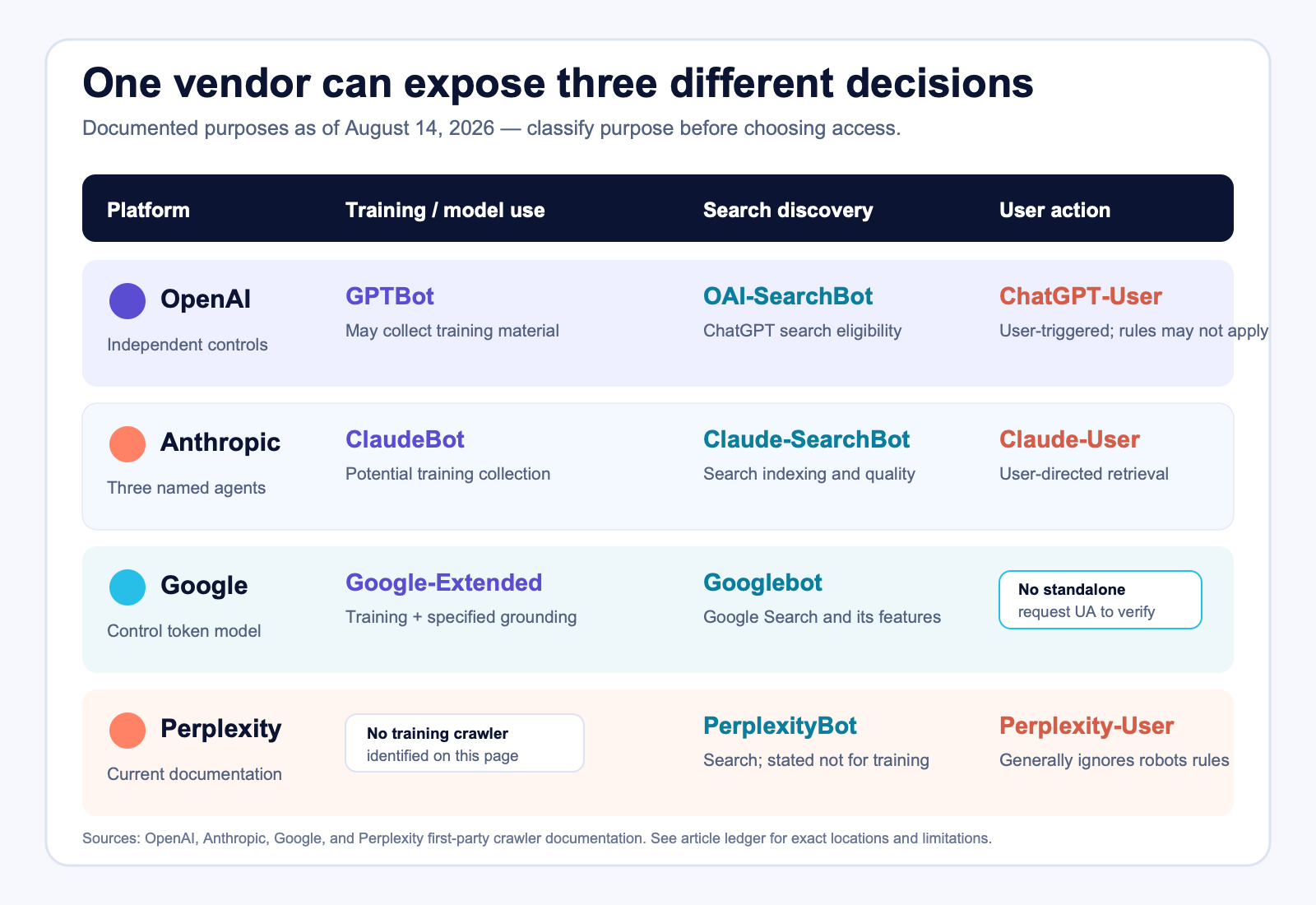
A policy can reasonably answer “no” to training and “yes” to discovery. OpenAI’s current crawler page explicitly gives that example: allow `OAI-SearchBot` for ChatGPT search while disallowing `GPTBot` as a training signal.1 Anthropic documents the same purpose separation across `ClaudeBot`, `Claude-SearchBot`, and `Claude-User`.2 The controls are not perfect equivalents, but they make one conclusion unavoidable: a single “AI bots” switch discards information the platforms themselves expose.
2. What each named control actually does
OpenAI: GPTBot is not the ChatGPT search control
OpenAI documents three relevant identities. `GPTBot` collects content that may be used to improve and train its generative foundation models. `OAI-SearchBot` supports websites appearing in ChatGPT search answers. `ChatGPT-User` supports certain actions initiated by ChatGPT or Custom GPT users and is not used to determine search inclusion. Each has a separate published IP-range endpoint.
The operational implication is precise. Blocking `GPTBot` expresses a training preference; it does not opt the site out of ChatGPT search. Blocking `OAI-SearchBot` is the search decision, and OpenAI says opted-out sites will not be shown in ChatGPT search answers, although they may still appear as navigational links. For `ChatGPT-User`, OpenAI says robots rules may not apply because a user initiated the action. A team that wants to permit those actions must make an access-layer decision as well as a crawl-policy decision.
Anthropic: three agents, three consequences
Anthropic describes `ClaudeBot` as collecting public web content that could contribute to model training, `Claude-SearchBot` as navigating the web to improve search result quality, and `Claude-User` as retrieving content at a user’s direction. Its documentation says blocking the search agent may reduce the site’s visibility and accuracy in user search results; blocking the user agent may reduce visibility for user-directed retrieval.
Anthropic says its bots honor `robots.txt` and supports the non-standard `Crawl-delay` directive. “Non-standard” matters. RFC 9309 defines `allow` and `disallow`, not a portable crawl-delay behavior. A delay that Anthropic accepts should not be presented as a universal rate-control mechanism. If request volume threatens origin capacity, enforce a rate at the CDN, reverse proxy, or WAF and measure the result.
Google: Google-Extended is not a crawler you will see
Google’s model is the most likely to be implemented incorrectly. Its crawler documentation says `Google-Extended` has no separate HTTP user-agent string. Google crawls with existing user agents; `Google-Extended` is a standalone control token that governs whether content may be used for training future Gemini models and for specified grounding uses. Google states that the token neither affects inclusion in Google Search nor acts as a Google Search ranking signal.3
Therefore, a WAF rule looking for `Google-Extended` in the request header is conceptually broken: there is no such request identity to match. Put the control in `robots.txt`. Keep the separate `Googlebot` decision aligned with classic Google Search and its features. If you block Googlebot because you intended only to block model training, the collateral damage is ordinary search visibility.
Perplexity: PerplexityBot is documented as search, not training
Perplexity currently describes `PerplexityBot` as an agent that surfaces and links websites in Perplexity search results and says it is not used to crawl content for foundation-model training. `Perplexity-User` supports user-requested visits and is also described as not collecting foundation-model training content. The same page says the user fetcher generally ignores `robots.txt` because the fetch was requested by a user.4
Older third-party lists often put “PerplexityBot” into one undifferentiated training bucket. That is not what the current primary documentation says. If your objective is AI-search discovery, blocking it conflicts with that objective. If your objective is to stop user-triggered access, a robots entry alone may not produce the desired enforcement; Perplexity recommends combining its current published IP ranges with the user-agent condition in the WAF.
3. A decision framework that starts with content economics
The appropriate policy depends less on company size than on how the content creates value. A public SaaS documentation page benefits when prospects receive a correct answer and follow a citation. A paywalled investigative article may lose subscription value when its core reporting is reproduced without a visit. A product catalog may welcome discovery but reject mass collection that helps a competitor rebuild the catalog. A support article may reduce tickets even when it produces no referral. A private account page should never rely on crawler goodwill at all.
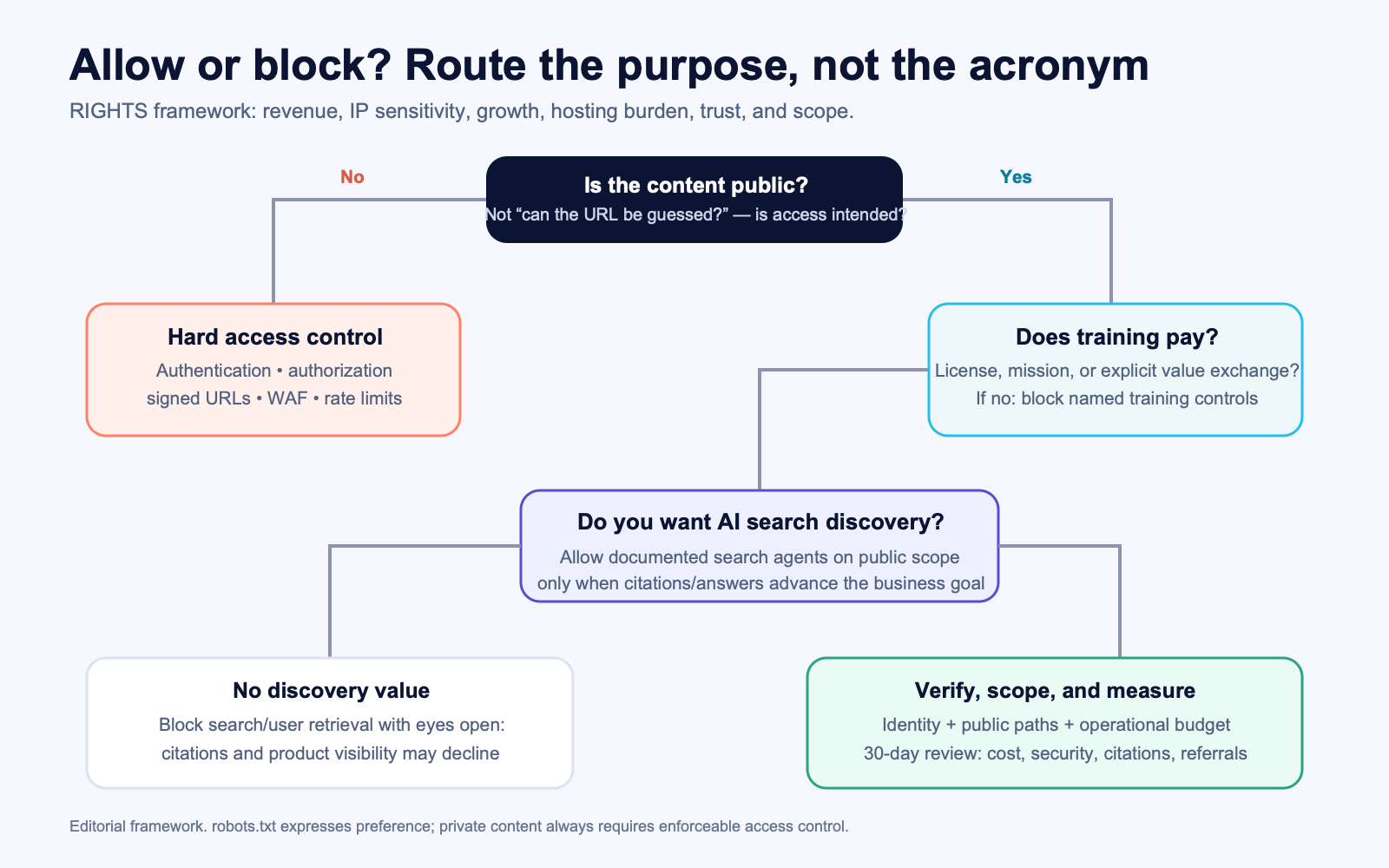
Use the RIGHTS framework before editing a file:
- R — Revenue path: does a citation, answer, referral, or reduced support cost have a measurable route to value?
- I — Intellectual-property sensitivity: is the page commodity information, licensed material, original reporting, proprietary data, or a paid product?
- G — Growth objective: do you want discovery in this product, or is scarcity part of the business model?
- H — Hosting burden: what do requests cost in bandwidth, rendering, database work, cache misses, and operational risk?
- T — Trust level: can the requester be verified beyond a self-declared header?
- S — Scope: which hosts, paths, file types, countries, and environments should the decision cover?
The framework avoids a misleading trade: “give away all content or disappear.” Most sites have multiple classes of content. Public marketing, documentation, and editorial pages can remain discoverable while account areas, exports, expensive search endpoints, licensed archives, and pre-release environments use hard access controls. Training preferences can differ again. Scope the policy to the asset, not only to the vendor.
4. Three practical policy positions
Position A: discovery-first, training opt-out
This is a reasonable starting point for many SaaS, ecommerce, local-service, and lead-generation sites. Public pages exist to be discovered. The company wants citations and user-directed retrieval but sees no demonstrated value in model-training collection. It blocks `GPTBot`, `ClaudeBot`, and `Google-Extended`; it allows or does not explicitly restrict `OAI-SearchBot`, `Claude-SearchBot`, `Claude-User`, `PerplexityBot`, and product-specific user fetchers on public paths. The WAF still protects expensive and non-public endpoints.
Position B: measured open access
A developer platform, open educational project, standards body, or documentation-led product may permit both search and training collection. That decision should still include verified identity, resource budgets, and scope. “Allow” does not mean unlimited concurrency against dynamic search pages, infinite calendar URLs, large exports, or uncacheable rendering. The site can allow a purpose while limiting operational harm.
Position C: rights-first restricted access
A subscription publisher, licensed database, image library, or research service may decide that neither training collection nor answer-layer retrieval creates an acceptable exchange. It can block documented crawlers in `robots.txt`, enforce the decision at the edge, and keep content behind authentication or entitlement checks. The cost is reduced discoverability and potential citations. That cost can be rational when the content itself—not downstream leads—is the product.
The strongest case for blocking all AI-related access is therefore real: referrals may be too small, copied answers may substitute for visits, origin cost may be material, and voluntary controls may be inconsistently honored. Independent evidence supports the caution. A peer-reviewed 2025 ACM study analyzed roughly 3.9 million requests across 36 university sites and ran sequential policy experiments on one site. Its weighted compliance averages fell from 0.609 for a 30-second delay to 0.310 for restricted-endpoint access and 0.307 for disallow-all.6
That evidence does not prove every named platform ignores every rule. The study covered one institution, its strict experiment ran on one site, user-agent identity is self-declared, and behavior was observed in early 2025. It does show why a high-value publisher should not equate a text preference with enforcement. The fair answer to the block-all position is not blind openness. It is purpose separation plus controls appropriate to the content’s value.
5. `robots.txt` is a routing policy, not a lock
RFC 9309 standardizes how compliant crawlers retrieve and interpret `/robots.txt`. It also says the rules are not access authorization and explicitly warns that the protocol is not a substitute for security measures.5 Anyone can read the file. Anyone can request a public URL. A badly behaved client can skip the file or claim another user agent. Sensitive content needs authentication, authorization, unguessable signed URLs where appropriate, or network-layer enforcement.
The standard creates several implementation traps:
- Scope is per scheme, host, and port. The file on `https://example.com` does not govern `https://docs.example.com` or a non-standard port.
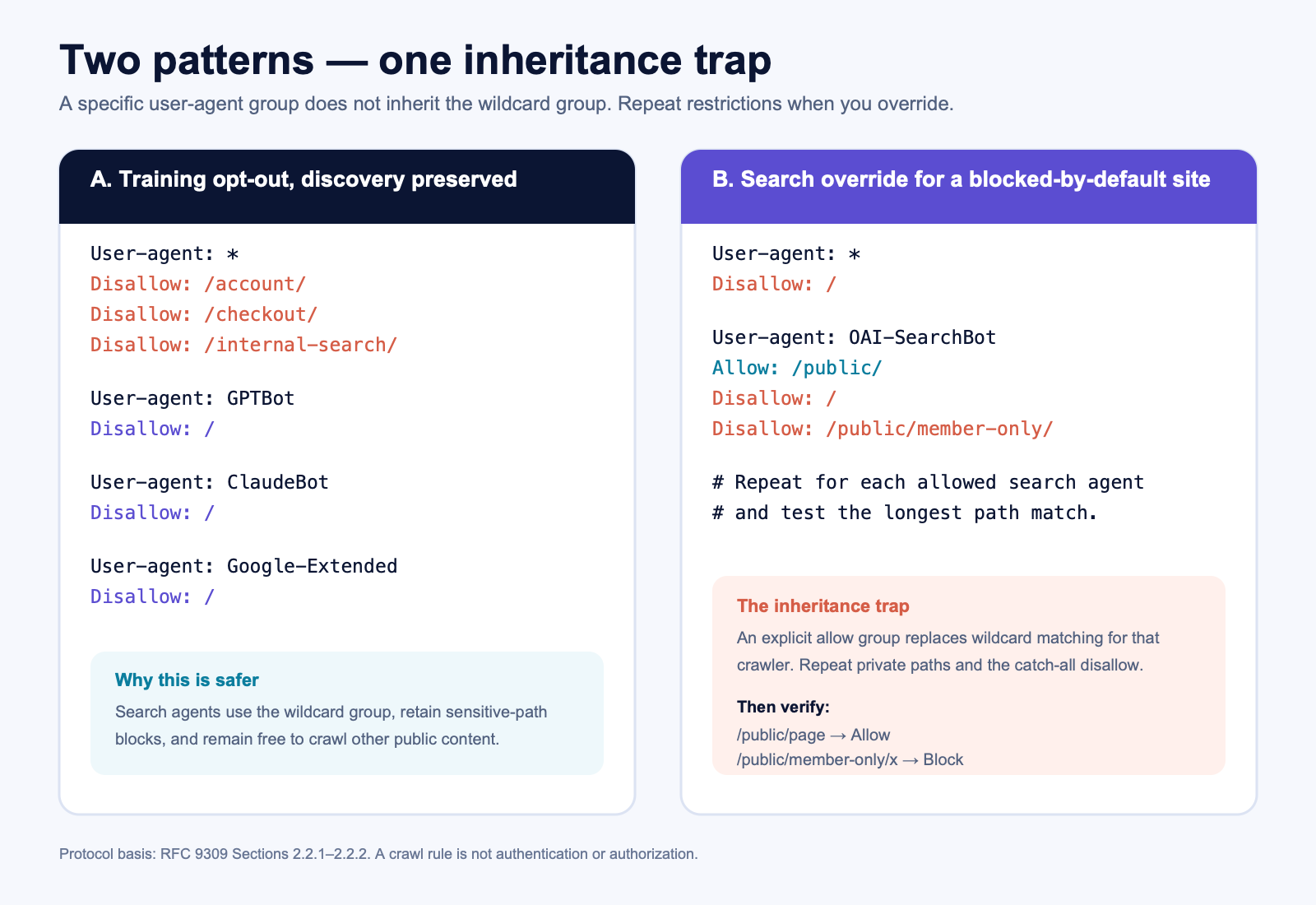
- Specific groups do not inherit wildcard rules. A crawler uses the most specific matching group. If you add a named group, repeat the sensitive-path rules that crawler must retain.
- The longest path match wins. Test exceptions rather than assuming visual order decides the result.
- A missing 4xx file can mean allow. Do not return 403 for `/robots.txt` and assume the crawler interprets that as “blocked.” RFC 9309 permits access when the file is unavailable.
- A 5xx file can temporarily mean disallow all. A broken deployment can remove compliant crawlers until the file is reachable again.
- Caching introduces delay. The standard says a cached copy normally should not be used for more than 24 hours, but empirical work has observed slower re-checking among some bot categories.
6. Tested `robots.txt` patterns
Pattern 1: block documented training collection, preserve public discovery
This pattern avoids explicit search-agent groups, so public search agents fall through to the wildcard group and retain the common sensitive-path restrictions. It expresses a model-training opt-out while leaving public content crawlable.
User-agent: *
Disallow: /account/
Disallow: /checkout/
Disallow: /internal-search/

User-agent: GPTBot
Disallow: /

User-agent: ClaudeBot
Disallow: /

User-agent: Google-Extended
Disallow: /

Sitemap: https://www.example.com/sitemap.xml
Notice what is absent: no `PerplexityBot` training block, because Perplexity’s current primary documentation describes that agent as search, not foundation-model training. No `Googlebot` block, because Googlebot controls Google Search. No assumption that a `ChatGPT-User` entry will govern every user-triggered action.
Pattern 2: override a broad wildcard block for selected search agents
Some licensed publishers block automated access by default and selectively allow search agents on a public preview directory. In that case, every specific group must repeat the paths that remain private. A named group does not inherit `User-agent: *`.
User-agent: *
Disallow: /

User-agent: OAI-SearchBot
Allow: /public/
Disallow: /
Disallow: /public/member-only/

User-agent: Claude-SearchBot
Allow: /public/
Disallow: /
Disallow: /public/member-only/

User-agent: PerplexityBot
Allow: /public/
Disallow: /
Disallow: /public/member-only/

Sitemap: https://www.example.com/public-sitemap.xml
The longest matching rule lets `/public/` through while the longer `/public/member-only/` path remains blocked. The catch-all `Disallow: /` keeps all other paths closed for that specific agent. This is a crawl preference, not entitlement enforcement; member content must still require a valid session or token.
Pattern 3: stage the change before enforcement
For a live site, deploy the policy signal first, confirm that `/robots.txt` returns `200`, plain text, and the expected body on every host, then monitor for at least 24 hours before interpreting behavior. OpenAI says search adjustments can take about 24 hours; Perplexity says changes may take up to 24 hours; RFC 9309 allows normal caching for up to that window. The ACM study found that some bots re-checked less frequently, so a longer observation window may be necessary before declaring non-compliance.
7. Verify requests before the WAF makes a promise
A user-agent header is a claim written by the requester. Google warns that it can be spoofed. The ACM study found traffic patterns consistent with possible spoofing, although its ASN heuristic could not prove who generated each anomalous request. A 2026 controlled preprint adds a different warning: in 200 prompted trials across ten assistant configurations, several systems used generic user agents or produced page access that diverged from the visible answer.7
The preprint is useful for method, not a permanent vendor scorecard. It tested five repetitions per condition, one retrieval prompt, simple pages, and specific rapidly changing product configurations. Its strongest operational lesson is that “the assistant did not quote the page” does not mean “the system did not fetch the page.” Likewise, failure to fetch a blocked page is not proof of compliance unless the same configuration can fetch a comparable allowed page. Use positive and negative controls.
Request-verification checklist
- Capture the raw evidence: timestamp, host, path, query class, response status, bytes, user agent, source IP, ASN, TLS/client fingerprint if available, cache status, WAF action, and request ID.
- Resolve the documented purpose: training, search, user-triggered agent, other, or unknown. Save the source URL and the date reviewed.
- Verify identity: use the operator’s current published IP JSON, documented forward-and-reverse DNS process, cryptographic Web Bot Auth signature, or a trusted CDN verified-bot field. Cloudflare’s current taxonomy separates Search, Agent, and Training behaviors.8
- Require both identity and purpose: a matching IP without the expected user agent, or the expected header from an unverified address, should not receive a privileged bypass.
- Test access outcomes: a public 200 page, a deliberately disallowed crawl path, an authenticated path, and an expensive endpoint. Do not run destructive tests against production transactions.
- Review edge precedence: confirm whether an allow/skip rule bypasses rate limiting, managed security rules, authentication, or only a specific bot challenge. “Allow” should not mean “skip every defense.”
- Keep unknown automation constrained: challenge, rate-limit, or block by behavior. Never elevate it because its header contains a famous bot name.
8. A worked policy for a mixed SaaS site
Consider a SaaS company with five surfaces: marketing pages, public help documentation, a customer dashboard, an internal site-search API, and downloadable audit reports. The growth team wants citations. The legal team does not want future public material collected by documented training crawlers. The infrastructure team has seen bursts against site search.
The policy owner records the decision in one table:
| Surface | Training | Search / user retrieval | Enforcement | Success signal |
|---|---|---|---|---|
| Marketing | Disallow named training controls | Allow verified discovery and user agents | Cache + fair rate limit | Citations, referrals, qualified visits |
| Public docs | Disallow | Allow | Cache + monitor versions | Correct citations, assisted support resolution |
| Dashboard | Not applicable | Not public | Authentication and authorization | Zero anonymous content responses |
| Site-search API | Disallow | No crawler access | Token + rate limit + WAF | Stable latency and cost |
| Audit reports | Disallow | Only customer-directed sharing | Signed expiring URL | No unauthorized fetches |
The team deploys Pattern 1, verifies the current OpenAI and Perplexity IP lists at the edge, uses its CDN’s verified-bot identity for supported agents, and does not create a WAF matcher for `Google-Extended`. Search discovery receives a narrow skip only for generic bot challenges on public cached paths; it does not bypass authentication, API throttles, or managed exploit rules.
This worked example resolves the internal conflict without pretending the benefit is known in advance. The company has not “chosen AI.” It has chosen a documented value exchange per surface and created evidence that can justify changing the policy.
9. What to measure for 30 days
A crawler policy should have an expiry date unless the evidence renews it. For 30 days, maintain a weekly policy scorecard with one row per verified agent and content class. Record:
- requests, unique URLs, bytes transferred, cache-hit rate, origin requests, render/database time, and peak requests per minute;
- response distribution: 2xx, 3xx, 403, 404, 429, and 5xx;
- `robots.txt` fetch time and the policy version the crawler could have cached;
- verified versus claimed identity, including mismatches and generic user agents;
- public-content coverage by path group and any attempted access to excluded or authenticated paths;
- referrals from documented platform domains, landing pages, engaged sessions, signups, leads, revenue, and support deflection where measurable;
- manually sampled citations or answers for accuracy, attribution, freshness, and whether the cited URL was actually accessible under policy.
Do not invent a crawler-to-referral “ROI” by valuing every request or every citation equally. Training crawls may produce no observable short-term referral at all. Search crawling is an input to eligibility, not proof of a citation. User-triggered retrieval may help a user without sending a visit. The scorecard should expose these different outcomes rather than force them into one conversion rate.
Thirty-day measurement template
- Days 1–3 — baseline: inventory all current rules, snapshot the file on every host, label observed agents, and measure origin cost before changing access.
- Days 4–7 — signal: deploy the new `robots.txt`, validate its status/content type/body, and avoid broad WAF changes while compliant agents refresh caches.
- Days 8–14 — enforce: apply identity-plus-purpose WAF rules to high-cost or rights-sensitive paths. Compare an allowed public control URL with a disallowed control URL.
- Days 15–21 — value: sample platform answers and referrals; verify that discovery agents can fetch current canonical pages and that private paths remain inaccessible.
- Days 22–30 — decide: keep, narrow, or reverse each purpose-level rule. Record the decision owner, evidence, uncertainty, and next review date.
For a small site, daily referral or citation counts will be sparse. Aggregate weekly, use a longer window if necessary, and report “insufficient evidence” instead of reading meaning into two visits. Security findings do not need large samples: one verified anonymous response containing private data is material. Commercial value usually does.
Change-course thresholds
- Tighten immediately if a supposedly verified identity fails validation, authenticated content is exposed, crawling destabilizes the service, or disallowed high-value content is repeatedly fetched after propagation and verification checks.
- Narrow access when a useful search agent creates excessive origin load on low-value paths: keep public canonical pages open, block faceted/infinite spaces, and rate-limit expensive endpoints.
- Reopen discovery when the team blocked a search agent while expecting that platform’s citations, provided the content model benefits from discovery and access can be verified safely.
- Keep the training block when no intentional value exchange exists. Absence of referrals is not proof of harm, but you do not need a fabricated benefit to maintain a stated rights preference.
10. What the evidence does not show
Claims this guide does not support
- “Blocking GPTBot removes a site from ChatGPT search.” OpenAI documents a separate search agent.
- “Google-Extended traffic can be found in access logs.” Google says it is a control token without its own HTTP user agent.
- “PerplexityBot is currently documented as a training crawler.” Perplexity’s current first-party page describes it as search and says it is not used for foundation-model training collection.
- “A `Disallow` rule prevents access.” RFC 9309 says the protocol is not authorization; enforcement requires another layer.
- “No quote in an answer means no fetch occurred.” The controlled preprint observed access and answer correctness diverging.
- “The compliance studies prove a permanent vendor ranking.” They test bounded sites, dates, prompts, and configurations, with identity and generalizability limits.
- “Allowing a crawler guarantees citations or traffic.” It creates eligibility for documented functions, not a placement promise.
- “One policy fits every URL.” Public discovery pages, licensed content, dynamic APIs, and authenticated customer data have different value and risk.
11. What to do this week
- Name one owner. Crawler policy spans growth, security, infrastructure, and rights; one person must own the final matrix and review date.
- Inventory every host. Fetch `/robots.txt` on the apex, `www`, documentation, shop, media, API, and staging hosts. Record status, content type, redirects, and body.
- Build the purpose matrix. Start with current first-party documentation, not a copied “AI bot list.” Record the access date because names and behavior change.
- Classify content. Separate public growth pages, public reference content, licensed/paid content, dynamic-cost endpoints, and private data.
- Choose one of the three positions per class. Discovery-first training opt-out, measured open access, or rights-first restriction.
- Validate syntax and group behavior. Test representative allowed and disallowed URLs for every named group; confirm specific groups retain sensitive-path restrictions.
- Stage WAF enforcement. Log first where safe, verify identity, then enforce. Preserve authentication and exploit protection for every bot.
- Start the 30-day scorecard. Measure access cost, verified identity, content scope, citations/referrals, and security outcomes separately.
Keep a policy record beside the configuration
A `robots.txt` file shows the current instruction but not why the instruction exists. Keep a short, versioned policy record in the same change workflow as the edge configuration. For each agent or control token, record the documented purpose, source link, review date, content scope, chosen action, enforcement layer, decision owner, and next review. Add the exact test URLs and expected results. When a platform changes an agent name or purpose, the team can update one evidence record instead of reverse-engineering an old rule from comments.
Treat vendor-specific or emerging metadata as supplementary. A new declaration can describe intended reuse more finely, but it does not replace RFC 9309 behavior, access logs, authentication, or WAF enforcement unless the receiving system explicitly supports and applies it. Avoid adding an `llms.txt` file, content-use signal, or custom header and then reporting that the site is protected. The relevant question is always: which requester reads this signal, what documented action follows, and what independent observation would reveal a failure?
Finally, include rollback. Store the previous `robots.txt` body and WAF rule IDs, define who can restore them, and state the trigger. A broad crawler block can remove discovery quietly; a broad allow exception can bypass controls quietly. Rollback should require minutes, not a new cross-team debate. After restoration, re-run the allowed public URL, disallowed control URL, authenticated URL, and rate-limit check so the team knows that both growth and security behavior returned to the intended state.
The durable policy is not “block AI.” It is: protect private and expensive resources with enforceable controls; state training preferences explicitly; keep useful discovery open only where it advances the content’s business purpose; and verify the requester before granting an edge exception. That policy can survive the next bot rename because it is organized around purpose, value, and evidence rather than a static list.
Primary references
- OpenAI, “Overview of OpenAI Crawlers”, accessed August 14, 2026.
- Anthropic, “Does Anthropic crawl data from the web, and how can site owners block the crawler?”, April 7, 2026.
- Google, “Google’s common crawlers”, updated July 14, 2026.
- Perplexity, “Perplexity Crawlers”, accessed August 14, 2026.
- Koster et al., RFC 9309, “Robots Exclusion Protocol”, September 2022.
- Kim et al., “Scrapers Selectively Respect robots.txt Directives: Evidence From a Large-Scale Empirical Study”, ACM IMC 2025, DOI 10.1145/3730567.3764471.
- Lopez-Fonseca et al., “Do Generative AI Assistants Respect robots.txt? Tracing Web Access Beyond Visible Answers”, arXiv preprint v2, July 19, 2026.
- Cloudflare, “Verified bots”, updated July 1, 2026.