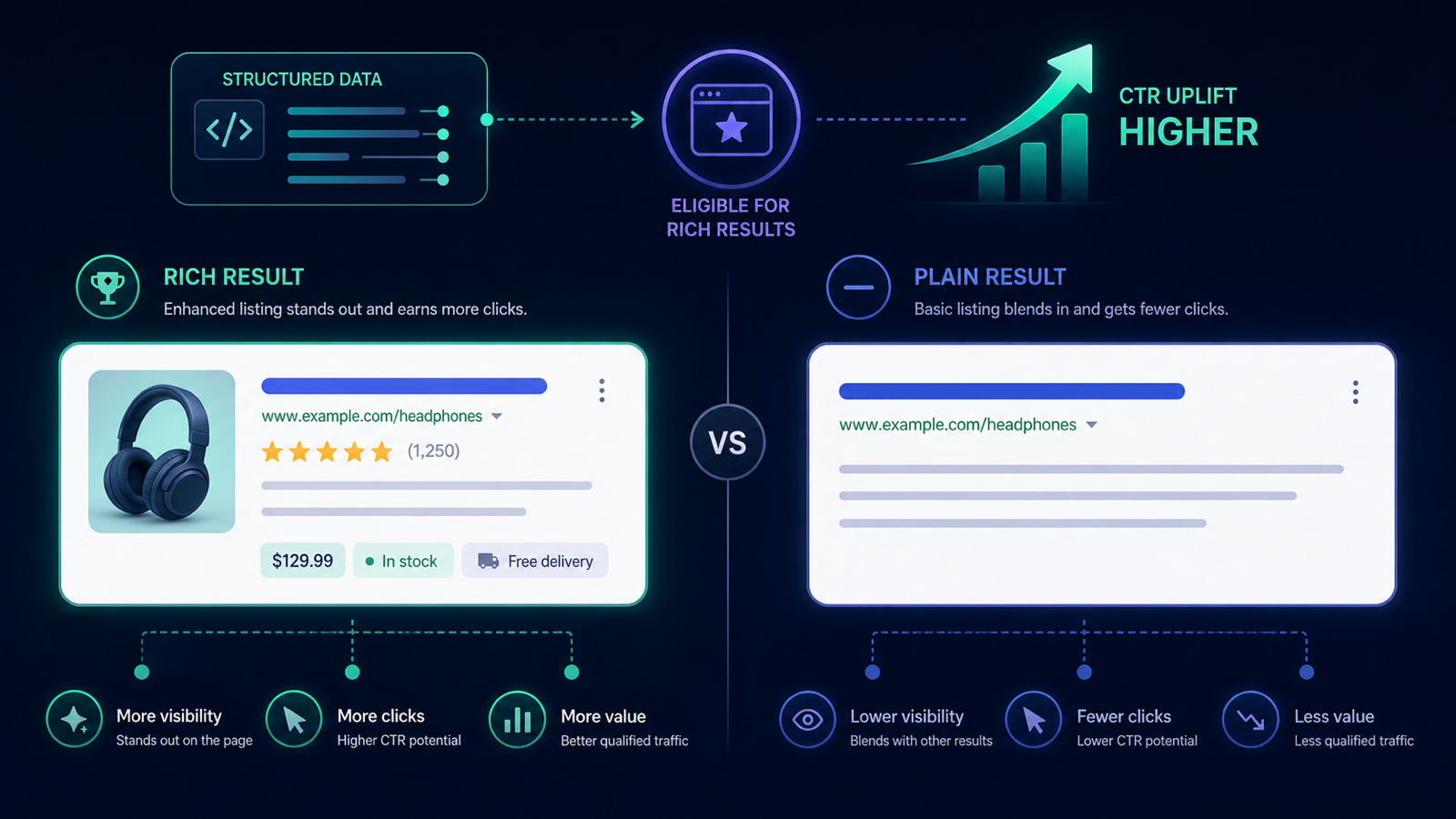
Schema.org is your direct line into Google's rich results, AI Overviews, and entity graph.
A single missing required property — for example, priceCurrency on a Product —
disqualifies the entire markup from rich result eligibility.
Most teams add schema once and never re-validate, until rich results disappear and traffic drops with them.
Step 1. Site-wide schema scan
Site → Schema parses every page's JSON-LD, plus microdata and RDFa where present. For each markup it records: type, required properties, recommended properties, and validation status.
Step 2. Filter by eligibility, not just validity
Google rich-result eligibility is stricter than schema.org's spec. The 2-UA validator runs both checks:
- Schema.org validity — does the markup parse as valid JSON-LD?
- Rich result eligibility — does it qualify for SERP enhancement?
Step 3. The six schema types to audit first
- Product —
name,image,offers.price,offers.priceCurrency,offers.availability. - Article —
headline,image,datePublished,author. - FAQ — at least two Question entries with non-empty Answer.
- BreadcrumbList — every level with
position,name,item. - LocalBusiness —
name,address,telephone,geo. - Review and AggregateRating — must be on the item being reviewed, not on a list page.
Step 4. Use the Schema Validator Pro
The Pro validator catches issues Google's own tool misses:
cross-page consistency (same product, different price in markup vs page),
entity linking via sameAs,
and graph-level conflicts when multiple JSON-LD blocks declare the same entity differently.
Three schema mistakes that lose rich results
- Fake reviews or star ratings — Google manually penalizes; the risk far outweighs the rich-result reward.
- Schema does not match visible content — flagged as deceptive; rich results revoked, sometimes for the whole domain.
- Multiple JSON-LD blocks contradicting each other — Google picks one unpredictably; behavior is non-deterministic.
JSON-LD over microdata in 2026
JSON-LD is Google's preferred format and the implementation pattern with the lowest engineering overhead.
Place blocks in <head> or <body> — both work, with <head> parsing earlier.
Schema does not directly rank your pages higher; it earns rich results that drive CTR, powers AI Overviews,
and contributes to entity-level understanding that compounds across queries.
Use the free Schema Validator Pro for single-page validation, or run full-site recurring validation inside any 2-UA project.