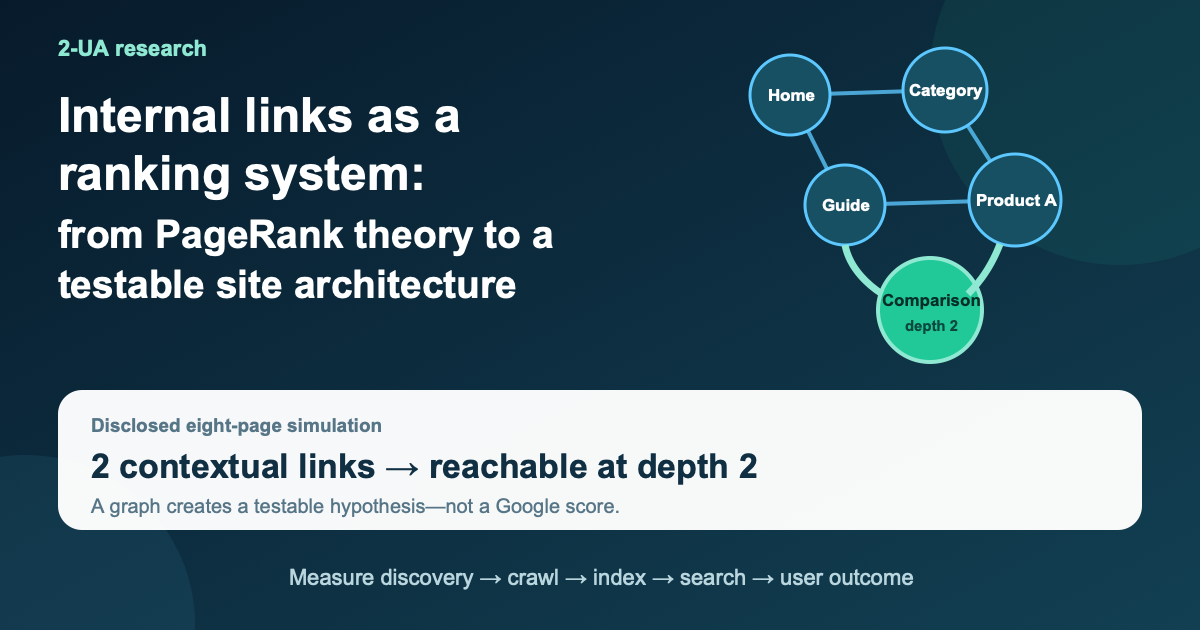
A merchandising team has one development slot before a seasonal launch. Its new comparison page answers the question customers ask before buying, but the page sits outside category navigation and no published guide links to it. One proposal adds the page to the global menu. Another adds 200 keyword-matched links across old articles. A third leaves the templates alone and inserts two contextual links at the moments when a reader needs the comparison.
A count-based audit can make the second proposal look strongest. A PageRank story can make any of the three sound scientific. Neither resolves the costly decision. The team needs to know whether the page is discoverable through a real user path, whether its internal treatment matches its intended importance, whether the links are technically crawlable, and what evidence would show that the change helped. Those are architecture and measurement questions. They are not requests for a secret Google score.
This guide builds that decision system from the original PageRank model, an independent academic treatment, current Google documentation, and web standards. It uses a reproducible eight-page simulation to explain graph mechanics, then deliberately steps away from the model when the evidence no longer supports precision. The result is a workflow you can run on a small publication, an ecommerce catalog, or a large platform without pretending that an internal crawl is a copy of a search engine.
The decision is not “how many internal links?”
Google’s current link guidance says links help it find new pages and act as a relevance signal. It also says every page you care about should have a link from at least one other page, while explicitly rejecting a magical ideal number of links per page. That combination matters. Zero crawlable inlinks is a clear structural condition. Ten versus 12 links is not a published optimization target.
The useful decision is therefore relational: does the route offered by the site match the route a person and a crawler should be able to follow? A product comparison may deserve contextual links from a buying guide and the two products it compares. It may not deserve a place in a global menu seen on every URL. A temporary campaign landing page may be intentionally absent from permanent navigation. An orphan report cannot decide between those cases; it can only expose them for review.
Start with the destination’s role. Is it a canonical page with unique value? Which user question does it resolve? From which page would that question naturally arise? How long should the destination exist? Only then should graph metrics enter the conversation. Otherwise, the metric becomes the objective and the site accumulates links that no one needed.
What PageRank actually models
Brin and Page’s 1998 search-engine paper described a system that used web hyperlink structure as one input to retrieval. In its PageRank model, a page receives more weight when linked by pages that themselves carry weight, and a linking page divides its contribution across its outgoing links. The paper described iterative calculation with a damping factor; it did not say that every link contributes an equal fixed unit.
The Stanford information-retrieval text gives the clean mathematical interpretation. Imagine a random surfer who usually follows one outgoing link, chosen uniformly, but sometimes teleports to any page. Pages visited more often in the steady state receive a larger PageRank share. Teleportation and special handling for pages with no outlinks make the transition matrix converge to a probability distribution. In a closed graph, the shares sum to one.
Three consequences are useful for architecture work. First, an inlink is not independent of its source: where it comes from and what else the source links to affect the model. Second, adding an outlink redistributes probability rather than manufacturing a new total. Third, cycles, dead ends, and disconnected components change the distribution in ways that raw inlink counts miss. These are mathematical properties of the disclosed model. They are not claims about hidden modern Google weights.
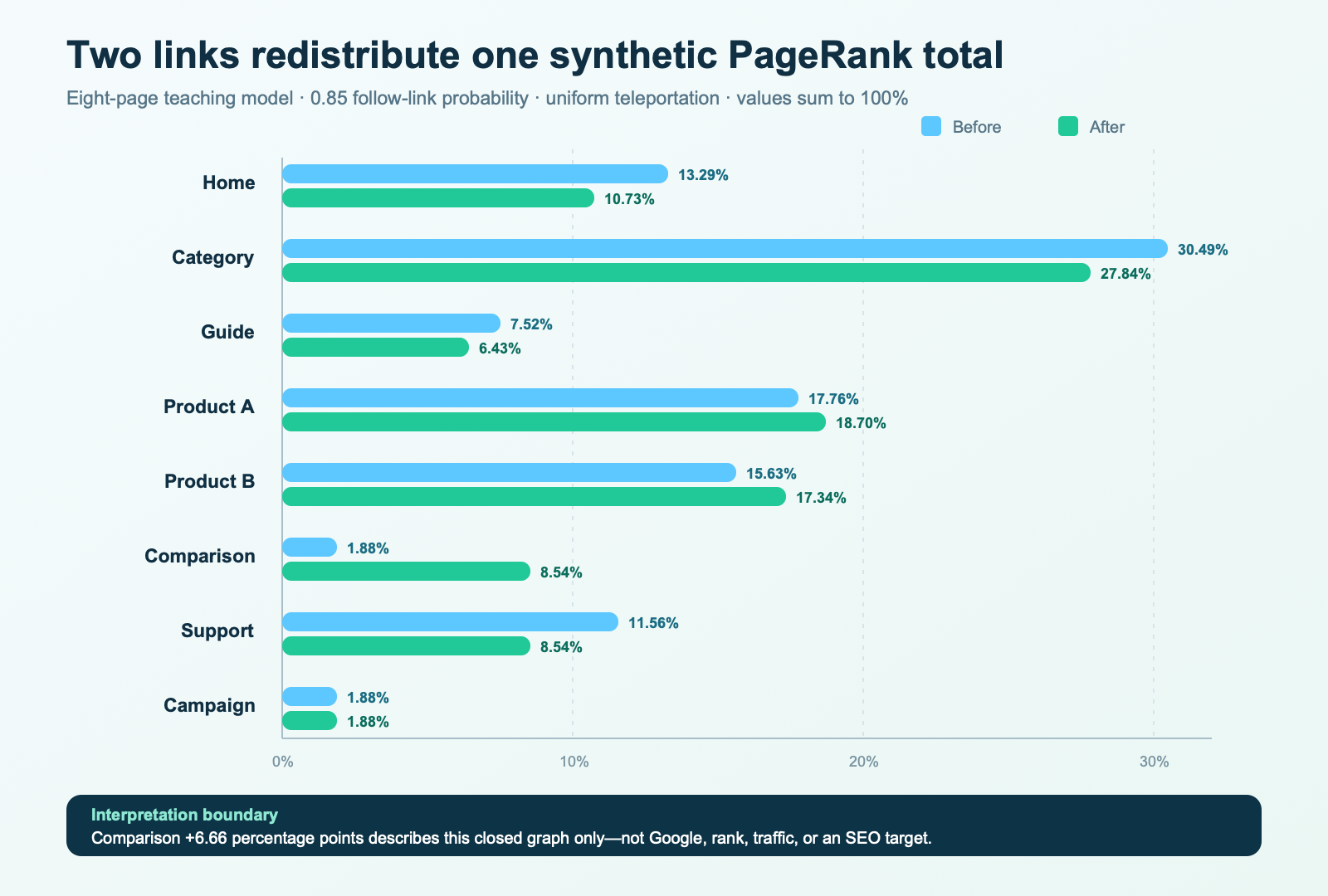
The simulation uses eight pages, a 0.85 probability of following a link, uniform 0.15 teleportation, equal splitting across outlinks, and power iteration to a strict convergence threshold. Before the change, Comparison links out to Product A and Product B but has no internal inlink; Campaign also has no inlink. After the change, Guide and Product A each add one contextual link to Comparison. Nothing else changes. The complete graph, formula, input edges, output vector, and rounding rules are preserved in the visual manifest and source ledger.
The model produces a strong hypothesis: the site’s own structure previously treated Comparison as peripheral even though the business brief called it important. It does not produce the next sentence many SEO reports want to write: “Google will increase the page’s rank by 6.66 points.” Google does not expose such a metric, the current web-scale graph is not this internal graph, and ranking uses many signals beyond links.
What current Google evidence does—and does not—say
Historical PageRank explains why graph structure can carry information. Current platform documentation defines what a site owner can safely act on. Google says it primarily discovers pages through links from pages it already knows, and gives the example of a category hub linking to a new post. It also separates discovery from crawling, indexing, and serving: a discovered URL is not guaranteed to pass through the later stages.
For ecommerce sites, Google is unusually direct. Its site-structure guidance says navigation and cross-page links can affect its understanding of the site, and that the number of links required to reach a page plus the number of links to that page can inform relative importance. It recommends crawlable category-to-subcategory-to-product paths and warns that Googlebot generally does not submit searches into a site search box. A product available only through search is therefore not equivalent to a linked product.
The same guidance does not publish a preferred click depth, a minimum inlink count, or a conversion from those measurements into rankings. Google’s Starter Guide currently states that PageRank uses links and remains a fundamental algorithm, but that Search has many ranking signals and PageRank is only one. The broader Search documentation says relevance is determined by hundreds of factors, including query and user context. A graph score is therefore a diagnostic of your architecture, not a complete model of search serving.
Anchor text belongs inside the same boundary. Google says concise, relevant link text helps people navigate and helps it understand the destination. That supports truthful labels such as “compare trail shoes” when the link really opens a trail-shoe comparison. It does not support repeating an exact commercial phrase across every template. The internal link must make sense in its source context even if search engines disappeared tomorrow.
Five measurements, five different questions
A reliable audit refuses to compress unlike facts into one score. Measure at least five layers, keep their definitions visible, and use each to answer its own question.
- Reachability: can a crawler starting from approved entry pages reach the canonical URL through standard crawlable links? An unreachable page may be accidental, intentionally isolated, newly published, or missing from the crawl because the crawl boundary was incomplete.
- Shortest click depth: what is the minimum number of followed links from the selected entry page to the destination? Depth is a property of the chosen crawl graph, not a universal importance scale. Changing the start set or excluding navigation changes the answer.
- Unique internal inlinks: how many distinct canonical source pages link to the destination? Count page-to-page relationships, not duplicate DOM occurrences, unless repeated placements are the question being investigated.
- Graph centrality or simulated PageRank: how does link distribution behave under an explicitly defined model? Use it to compare versions of the same crawl, never as a claimed Google value or a benchmark across unrelated domains.
- Context and anchor fit: does the source create a credible user next step, and does the anchor set an accurate expectation? This requires editorial review; a crawler can inventory text but cannot decide whether the link helps a real reader complete a task.
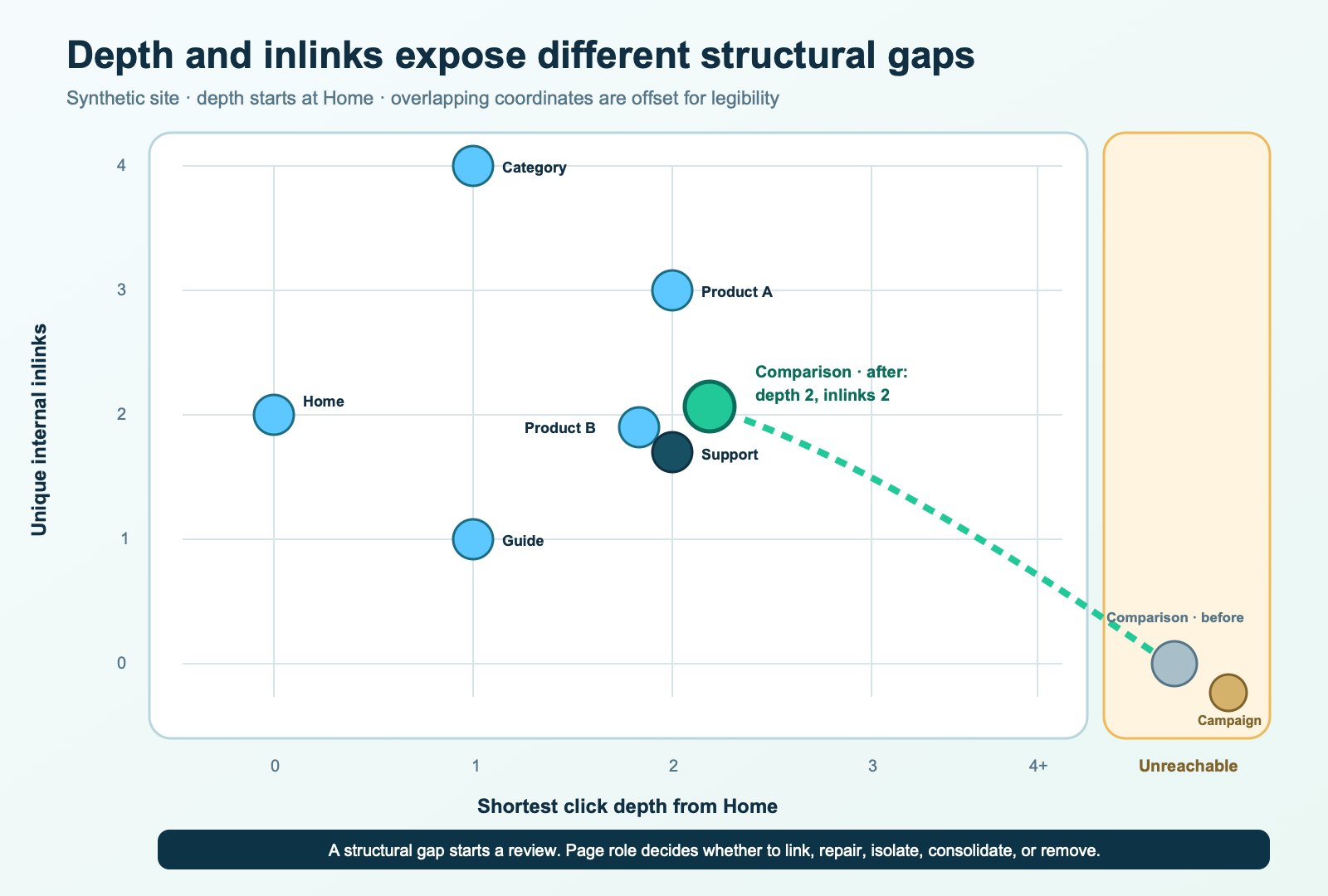
The matrix prevents a common diagnostic failure. A page at depth two may still have only one fragile inlink from a low-traffic pagination page. A page with 500 template inlinks may be easy to reach but contextually irrelevant across most sources. A page with zero crawl inlinks may be an abandoned asset, a paid landing page, a private workflow, or an error in navigation. Each condition produces a different owner and remediation.
Build the crawl graph before evaluating it
Graph analysis is only as honest as its input. Define the graph contract before generating a report. Record the crawl date, device profile, rendering mode, start URLs, authentication state, robots behavior, canonical handling, redirect handling, parameter rules, and whether links from headers, footers, pagination, XML sitemaps, structured data, and rendered components are included.
Use standard HTML semantics as the minimum technical boundary. The WHATWG HTML Standard says an a element with a valid href
creates a hyperlink; without href, it does not. Google’s own extraction guidance similarly recommends an a href that
resolves to a real web address. A clickable span, an anchor with only an event handler, or a router token without a usable URL may work for
one browser session while failing the crawler contract.
Resolve relative URLs according to a defined base and preserve both the observed URL and normalized analysis key. RFC 3986 supplies deterministic reference-resolution rules, but application equivalence is still site-specific. Lowercasing a case-sensitive path, deleting a meaningful parameter, or merging locale variants can manufacture edges that do not exist. Normalize conservatively and make every transformation reversible.
Finally, compare mobile and desktop or rendered and source graphs when the implementation can vary. Google’s crawling troubleshooting guidance says separate mobile HTML should expose the same intended link set and notes that limiting mobile links can slow discovery. A desktop-only crawl cannot close a mobile discovery question. Treat parity differences as their own defects rather than averaging the two graphs.
The link-opportunity framework
An opportunity begins with a contradiction: the page matters to users or the business, yet the site graph does not support that role. It becomes an implementation candidate only after four gates pass. This keeps the team from turning every low-centrality node into a template link.
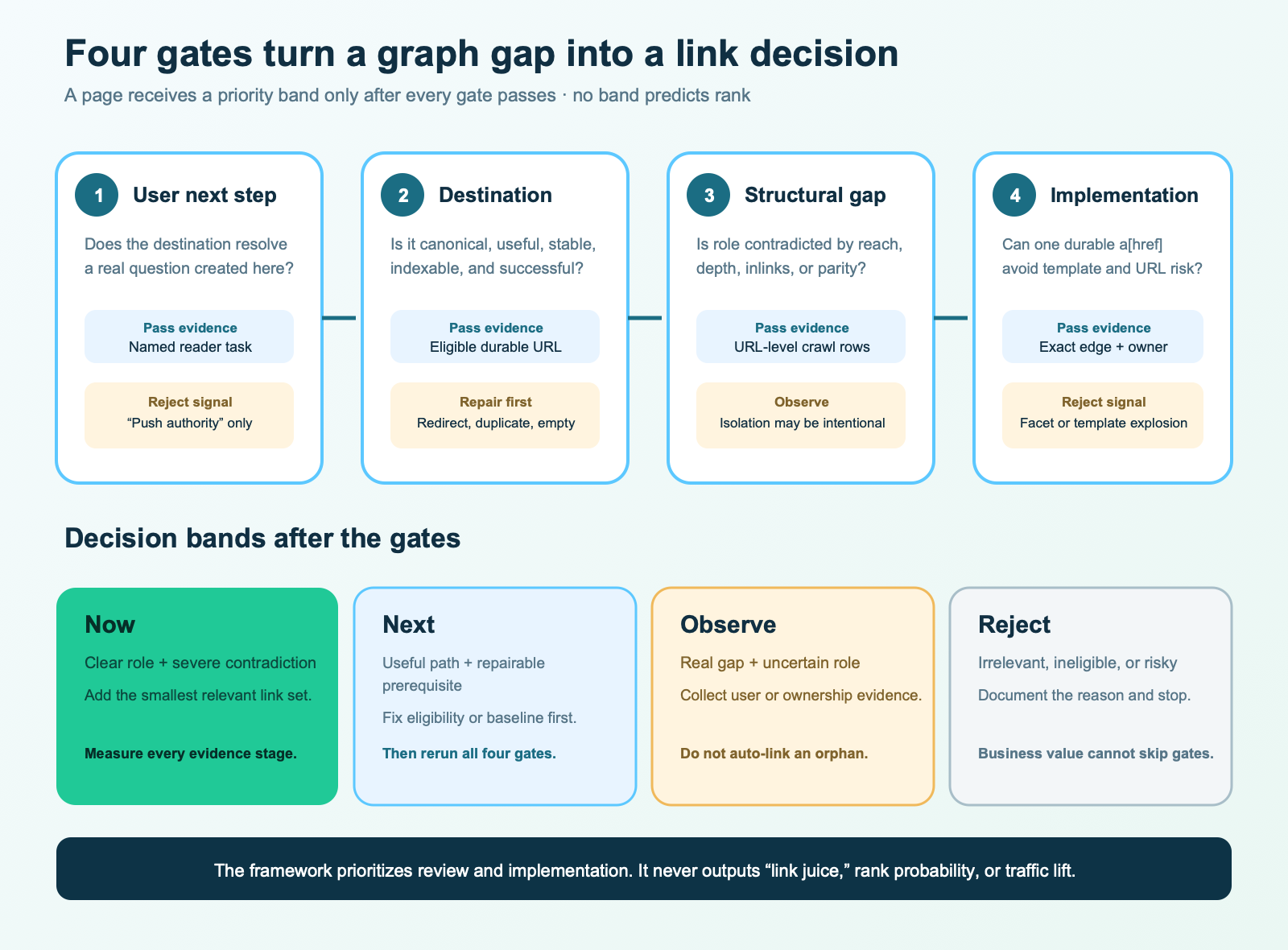
Gate 1: user next step
Name the reader’s state on the source page and the next question the destination resolves. “Readers comparing waterproof materials need the durability test” is testable. “We want to push authority to the money page” is not a user need. If a writer cannot complete the sentence “this link helps because…” without mentioning rankings, reject the candidate or find a better source.
Gate 2: destination eligibility
Confirm that the destination is the preferred canonical, returns the expected successful response, is indexable if search visibility is the goal, contains the promised information, and has a stable URL. Do not spend editorial attention linking toward a redirect chain, duplicate parameter URL, empty category, expired campaign, or page that contradicts its own canonical. Fix the destination first.
Gate 3: structural gap
Record the observed mismatch: no internal inlink, unreachable from the approved entry set, excessive depth for its role, few relevant sources, a template-dependent path, or a mobile / rendered parity failure. Include the URL list behind every count. “Two inlinks” is auditable; “internal authority 17” is not unless the complete formula and graph are available.
Gate 4: implementation integrity
Specify a durable a[href], a concise anchor that describes the destination, the exact source placement, the template scope, and a rollback
owner. Confirm that the change does not create a facet explosion, pollute every page with an unrelated commercial link, or hide essential links from
mobile users. A useful link that accidentally generates thousands of parameter combinations is not a clean win.
Assign a decision band
| Band | Use when | Action | Do not infer |
|---|---|---|---|
| Now | All gates pass; the page has a clear role and a severe structural contradiction. | Add the smallest relevant link set and start the measurement record. | A guaranteed ranking or traffic lift. |
| Next | The link is useful, but the destination or measurement baseline needs a small fix. | Repair the prerequisite, then recheck the gates. | That link volume can compensate for a weak destination. |
| Observe | The structural gap is real, but user relevance or permanence remains uncertain. | Collect navigation, search, or support evidence before changing templates. | That every orphan is an error. |
| Reject | The destination is ineligible, the source is irrelevant, or the change expands harmful crawl space. | Document the reason and remove it from the active backlog. | That a high business value overrides user and technical integrity. |
Worked example: the comparison page no navigation reaches
Return to the eight-page retail site. Home links to Category and Guide. Category links to Product A and Product B. Guide links to Category, Product A, and Support. Product A links to Category and Support; Product B links back to Category. Comparison links to both products, Support and Campaign link to Home, but neither has an internal inlink. The crawl starts at Home and follows only canonical HTML links.
The product owner marks Comparison as a durable decision page. Support transcripts show that shoppers ask which product fits long trips, and the Guide already explains the tradeoff without presenting the side-by-side evidence. Comparison passes the eligibility gate: it is canonical, indexable, complete, and stable. It fails the structural gate because it is unreachable from Home and has no inlinks. Campaign also fails that structural check, but its owner confirms it is a short-lived paid landing page with no permanent browse role. Campaign moves to Observe; it does not receive a token link.
The team rejects the global-menu proposal because Comparison is not a universal top-level task. It rejects the 200-link proposal because most source pages do not create the relevant question. It adds two links: Guide → Comparison beside the tradeoff explanation, and Product A → Comparison near the choice between the two products. Each anchor describes the comparison rather than repeating an exact keyword formula.
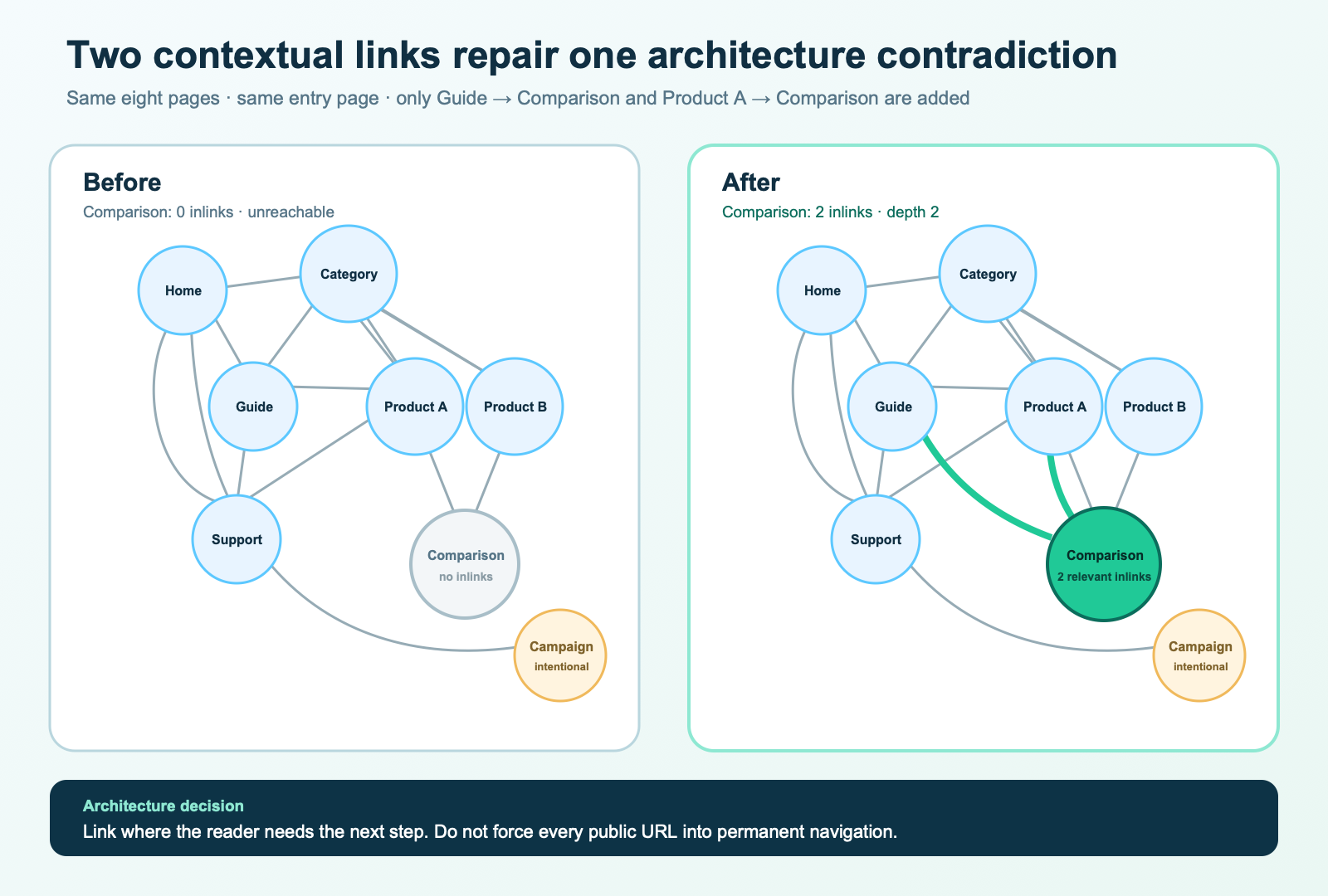
In the disclosed PageRank simulation, Comparison moves from 1.88% to 8.54% and becomes reachable at depth two. Home, Category, Guide, and Support lose modeled share because the total remains fixed and two sources now divide their outgoing probability across more links. Product A and Product B gain slightly because Comparison already points to them. This is why “add more links everywhere” is not even a faithful reading of the simple model.
The team’s release hypothesis is deliberately narrower: if crawlable contextual paths were the missing condition, the next independent crawl should find Comparison from both source pages, mobile and desktop rendered graphs should agree, server logs may later show verified crawler requests, and URL Inspection may eventually show post-change crawl and index evidence. Search impressions and qualified comparison use are downstream outcomes. No single observation is allowed to stand in for the whole sequence.
Choose the source before writing the anchor
Link-opportunity tools often start with a destination and search the corpus for matching words. That can produce candidates, but textual overlap alone is a weak source-selection rule. Prefer pages where the destination resolves a question created by the source. A pricing explainer can link to the plan comparison at the decision point. An article mentioning the word “plan” in a project-management context cannot.
Review repeated components separately from editorial body links. Header, footer, breadcrumb, category grid, recommendation module, pagination, and body copy perform different navigation jobs. Preserve a placement label in the crawl export. A destination with 1,000 footer occurrences and no contextual inlink should not be described merely as having “1,000 strong internal links.” Likewise, a breadcrumb can establish hierarchy without answering a lateral comparison need.
Anchor text should set a truthful expectation in reasonably concise language. Vary it when the source context genuinely varies, not to manufacture an artificial distribution. Avoid empty anchors, bare icons without useful alternative text, generic “click here” where a descriptive label fits, and keyword strings that make the sentence worse. Google’s guidance centers both people and machine understanding; the writing should do the same.
Architecture patterns that survive the evidence boundary
Hub-to-detail paths
A hub lets a reader choose among a coherent set of detail pages and gives crawlers a durable route to them. Ecommerce categories, documentation indexes, research collections, service overviews, and location directories can all use this pattern. The hub must contain actual navigational links, not only a search form or client-side control that never exposes destination URLs.
Contextual lateral paths
Lateral links connect pages at the moment their relationship matters: alternative products, prerequisite documentation, evidence behind a claim, related troubleshooting steps, or a comparison that resolves a choice. They often produce better source-destination fit than a global template because the source supplies the context for the next action.
Breadcrumb and parent paths
Breadcrumbs communicate location and provide a route toward broader pages. They should reflect a useful hierarchy, not a fabricated taxonomy built only for anchors. When a page belongs to several conceptual paths, choose the breadcrumb that best supports navigation and use contextual links for other relationships.
Controlled pagination and facets
Architecture must prevent unwanted discovery as carefully as it creates wanted discovery. Google’s current faceted-navigation documentation warns that crawlable combinations can produce enormous URL spaces, overcrawling, and slower discovery of useful pages. Do not add filter links at scale until the team has decided which states deserve durable URLs, how empty states behave, which canonicals apply, and how robots and navigation controls interact.
Intentional isolation
Not every public URL belongs in permanent browse paths. Paid landing pages, one-time confirmation screens, internal search results, experiment variants, and expiring campaign pages can be intentionally isolated or excluded. Record that disposition so the same URL does not return as an unexplained orphan after every crawl. If the page should not appear in search, use the correct indexing or access control; lack of internal links alone is not a reliable exclusion mechanism.
What the evidence does not show
The evidence does not reveal Google’s current PageRank value for a URL, its damping factor, the full graph used for calculation, how different link placements are weighted, how repeated links are consolidated, how much anchor text contributes, or how any of those components interact with a query. The historical formula and academic model are explanations of link analysis, not reverse-engineered production documentation.
It does not establish a universal maximum click depth, ideal inlink count, ideal number of links on a page, or percentage of internal “authority” that a category should receive. Google explicitly says there is no magical ideal link count. Ecommerce examples about depth and link counts support relational diagnosis; they do not turn three clicks or ten inlinks into a ranking threshold.
It does not show that adding an internal link causes higher rankings, impressions, clicks, conversions, or revenue. A release can coincide with content changes, external links, demand shifts, index processing, competitor changes, SERP changes, and seasonality. A before/after chart without a credible comparison and stage-specific evidence cannot isolate the link effect.
It does not show that a sitemap entry is equivalent to an internal link. Google describes sitemaps as discovery aids and suggestions, not crawl or index guarantees. A sitemap can close an inventory gap while leaving the user navigation contradiction unresolved. Conversely, a linked page can still fail crawling, canonicalization, indexing, quality evaluation, or query relevance.
Finally, it does not show that graph centrality equals user value. A legal notice or login page can become structurally central through a global footer; a specialized calculator can serve a high-value task with only a few relevant entry paths. Use analytics, site-search data, support evidence, and user research for user value. Use the crawl graph for the structure it actually observes.
The strongest counterposition: improve content and external demand instead
The strongest reasonable objection is that internal-link projects are attractive because they are easy to ship, while the real constraint is a weak destination or absent demand. A team can spend weeks rearranging links to a page that does not satisfy the query, has no differentiated evidence, or competes against a stronger canonical. In those cases, content quality, product usefulness, external discovery, or consolidation deserves priority.
That objection survives. Current Google documentation describes hundreds of relevance factors and refuses to guarantee crawling, indexing, or serving. Internal links cannot rescue a page that should not exist. The architecture workflow remains useful because Gate 2 rejects an ineligible or unhelpful destination before implementation, and the measurement plan requires outcomes beyond the graph. If the page is already reachable through strong, relevant paths, more links may be lower leverage than improving the page or addressing another bottleneck.
The narrower conclusion still holds: when a useful, eligible, durable page is structurally weak or unreachable, relevant internal links are a defensible intervention for navigation, discovery, and clearer site relationships. The team should ship the smallest coherent change and test it, not promise a rank.
Small sites and large platforms need different controls
On a small site, you can often inspect every indexable page and every candidate source manually. A simple table of reachability, depth, unique inlinks, page role, and owner may be more useful than centrality. The whole team can review the orphan list, make two or three editorial changes, and rerun the crawl. Do not install a graph-scoring bureaucracy where direct inspection resolves the decision.
On a large platform, templates generate most edges and small component changes can affect millions of page relationships. Segment first by canonical page type, locale, device rendering, indexability, and business role. Sample source pages within each template and preserve placement type. Estimate the number of new crawlable edges and URL states before release. Use canaries or a limited template cohort, then compare the same cohorts over time.
Large ecommerce sites also need an explicit facet contract. A link to a useful curated category and a link that creates another unbounded parameter permutation are not equivalent, even if both reduce click depth. Monitor total discovered canonical URLs, parameter families, duplicate clusters, and server load alongside target-page discovery. A local improvement that explodes crawl space can be a system regression.
Implementation checklist
- Define the crawl graph: date, entry pages, device, rendering, robots behavior, authentication, canonical policy, redirects, parameters, and placements.
- Export canonical destination URLs with response, indexability, depth, unique internal inlinks, source URLs, anchor text, and placement type.
- Assign every orphan one disposition: link now, repair first, intentionally isolated, redirect / consolidate, remove, or investigate crawl coverage.
- Identify pages whose user and business role conflicts with reachability, depth, relevant inlinks, or mobile / rendered parity.
- Apply the four gates: user next step, destination eligibility, structural gap, and implementation integrity.
- Select the smallest relevant source set. Name the question each destination resolves on each source.
- Use a standard
a hrefto a durable canonical URL and write a concise, truthful anchor. - Check that mobile and desktop experiences expose the intended path and that JavaScript rendering produces the same destination.
- Estimate template reach and unwanted URL expansion, especially for pagination, sorting, filters, calendars, and search states.
- Capture pre-change crawl, log, URL Inspection, Search Console, analytics, and conversion evidence available for the selected cohort.
- Predeclare the release date, changed edges, expected stage outcomes, guardrails, observation window, and rollback owner.
- Rerun the same crawl configuration after release and retain the raw before/after exports, not only dashboard scores.
A 30-day measurement plan
This week: establish the graph and decision record
- Select one coherent destination cohort, such as durable comparison pages, not a mixture of products, campaigns, and account screens.
- Freeze URL eligibility and crawl settings; list the exact source → destination edges proposed.
- Capture reachability, shortest depth, unique inlinks, anchors, placement type, mobile / desktop parity, and the optional disclosed graph metric.
- Record pre-change verified crawler requests where server or CDN logs are available, indexed state for a fixed URL sample, and search / user outcomes.
- Choose a comparison cohort with similar page type, age, demand, and baseline performance when a randomized or staggered rollout is operationally possible.
- Set guardrails: no new duplicate parameter families, no broken destinations, no material navigation regression, and no unexpected crawl-load spike.
Days 1–7: verify implementation and discovery
- Fetch every changed source and confirm a standard link resolves to the intended canonical destination.
- Rerun the fixed crawl on both relevant device profiles; require the new edge list, target reachability, and intended depth change to appear.
- Check that source, rendered DOM, and live response agree where JavaScript controls the component.
- Compare total discovered URLs and parameter families against guardrails. Roll back an edge that opens an uncontrolled crawl space.
- Annotate the release in analytics and Search Console reporting. Do not call an immediate rank movement causal evidence.
Days 8–30: observe each evidence stage
- Request: where logs exist, look for verified crawler requests to the destination cohort and preserve first-observed times.
- Index: inspect the fixed URL sample for post-change crawl dates, fetch state, canonical selection, and index eligibility.
- Search: compare impressions, query mix, average position distributions, and clicks for treatment and comparison cohorts with the same calendar window.
- User: measure link use, continuation to the destination, task completion, assisted conversion, and exits using privacy-appropriate analytics.
- System: monitor crawl volume, duplicate URL families, latency, errors, and template regressions.
Change course when the hypothesis fails
Keep the change when the links remain useful, the graph changed as specified, guardrails hold, and downstream evidence is directionally consistent enough to justify continued observation. Expand only to sources that pass the same relevance gates. Repair the implementation when the edge is absent from mobile or rendered output, resolves incorrectly, or creates unwanted URL states.
Reconsider the diagnosis when the target was already routinely crawled and indexed, the new path produces no user use, or a matched comparison moves similarly. Improve or consolidate the destination when discovery succeeds but indexing, query relevance, or task completion stays weak. Thirty days is an observation window, not a universal Google response time. If the evidence is still immature, say so rather than converting absence of proof into a loss or win.
Where 2-UA fits—and where it does not
2-UA can crawl the live site, identify orphan and weakly linked pages within the selected crawl boundary, inventory internal links and anchors, compare crawl depth and top pages, and expose desktop / mobile or source / rendered differences where the configured checks support them. Use that evidence to define the graph, verify the changed edges, and watch technical regressions. The product does not expose Google’s PageRank, prove a ranking cause, replace server or CDN logs, supply Search Console’s indexed state, or replace analytics and conversion measurement. Those external systems remain necessary for the later evidence stages.
Sources
- Brin, Sergey, and Lawrence Page. The Anatomy of a Large-Scale Hypertextual Web Search Engine. Stanford University / WWW7, 1998.
- Manning, Christopher D., Prabhakar Raghavan, and Hinrich Schütze. Introduction to Information Retrieval: PageRank. Cambridge University Press, 2008.
- Google Search Central. Link best practices for Google. Accessed September 14, 2026.
- Google Search Central. Help Google understand your ecommerce website structure. Accessed September 14, 2026.
- Google Search Central. Troubleshoot crawling errors on your site. Accessed September 14, 2026.
- Google Search Central. In-depth guide to how Google Search works. Accessed September 14, 2026.
- Google Search Central. SEO Starter Guide. Accessed September 14, 2026.
- Google Search Central. Sitelinks. Accessed September 14, 2026.
- WHATWG. HTML Standard: Links. Living standard accessed September 14, 2026.
- Berners-Lee, Tim, Roy Fielding, and Larry Masinter. RFC 3986: Uniform Resource Identifier (URI): Generic Syntax. IETF, January 2005.
- Google Crawling Infrastructure. Managing crawling of faceted navigation URLs. Accessed September 14, 2026.
- Google Search Central. Sitemaps overview. Accessed September 14, 2026.
- Google Search Central. Spam policies for Google web search. Accessed September 14, 2026.