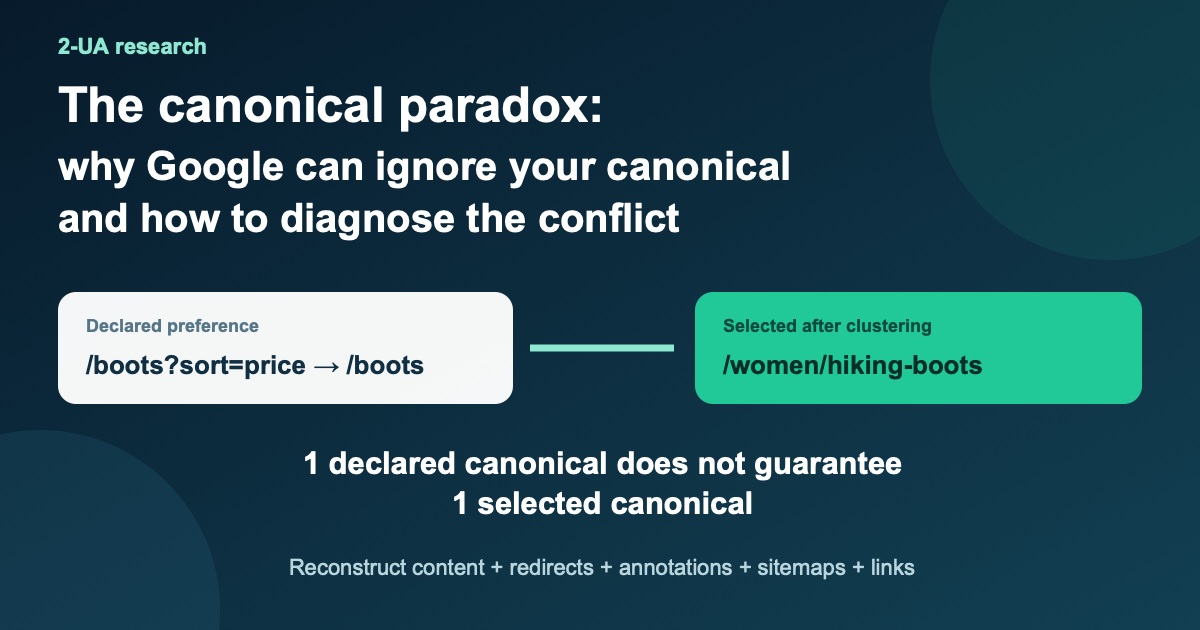
hreflang, or the content itself is a vote inside a disputed cluster—not an instruction that ends the vote. Diagnose the conflict by
comparing the inspected URL, your declared target, and Google’s selected URL; reconstruct the surrounding variants; test content equivalence; align
every controllable signal; and observe the indexed result across repeated crawls. Redirect retired variants, canonicalize true duplicates, keep useful
distinct variants self-canonical, and do not use canonical tags as a substitute for controlling an infinite crawl space.
A merchandising team launches a dedicated “women’s waterproof hiking boots” category. It has curated copy, a stable product set, and a clean self-referencing canonical. Two weeks later, Search Console says “Duplicate, Google chose different canonical than user” and selects the generic women’s boots category. The team responds by adding the same canonical again through an HTTP header, resubmitting the sitemap, and requesting indexing every morning. Nothing changes.
The tag is not missing. The diagnosis is. Internal navigation still links to a parameterized filter; the new page’s title is distinct but its primary product grid overlaps almost completely with the generic category; mobile rendering drops the curated introduction; and an old rule redirects one URL spelling through the generic category before returning to the new page. The site is describing several different clusters at once. Repeating one signal cannot resolve that contradiction.
This is the canonical paradox: the stronger the team believes the tag to be, the more likely it is to inspect only the tag. Google’s current documentation describes a different system. Canonicalization is deduplication. Google identifies primary content, groups pages it considers the same or very similar, and then selects a representative from the signals gathered during crawling and indexing. Your declaration matters, but Google may choose another representative.12
A canonical is a preference inside a duplicate set
RFC 6596 defines the canonical link relation as the author’s preferred IRI for resources with duplicative content. Its most important constraint is often skipped: the target must identify content that is either duplicative or a superset of the referring resource. The specification recommends checking that relationship before adding the link, using only one canonical relation, avoiding targets that return errors, and preferring a permanent redirect when a resource truly moved.3
The relation therefore makes a claim with two parts: “these resources belong together” and “this target should represent them.” It does not say “replace whatever you understand about this page with this URL.” If a red category page points to a generic shoes page, a regional offer points to a different-language home page, or page 3 of a listing points to page 1 even though their items differ, the declaration fails at the first part. The pages are not duplicates or a valid superset relationship merely because a template emitted the tag.
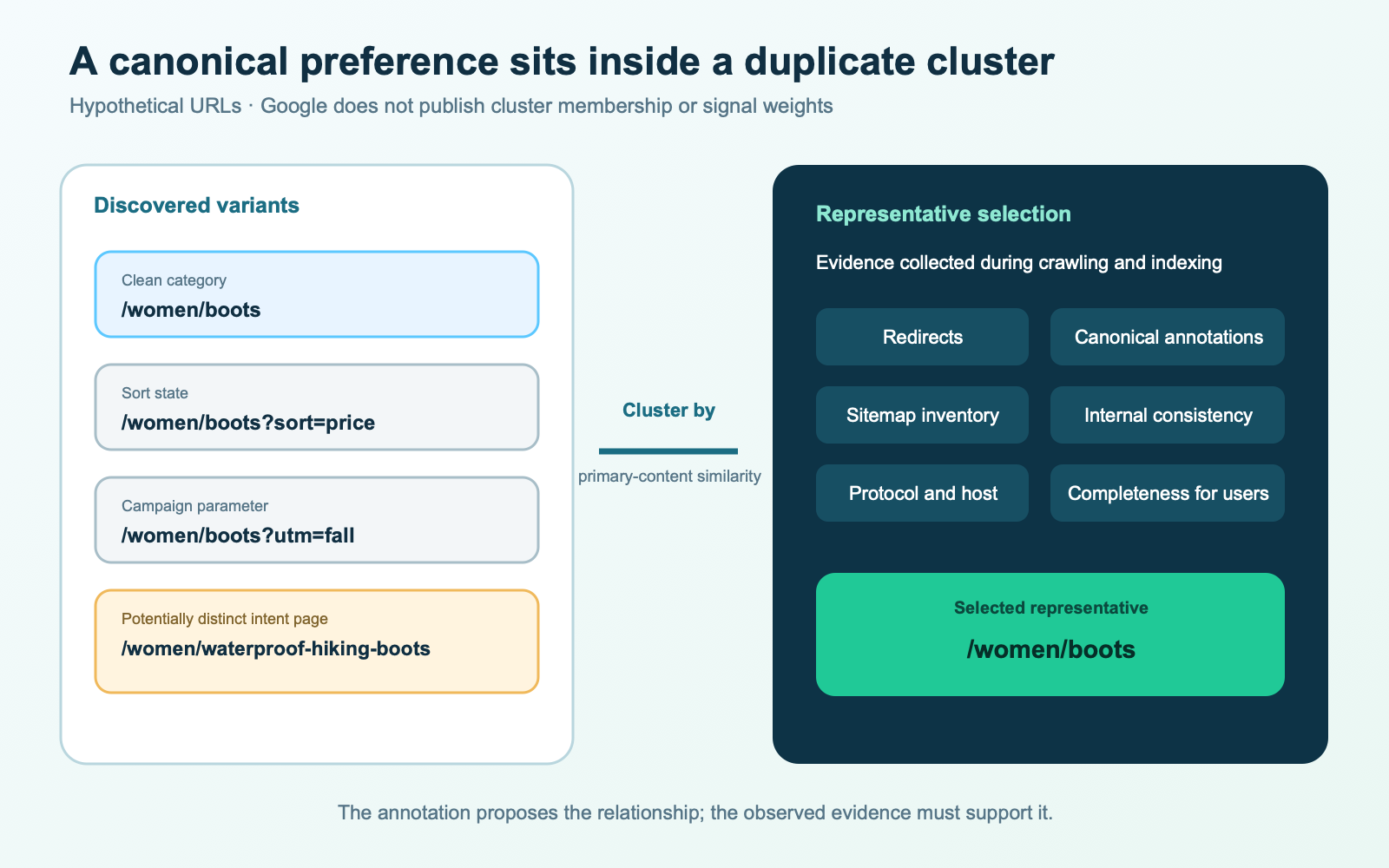
Google applies its own clustering and selection process. It determines each page’s primary content, clusters pages that seem the same or very similar, and selects the URL it judges the most complete and useful representative. The canonical is then crawled more regularly, while duplicates are generally crawled less often. Google explicitly calls a site’s preference a hint rather than a rule. This does not make the annotation decorative; it means the annotation operates only when the search engine’s observed evidence supports the relationship.1
Why “Google ignored my canonical” is the wrong starting statement
“Ignored” compresses at least five different failures into one accusation. Google may not have fetched the latest response. It may have fetched a response whose source and rendered canonical differ. It may consider the declared target insufficiently similar. It may have grouped the inspected URL with a third URL the team never audited. Or it may have accepted the relationship but selected another representative because stronger or more consistent evidence points elsewhere.
Each failure needs a different intervention. Recrawl requests can help discovery after a fix, but they cannot make unlike content duplicate. Adding a second canonical channel cannot repair a redirect in the opposite direction. Removing a URL from a sitemap cannot stop internal navigation from generating thousands of alternate paths. Before touching code, rewrite the problem in observable terms:
For URL A, the indexed inspection reports user-declared canonical B and Google-selected canonical C. The last crawl was before or after release R. A, B, and C return these statuses, render these primary-content signatures, and receive these site-controlled signals.
That statement separates facts from explanations. It can be reproduced, assigned, and checked after a release. “Google ignores canonicals” cannot.
The public signal ladder has only three labeled rungs
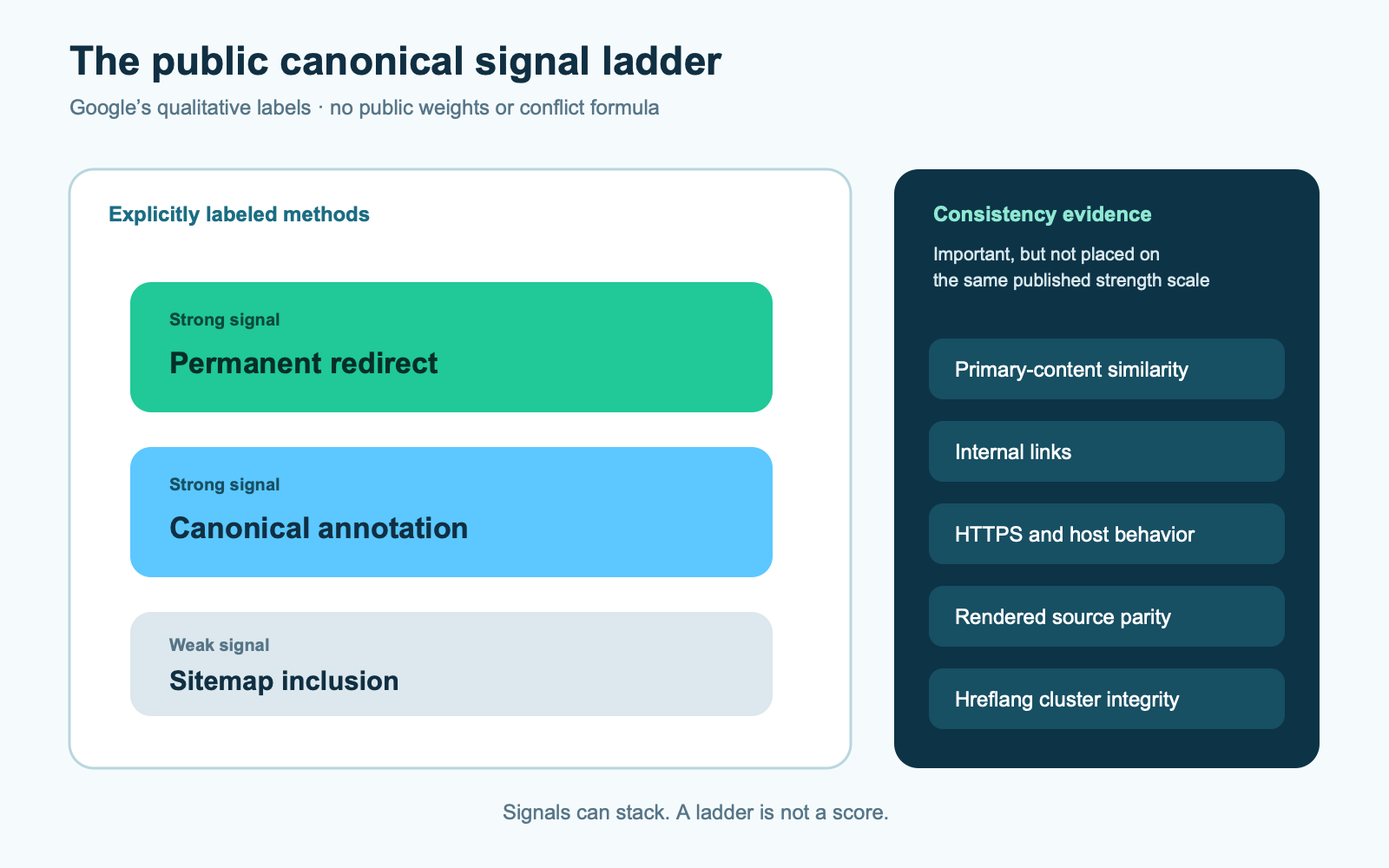
Google’s July 2026 guidance gives a qualitative ordering for the site-controlled methods it explicitly labels: permanent redirects are a strong
signal, rel="canonical" annotations are a strong signal, and sitemap inclusion is a weak signal. It also says these methods can stack.
This is useful, but it is not a scoring model. Google does not publish weights, thresholds, tie-breaking formulas, or the number of crawls required
for one signal to replace another.2
Internal links belong in the diagnosis because Google recommends linking consistently to the canonical URL, but the documentation does not place
them on the same strong-versus-weak scale. HTTPS preference and valid hreflang clusters also influence selection in defined situations.
Content similarity is more fundamental still: without a plausible duplicate relationship, signal alignment cannot turn a different page into the
canonical. Keep those facts visible without inventing an “SEO canonical score.”
Permanent redirects: choose them when the old URL is finished
A 301 or 308 communicates that the target resource has a new permanent URI. RFC 9110 says future references ought to use the new URI; Google calls redirects a strong canonical signal and recommends them when deprecating a duplicate page. If users, crawlers, and internal links should no longer use the old URL, redirect it directly to the final relevant destination and update the links that still request it.210
A redirect is not appropriate merely because two useful pages compete. Redirecting a regional landing page, a filtered inventory page with genuine demand, or a print-friendly resource may erase a user path the business intends to keep. The decision begins with product and information architecture: should the variant continue to exist for people? If no, redirect. If yes and it is truly duplicate or a superset relationship, a canonical may fit. If yes and it serves a distinct intent, make it independently valuable and self-canonical.
Canonical annotations: choose them for reachable duplicates
The HTML element or HTTP Link header fits variants that must remain reachable but should consolidate under one representative. Examples
include tracking parameters, alternate file formats, syndication arrangements, and some presentation variants. Google supports both HTML and HTTP
forms but recommends choosing one because dual implementations are more error-prone. Use an absolute URL, put an HTML element in a valid
<head>, and keep a self-reference on the preferred page.2
Do not point the canonical at a redirect, error, blocked resource, login wall, or page whose main content does not contain the referring page’s substance. RFC 6596 warns against error targets and temporary-redirect sources. Even where a crawler follows the chain, every extra hop makes the intended representative less direct and gives the system another state to observe.
Sitemaps: publish the preferred inventory, not every route
A sitemap should list fully qualified URLs you want search engines to treat as preferred. Google calls sitemap inclusion a weak canonical signal and
still determines which listed URLs are duplicates. The Sitemaps protocol requires a loc for each entry and caps each uncompressed file at
50,000 URLs or 50 MB. Its optional hints do not command crawler behavior.89
Including both a parameterized variant and its clean target does not provide “more discovery.” It tells the crawler that both belong in the preferred inventory while the canonical annotation says only one does. On a large site, generate a daily set difference between sitemap URLs and the expected canonical set. A clean sitemap is not sufficient evidence, but a contradictory one is avoidable noise.
Content similarity is the gate teams inspect last
A technically perfect annotation cannot establish a duplicate relationship that the content contradicts. RFC 6596 requires duplicate or superset content. Google says a declared target that is not similar to the inspected page will not be chosen as that page’s canonical. The Page indexing help makes the debugging implication explicit: compare the inspected page, the declared target, and the Google-selected URL in the browser. 35
Compare primary content, not only titles and boilerplate. For category pages, collect the products visible to the crawler, headings, introductory copy, pagination state, filter labels, structured data, and key internal links. For articles, compare the body, media, byline, date, and comments or embedded modules that materially change the resource. For product variants, compare the purchasable item, price and availability context, selected attributes, description, reviews, and media.
There is no published percentage at which two pages become duplicates. A text-similarity score can prioritize review but cannot reproduce Google’s cluster. Hash exact bodies to find obvious copies, use normalized component fingerprints to find template variants, and keep a human judgment for whether either page serves a meaningfully different task. Label the score as your triage model, never as “Google similarity.”
Rendered content can reverse the relationship
Source HTML and rendered HTML may describe different pages. JavaScript can replace a canonical, remove unique copy, fail to render products, or expose a default state to one crawler profile. Google recommends placing the canonical in source HTML when possible and keeping JavaScript from changing its value. If the source and rendered values disagree, the first fix is deterministic output—not another inference about Google’s preference.11
Test both mobile and desktop rendering because the project rule is operationally important here: the same URL can return different content for different User-Agents. Record a device badge beside each URL in audit exports. Google’s selected canonical is not necessarily the URL displayed in every user context, and a device-specific display choice does not automatically mean the cluster is broken.14
Reconstruct the cluster, not just the inspected pair
Search Console exposes the user-declared and Google-selected canonical for an inspected indexed URL. That gives you an edge in the graph, not the whole graph. The unexpected selected URL may itself declare a fourth target. Other parameter orders, hosts, protocols, locale variants, print views, pagination states, session paths, and historical redirects may feed the same cluster without appearing in the first report.
Start with three mandatory nodes: inspected A, declared B, selected C. Add every URL discovered from their redirects, canonical annotations, sitemap
membership, hreflang, internal links, and known route rules. Expand one hop at a time until new variants stop appearing or you hit a
deliberately defined scope. For a million-page platform, group by normalized pattern and sample instances; do not attempt to draw every node.
Capture the indexed last-crawl time before interpreting a mismatch. Search Console notes that its canonical value can be hours behind the current
index value. A live test describes the page fetchable now; it does not prove that the indexed version has processed the new canonical. The URL
Inspection API returns indexed information, including googleCanonical, userCanonical, crawl time, fetch state, known
sitemaps, and referring URLs. The sitemap and referring URL lists are not guaranteed exhaustive.46
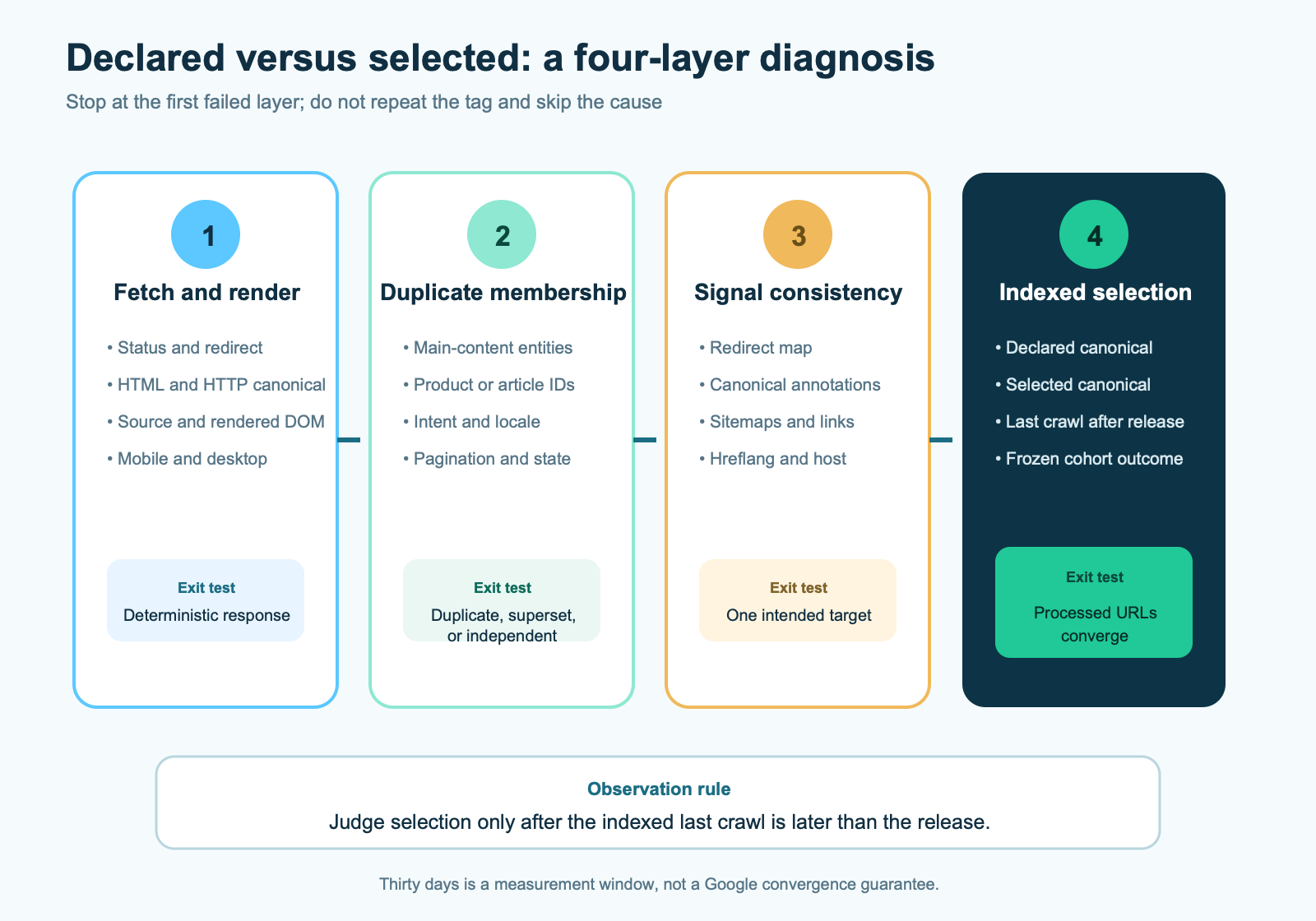
A four-layer canonical conflict diagnosis
Use the same sequence for one page or one hundred templates. Each layer has an exit condition. Do not skip forward because the tag looks right in a browser extension.
Layer 1: fetch and render truth
- Request A, B, and C without following redirects; record status, location, final URL, canonical headers, robots directives, and content type.
- Parse canonical elements from source HTML and verify there is one absolute value in a valid
<head>. - Render with the relevant mobile and desktop profiles; compare canonical, robots, primary content, and visible state.
- Confirm every target is fetchable, indexable where intended, and not a redirect chain or error.
Exit only when the evidence is deterministic across the profiles the site intends to support. If values change by cache, cookie, geography, login state, or deployment host, fix the delivery layer first.
Layer 2: duplicate membership
- Extract the main-content region and normalize global navigation, consent layers, recommendations, and other known boilerplate.
- Compare product or article identifiers, visible entities, headings, copy, media, structured data, and pagination state.
- Decide whether the target duplicates, contains as a useful superset, or serves a distinct user intent.
- Write that decision in the URL-policy table; do not let a template choose implicitly.
Exit with one of three labels: duplicate, valid superset, or independent. If the answer is independent, remove the cross-canonical and make the page’s value legible. If it is duplicate or a valid superset, continue.
Layer 3: site-controlled signal consistency
- Trace redirect edges and eliminate loops, chains, temporary hops, and routes that contradict the preferred representative.
- Compare HTML and HTTP canonical values across every sampled variant.
- List only preferred canonical URLs in sitemaps and use truthful modification dates.
- Count internal links by variant and update navigation, templates, feeds, structured data, and campaign links to the preferred URL.
- Validate same-language regional canonical and
hreflangrelationships separately from different-language pages.
Exit when one URL policy generates the same answer everywhere. “Mostly aligned” is acceptable only when the remaining exceptions are named, intentional, and monitored.
Layer 4: indexed selection over time
- Record indexed user-declared and Google-selected canonicals, last crawl, coverage state, fetch state, and crawler profile for a fixed sample.
- Deploy one coherent signal change rather than several unrelated content and architecture changes.
- Wait for the sample to be recrawled; compare only URLs whose indexed last-crawl time is after the release.
- Measure convergence by template and conflict type, while retaining an “unknown or not recrawled” state.
Exit when the selected representative aligns for the decision-critical cohort, or when the evidence shows that the proposed cluster was wrong. There is no published universal deadline. Thirty days is a practical observation window for many evergreen sites, not a Google guarantee.
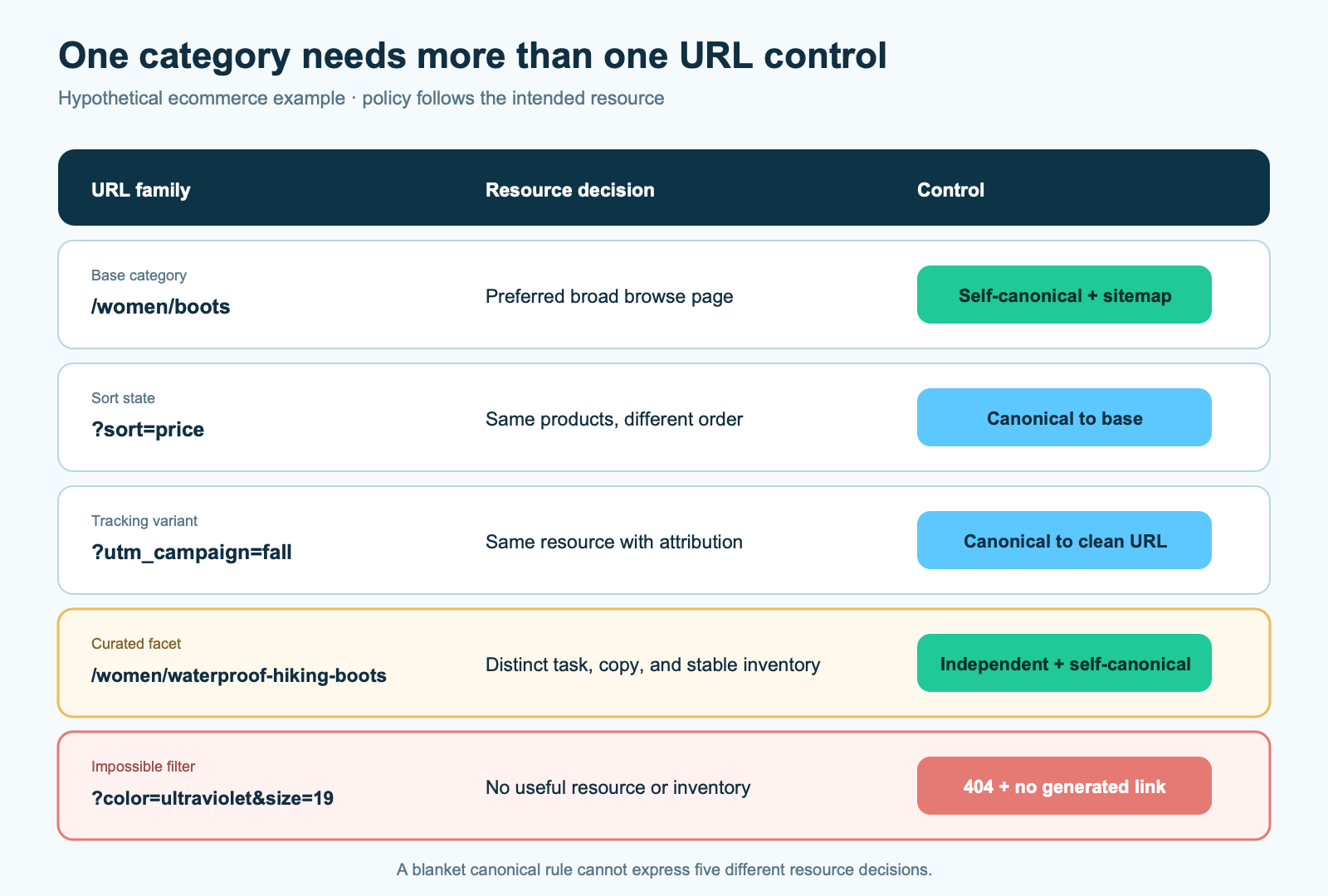
Worked example: an ecommerce facet that should not have one policy
Consider a hypothetical outdoor retailer. This is a diagnostic example, not 2-UA customer data or an industry benchmark. The base category is
/women/boots. Filters create waterproof, hiking, color, sort, tracking, and pagination variants. The original template canonicalizes every
filtered URL to the base category. That simplicity is appealing—and wrong for at least one variant.
| URL family | Primary-content decision | Correct control | Reason |
|---|---|---|---|
/women/boots |
Base browse experience | Self-canonical; sitemap; internal hub links | Preferred representative for the broad category |
?sort=price |
Same products, presentation order only | Canonical to base; avoid crawlable sort links where feasible | Reachable user state without independent search value |
?utm_campaign=fall |
Same resource with tracking | Canonical to clean URL; links and sitemap stay clean | Tracking parameter does not define content |
/women/waterproof-hiking-boots |
Curated intent page with distinct copy and stable inventory | Self-canonical if the business commits to independent value | Collapsing it to the base contradicts its intended task |
?color=ultraviolet&size=19 |
Impossible combination with zero products | 404 and no generated internal link | No useful resource exists to canonicalize |
Google’s faceted-navigation guidance warns that combinations can produce a very large crawl space. If filtered URLs do not need to appear in Search, prevent the space from expanding through architecture, robots rules where appropriate, or fragment-based states. Google says a canonical may reduce crawling of non-canonical facets over time, but calls it less effective long-term than the main crawl-prevention approaches. Canonicalization is not an infinite-URL firewall.7
If some facets do deserve indexing, define an allowlist from user demand, inventory stability, content differentiation, and internal navigation. Give those pages stable, ordered URL patterns, self-canonicals, unique supporting content, and intentional links. Do not simultaneously self-canonicalize them in one template and map them to the base in another. For zero-result or nonsensical combinations, return 404 rather than redirecting everything to a generic category.
Common conflicts and the evidence that resolves them
Self-canonical versus redirected preferred URL
If B self-canonicalizes but redirects to C, the site claims both that B is the representative and that B permanently moved. Resolve the redirect first. Canonical annotations should point directly to the final 200 response. Update internal links and the sitemap to C if the move is intentional; otherwise remove the redirect and restore B consistently.
Canonical B versus internal-link majority C
A navigation or component library that still emits C repeatedly creates discovery and importance evidence for the wrong variant. Count internal links by template, not just on a small crawl sample. Update the reusable source and verify both device profiles. External links are not fully controllable, but a permanent redirect from retired variants and consistent internal references reduce ambiguity.
HTML canonical B versus HTTP canonical C
Google supports both channels and warns that using both increases error risk. Choose one source of truth. Headers are useful for non-HTML documents; HTML is easier to inspect for ordinary pages. Test edge configuration because a CDN rule can add a header after the application renders the correct element.
Source canonical B versus rendered canonical C
This is a release defect, not a selection mystery. Remove the client-side mutation or make both phases deterministic. Also test the response when consent, experiments, personalization, locale, and hydration fail. A crawler cannot infer that one value was “temporary.”
Canonical across languages or regional variants
Different-language primary content is not generally one duplicate set. Keep each translated page self-canonical and connect localized equivalents
with reciprocal hreflang. Same-language regional pages may be similar enough to require a preferred canonical plus regional annotations.
Google recommends a canonical in the same language or the best available substitute, and notes that valid hreflang clusters can influence
canonical preference.212
Canonical to page 1 from deeper pagination
Page 2 is not a duplicate of page 1 when it contains different items. RFC 6596 explicitly warns against mapping later component pages to the first page unless the target is a genuine superset such as a usable view-all resource. Preserve crawlable pagination, give each page a self-reference, and make navigation clear. Do not erase inventory with a blanket canonical.
Choose redirect, consolidate, annotate, or preserve
The following framework turns canonical debugging into a product decision before it becomes a markup task.
- Should users keep reaching the variant? If no and a relevant replacement exists, use a direct permanent redirect. If no replacement exists, return 404 or 410 rather than redirecting to an unrelated hub.
- Is its primary content duplicate or contained by a useful superset? If yes and the variant must remain reachable, annotate the preferred representative and align the surrounding signals.
- Does it serve a distinct intent, locale, state, or inventory? If yes, preserve it as an independent self-canonical resource and make that distinction visible in content and links.
- Is the problem an unbounded generated space? Control URL creation and crawling. Do not expect a canonical to prevent discovery or fetches.
“Consolidate” may mean removing duplicate routes at the application layer rather than keeping them all and adding tags. The lowest-conflict canonical system is one with fewer unnecessary public URLs. However, simplification must not erase variants that people need or pages that answer distinct search tasks.
A one-week implementation checklist
A small team can complete a bounded investigation this week without waiting for a site-wide migration.
- Choose one decision-critical cohort. Use a template or business state, such as twenty index-worthy category pages showing canonical mismatches. Record mobile, desktop, or desktop+mobile beside every URL.
- Export indexed evidence. Save inspected URL, declared canonical, selected canonical, last crawl, coverage state, fetch state, and crawler profile. Keep “missing” distinct from “matches.”
- Build the three-node graph. Fetch A, B, and C; expand through redirect, canonical, sitemap,
hreflang, and internal-link edges. - Classify content membership. Mark each relationship duplicate, valid superset, or independent, with the evidence field that made the decision.
- Fix one policy source. Correct the route, canonical generator, redirect map, sitemap feed, or navigation component that creates the dominant contradiction.
- Deploy a regression test. Assert final status, one canonical, exact absolute target, source/rendered parity, sitemap membership, and internal-link output for representative states.
- Freeze the sample and start observation. Do not replace inconvenient URLs after the baseline; preserve the denominator.
A 30-day measurement plan
The purpose of the window is not to promise convergence in thirty days. It is to prevent perpetual ad hoc checking and to separate URLs Google has recrawled after the fix from URLs that still carry old indexed evidence.
| Window | Evidence | Decision |
|---|---|---|
| Days 0–3 | Freeze cohort and baseline; verify every site-controlled signal and regression test | Do not request indexing until the shipped response is internally consistent |
| Days 4–14 | Sample indexed inspections twice weekly; segment by last crawl after release | Escalate fetch/render regressions immediately; leave not-recrawled URLs unjudged |
| Days 15–30 | Measure selected-canonical convergence and index coverage by template and conflict type | Keep the policy if processed URLs converge; reopen membership or hidden-variant analysis if they do not |
Use three rates with explicit denominators: processed rate equals sampled URLs with an indexed last crawl after the release divided by the frozen cohort; declared-consistency rate equals processed URLs whose current response declares the intended target divided by processed URLs; selection convergence equals processed URLs whose Google-selected canonical matches the intended target divided by processed URLs. Never put not-recrawled URLs into the failure numerator.
Predeclare a change rule. For example: keep the implementation if at least 90% of processed decision-critical URLs select the intended target and no template-level cluster maps independent pages together. Reopen the content-membership decision if convergence remains below 70% after most of the cohort has been processed. Those thresholds are an internal risk choice, not Google benchmarks; choose values appropriate to the cost of a wrong representative.
The strongest counterposition: sometimes Google’s choice is better
The uncomfortable counterargument is that the site owner may be wrong. A team can prefer a campaign URL because its name is cleaner while the older category has stronger navigation, complete content, stable inventory, fewer rendering failures, and a better user experience. Google’s choice of the older page may expose a product-design or architecture problem rather than a search bug.
Test that possibility honestly. Put A, B, and C in front of someone who does not know the desired answer. Ask which page fully satisfies the task, remains useful when inventory changes, and deserves long-term internal links. Compare mobile rendering, availability, localization, and structured data. If the selected URL is genuinely the better resource, either make the preferred URL better and migrate deliberately or accept the selected representative. Do not fight the system solely to preserve a naming convention.
The conclusion survives the counterposition: signal consistency is still necessary, but it follows the resource decision. A technically unified set of signals cannot rescue a weak target; a strong page with contradictory signals remains harder to interpret than it needs to be.
Small-site and large-platform boundaries
A small site should not build a graph database or exhaust API quotas. Crawl the full public inventory, inspect the few mismatches manually, and fix the shared template or redirect rule. The Search Console UI is usually enough when the cohort is dozens of URLs. Spend engineering effort on making public routes deterministic, not on estimating a proprietary similarity model.
A large platform cannot inspect every variant individually. Build a canonical-policy registry by template and state, normalize URL patterns, and sample across value, locale, inventory, depth, and device. The URL Inspection API has a documented per-property quota of 2,000 queries per day and 600 per minute, so use it for a stable, stratified sample rather than pretending it is a full cluster export. Join the indexed result to crawl data, sitemap inventory, internal-link counts, release IDs, and—where available—verified access logs.6
Neither scale changes the evidence hierarchy. Delivery and content establish what exists. Site-controlled signals express the intended representative. Search Console reports Google’s indexed outcome. A dashboard that mixes those layers into one “canonical health” percentage without preserving the underlying states makes the system harder to debug.
Where 2-UA fits—and where it does not
A 2-UA crawl can inventory HTML and HTTP canonicals, canonical counts, redirects, response codes, robots directives, sitemap URLs, internal links, and duplicate page signals across a site. Run representative URLs with both mobile and desktop profiles where output can vary, and use crawl comparison or tracked URL monitoring to catch a release that changes a canonical or redirect. That covers the site-controlled evidence layers in this workflow.
2-UA does not decide Google’s duplicate cluster, reproduce Google’s unpublished signal weights, or replace Search Console’s user-declared and Google-selected canonical fields. It also does not replace CDN or origin access logs. Use Search Console for the indexed outcome and your logs for actual Googlebot requests. The useful bridge is a join: compare the page the site serves with the representative Google reports, without pretending either dataset contains the other.
What the evidence does not show
The reviewed sources do not publish Google’s canonical signal weights, content-similarity threshold, complete duplicate-cluster membership, or a formula for resolving conflicts. “Strong” and “weak” are qualitative platform labels, not numbers. No source supports a canonical health score or a guaranteed number of days before selection changes.
URL Inspection is a URL-level view of indexed information. It is not an access log, live cluster export, ranking report, or counterfactual experiment. Its selected canonical can lag, its known sitemap and referring URL fields are not guaranteed exhaustive, and the live test does not prove that the index has incorporated the response.
Correct canonicalization does not guarantee indexing, rankings, traffic, conversions, or revenue. It can consolidate duplicate handling and make the preferred inventory clearer, but a selected canonical still has to meet indexing and ranking requirements. A result URL can also vary by user context even when Google has one underlying canonical. Measure those outcomes separately and do not attribute a business change to a canonical fix without a design that can separate the fix from other changes.
Finally, this workflow cannot decide the product question for you. Whether a facet, locale, format, or campaign page deserves independent existence depends on user need, inventory, content, and business ownership. Canonical markup should express that decision; it should not be used to avoid making it.
The decision to make now
Stop asking whether the tag exists. Ask whether the declared target belongs in the same duplicate set, whether users should keep reaching the variant, and whether every system you control points to the same representative. Then observe the indexed result only for URLs Google has processed after the release.
Redirect a retired URL. Canonicalize a true reachable duplicate. Preserve a useful distinct variant with a self-reference. Prevent an infinite generated space at the architecture layer. If Google still chooses differently after a coherent recrawl, reopen the cluster and consider the strongest alternative: the selected page may be more complete, more stable, or simply more consistent than the one you preferred.
Sources
- Google Search Central, “What is canonicalization”, updated August 20, 2026. First-party platform documentation.
- Google Search Central, “How to specify a canonical URL with rel=canonical and other methods”, updated July 10, 2026. First-party implementation documentation.
- M. Ohye and J. Kupke, “The Canonical Link Relation”, RFC 6596, April 2012. IETF informational RFC.
- Google Search Console Help, “URL Inspection tool”, reviewed September 10, 2026. First-party product documentation.
- Google Search Console Help, “Page indexing report”, reviewed September 10, 2026. First-party product documentation.
- Google Search Console API,
IndexStatusInspectionResultreference, and Google Search Central, “Welcoming the new Search Console URL Inspection API”, reviewed September 10, 2026. First-party API documentation. - Google Crawling Infrastructure, “Managing crawling of faceted navigation URLs”, updated December 18, 2025. First-party crawler documentation.
- Google Search Central, “Build and submit a sitemap”, reviewed September 10, 2026. First-party implementation documentation.
- Sitemaps.org, “Sitemaps XML format”, last updated November 21, 2016. Industry protocol.
- Roy Fielding, Mark Nottingham, and Julian Reschke, “HTTP Semantics”, RFC 9110 / STD 97, June 2022. IETF Internet Standard.
- Google Search Central, “Understand JavaScript SEO basics”, reviewed September 10, 2026. First-party rendering guidance.
- Google Search Central, “Managing multi-regional and multilingual sites”, reviewed September 10, 2026. First-party international guidance.