A commerce team migrates a product template from server-rendered HTML to a hydrated application. Users with an existing session see the product name,
price, availability, reviews, and related links. The raw response contains a loading shell. A clean browser reaches the product API, but the renderer used
in the release test carries a developer cookie. Googlebot's renderer is stateless, the API rejects its request, and hydration replaces the shell with an
empty error boundary. The server still returns 200 OK. Lighthouse remains green. Nothing in that dashboard proves that the indexable product
evidence survived.
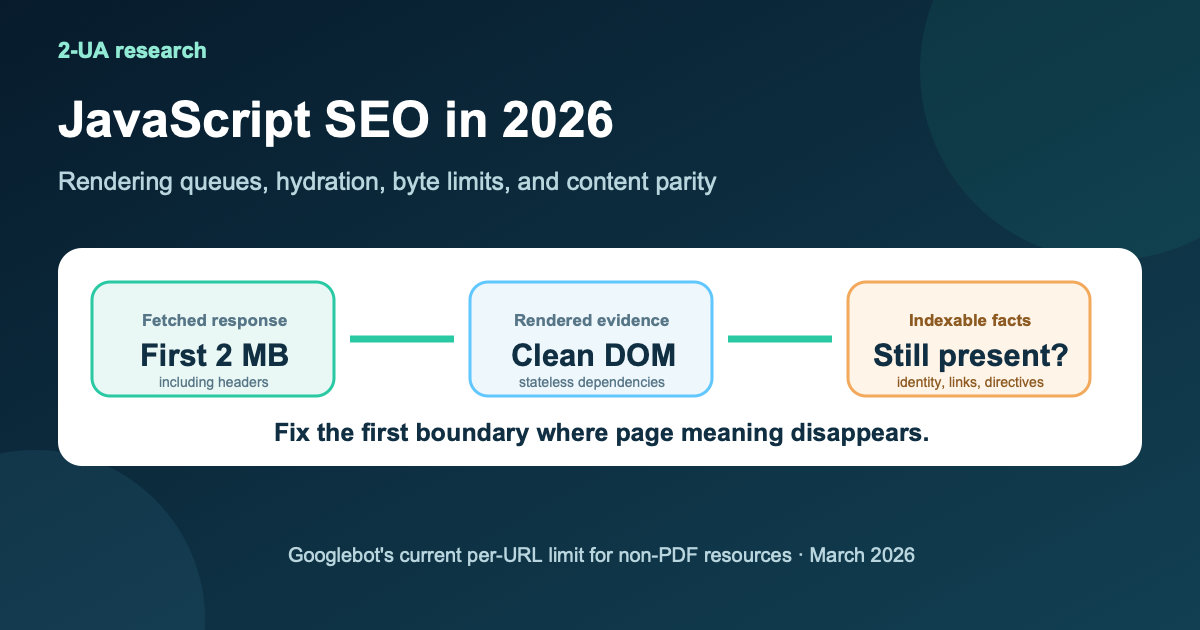
The expensive decision is not “Does Google run JavaScript?” It does. The decision is which facts must exist before execution, which facts may be enhanced afterward, and which evidence can prove that the production page stayed equivalent across fetch and render states. The wrong abstraction turns a release into a debate about frameworks. The useful abstraction is a sequence of evidence boundaries, each with a different failure mode and a different test.
This guide builds that test. It explains the 2026 fetch limit without confusing it with total page weight, treats hydration as a consistency contract, supplies a raw/rendered/Googlebot parity matrix, works through a failed product page, and ends with an implementation checklist and a 30-day measurement plan. The recommendation is deliberately narrower than “always use SSR”: put index-critical facts in resilient HTML, then choose the rendering architecture that meets product and performance needs.
The decision: define a server-rendered search contract
Start with the page's public meaning rather than its component tree. A search contract is the smallest set of facts that must survive a direct request, disabled or failed JavaScript, a stateless renderer, and a cold cache. For a product page, that usually includes the product identity, descriptive copy, current availability, stable price or price range where appropriate, canonical URL, indexability directive, primary image URL, breadcrumbs, and crawlable links to the surrounding category. For an article it includes the headline, body, author or publisher context, publication metadata, canonical, and related links. For a listing it includes the category identity and useful items or a truthful empty state.
This is an editorial and systems decision. Not every accordion panel, recommendation, stock counter, review widget, or personalized module belongs in the first response. A user-specific cart count should not be server-rendered as universal content. A product name should not wait for a browser-only store. Classify each fact as identity, discovery, directive, transactional, or personalized. Server-render the first three when they determine what the public URL is and how it is found. Hydrate transactional controls and personalize only after a stable public representation exists.
The contract is not a claim that server rendering causes rankings. It is a reliability boundary. It reduces the number of resources, states, and timing assumptions that must succeed before a crawler or user receives the page's meaning. Google explicitly recommends server-side or pre-rendering as a sound approach because it helps users and crawlers and because not every bot executes JavaScript. Google also calls dynamic rendering a workaround rather than a recommended long-term solution. The target is one substantially equivalent public page, not a special SEO copy.
Crawl, render, and index are different clocks
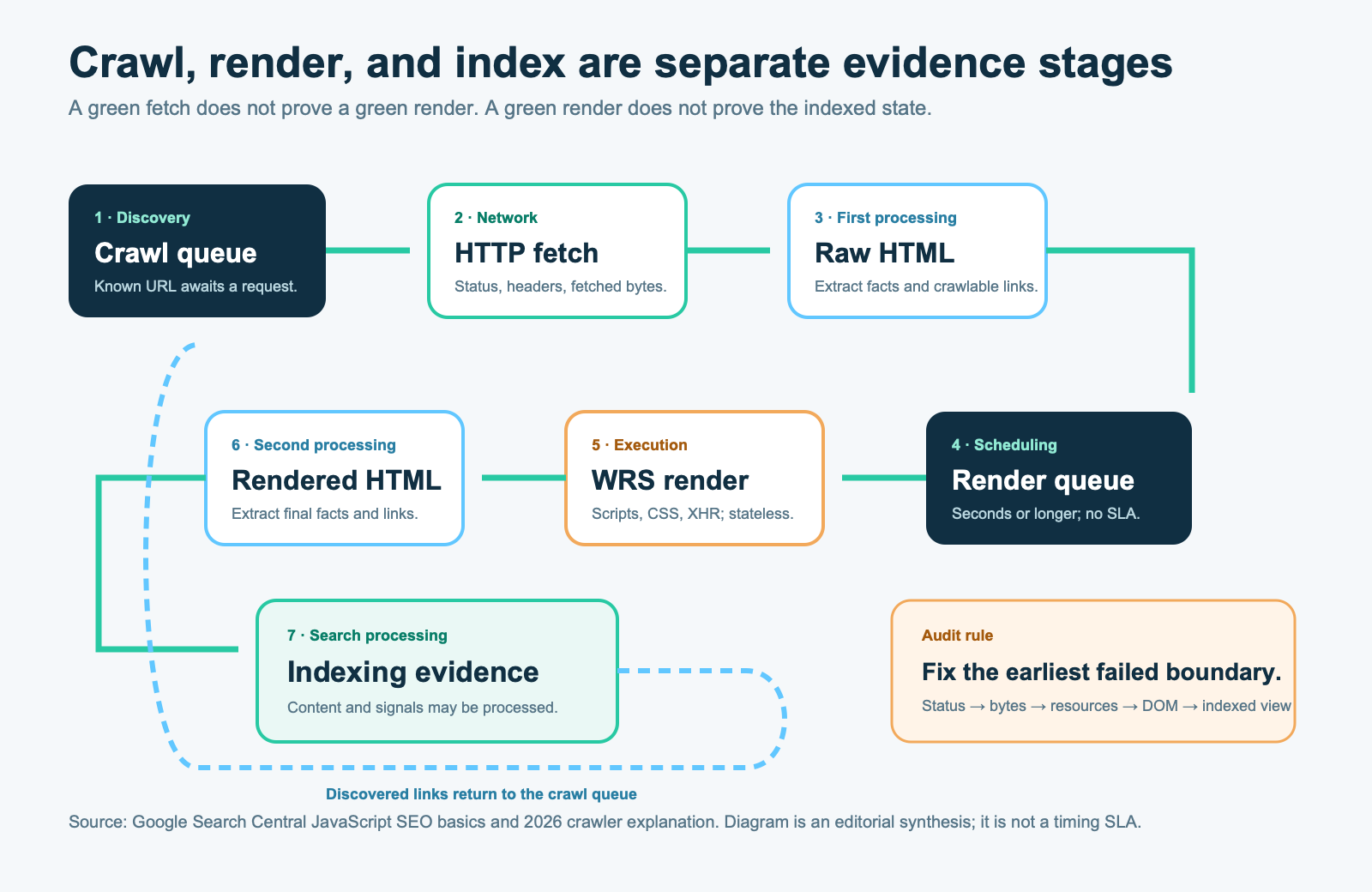
Google's JavaScript SEO documentation describes three main phases: crawling, rendering, and indexing. Googlebot first checks crawl permission and fetches
the response. Processing can extract crawlable <a href> links from that response. Pages eligible for rendering enter a render queue;
Google says the wait may be seconds or longer. When resources allow, the Web Rendering Service runs a headless Chromium, executes JavaScript, and returns
rendered HTML for another processing pass. Links found after rendering can then re-enter the crawl queue.
That sequence invalidates two common shortcuts. First, a successful fetch does not prove successful rendering. Second, a complete render in an engineer's browser does not prove what Google's systems received or later indexed. A browser may have authentication, cached data, local storage, service-worker state, experiments, a different viewport, and access from a different network. Google's troubleshooting guide says the Web Rendering Service clears local storage, session storage, and HTTP cookies across page loads. It also may decline requests that do not contribute to essential content.
Status precedes those render decisions. Google says 200 pages are queued for rendering unless a robots directive blocks indexing, while a
non-200 response may skip rendering. HTTP itself defines 200 as a successful request whose GET response represents the target
resource; it defines 404 as no current representation found or disclosed. Client-side routing cannot retroactively turn the original network
response into a truthful 404. For a missing entity, respond correctly at the server or use Google's documented SPA fallbacks, understanding
that a client-added noindex is still a workaround for an HTTP-semantic problem.
The 2026 byte boundary: 2 MB is a cutoff, not a target
Google's March 31, 2026 crawler explanation replaces the number many teams still quote. Googlebot currently fetches up to 2 MB for an individual non-PDF URL, including the HTTP header. If the HTML response is larger, Google says the crawler stops at the cutoff, sends the fetched prefix to indexing and the Web Rendering Service as if it were the complete file, and ignores the remaining bytes. Referenced resources such as JavaScript and CSS have separate per-URL counters; they do not consume the parent HTML document's allowance. Media, fonts, and some other file types are treated differently.
Three qualifications matter. Google says the limit may change. The document does not give a universal safe threshold below 2 MB, and this article does not infer one. It also does not state a compression calculation that supports converting the limit into an “uncompressed HTML” rule. Measure the actual response path and keep decisive evidence comfortably early; do not build correctness around byte 2,000,000.
The practical failure is ordering. Large inline state, base64 assets, CSS, scripts, consent markup, mega-navigation, or personalization payloads can push a canonical, structured-data block, main entity, or closing markup beyond the fetched prefix. A truncated inline script may not execute. A module reference placed after the cutoff is not discovered. The renderer cannot execute bytes the crawler did not retrieve.
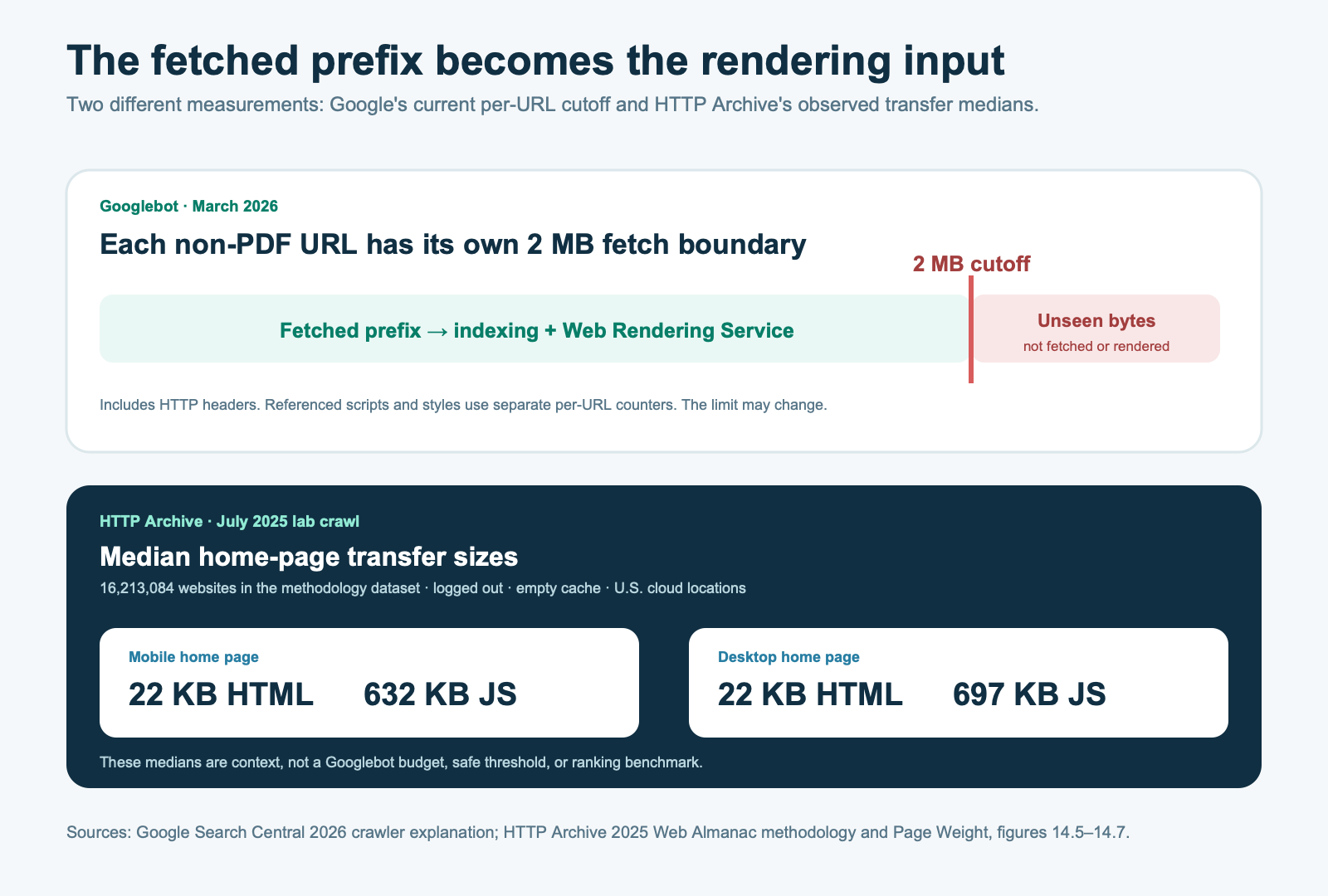
HTTP Archive provides scale, not a reason to relax. Its July 2025 Web Almanac dataset contained 16,213,084 websites sourced from Chrome UX Report origins, tested in logged-out, empty-cache lab conditions from U.S. cloud locations. The median mobile home page transferred 22 KB of HTML and 632 KB of JavaScript; desktop transferred 22 KB of HTML and 697 KB of JavaScript. The median inner page transferred 20–21 KB of HTML and 660–719 KB of JavaScript. Total page weight is not the same object as Google's HTML cutoff, and median behavior does not define safety for a particular template. The useful comparison is that ordinary HTML is far below the published limit; multi-megabyte document responses are an architecture signal worth investigating, not a new target.
Hydration is a consistency contract, not an SEO feature
Hydration attaches client behavior to HTML that the server already rendered. React's hydrateRoot() documentation expects the client-rendered
content to be identical to the server-rendered content and says mismatches should be treated as bugs. React does not guarantee that every attribute
mismatch will be patched. Next.js documents common causes including invalid HTML nesting, browser-only APIs, time-dependent values, browser extensions,
CSS-in-JS configuration, and edge or CDN transformations.
Search adds a second parity question. Framework parity asks whether server and first client render match closely enough to hydrate correctly. Search parity asks whether the facts that define the public page remain materially equivalent across the HTTP response, a clean rendered DOM, the response served to a Googlebot user agent, and Google's own live or indexed evidence. A page can hydrate without a warning yet fail search parity because an API returns an empty state only to a stateless client. It can also log a hydration warning while its index-critical content remains intact. Do not use the console message as a proxy for content evidence; capture both.
The HTML standard explains why delivery choices are operational, not cosmetic. Classic scripts without async or defer can block
parsing while they fetch and execute; deferred and module scripts follow different fetch and evaluation timing. The standard also encourages graceful
degradation where possible. These are browser semantics. They do not promise that an external crawler will wait for every application-defined event,
scroll a page, accept a prompt, or preserve state.
Five hydration failures that change page meaning
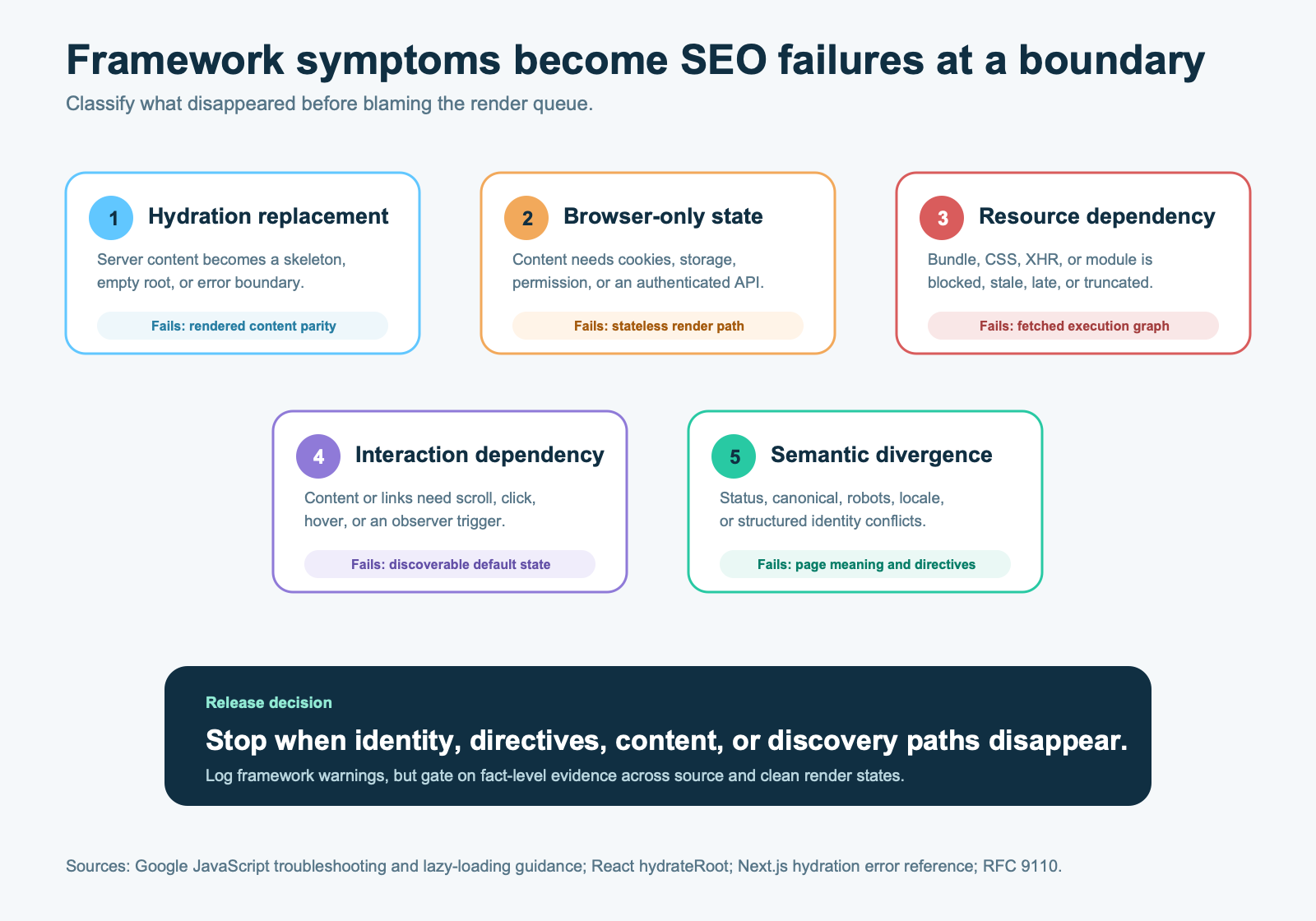
- Replacement: server HTML contains the product, but the first client render replaces it with a skeleton or error boundary.
- State dependency: content requires a cookie, local storage, service worker, geolocation, permission prompt, or authenticated API.
- Resource dependency: a blocked, timed-out, oversized, cached-stale, or unsupported script prevents the content tree from completing.
- Interaction dependency: links or copy appear only after click, scroll, hover, or an observer condition the crawler never triggers.
- Semantic divergence: status, canonical, robots, structured data, locale, or availability differs between source and render states.
Google specifically says Search does not interact with a page, so lazy-loaded content must not require scrolling or clicking. It recommends checking the rendered HTML in URL Inspection. That makes interaction-dependent discovery a testable failure, not an argument about whether a modern browser supports the code.
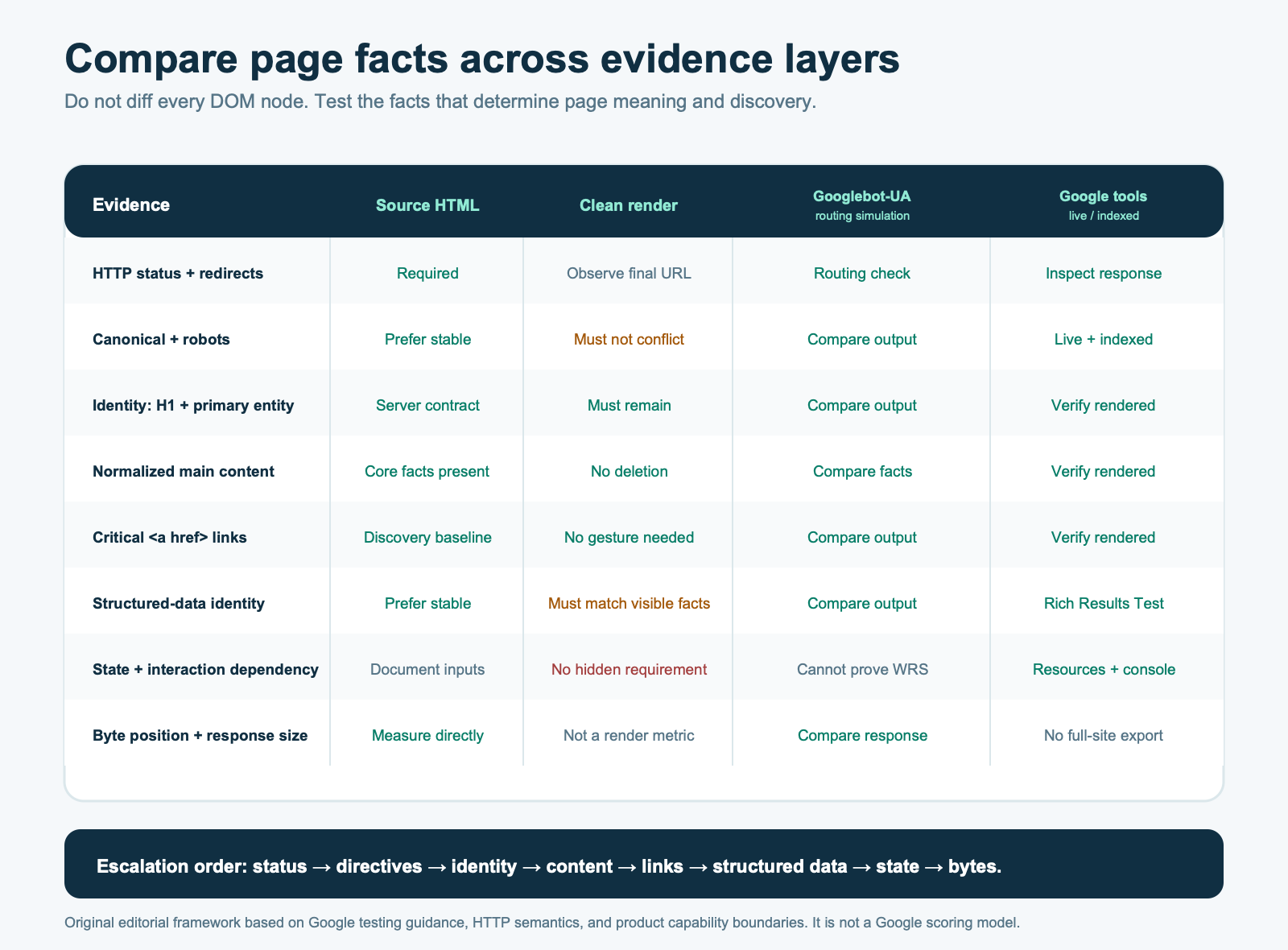
Build a parity matrix that compares facts, not HTML strings
A full DOM diff is noisy. Framework markers, element order, generated IDs, timestamps, consent wrappers, and client-only controls can change without changing the page's public meaning. Compare a structured set of facts. For every representative URL, record the HTTP status and redirect chain, final URL, title, meta description, canonical, robots directives, primary heading, normalized main text, critical crawlable links, structured-data identities, locale, and template-specific facts such as price and availability.
Capture at least four evidence columns. Source is the decoded HTML response obtained without executing script. Rendered is a clean browser DOM under declared desktop or mobile conditions. Googlebot-UA response is the server response to a documented Googlebot user agent; it can expose user-agent routing and WAF differences but is not a verified Google request and does not reproduce Google's renderer. Google evidence is the rendered HTML, screenshot, loaded resources, and console output from Rich Results Test or URL Inspection, with the indexed view kept separate from the live test.
| Difference | First question | Likely owner | Decision |
|---|---|---|---|
| Status or redirect differs by user agent | Is the CDN, WAF, bot rule, or edge function routing requests differently? | Infrastructure | Fix before interpreting render output |
| Source lacks content; clean render contains it | Does the render still succeed without state, interaction, or privileged API access? | Frontend and API | Server-render contract facts or prove robust rendering |
| Source contains content; render removes it | Is hydration replacing useful HTML after an error or mismatched state? | Frontend | Stop release; preserve fallback content |
| Canonical or robots changes after render | Are two components or edge variants asserting conflicting directives? | SEO platform and frontend | Emit one stable server value |
| Critical links require interaction | Are destinations present as crawlable anchors before a gesture? | Design system and frontend | Add persistent <a href> paths |
| Local render passes; Google evidence fails | Which resource, console error, API response, or state differs? | Frontend, API, or infrastructure | Reproduce the clean Google-like boundary and retest |
A diagnostic workflow from bytes to indexed evidence
1. Fetch the document without JavaScript
Record the final response code, redirect chain, headers, response bytes, decoded HTML bytes, and the position of each contract fact. Search the first fetched
prefix for the title, canonical, robots tag, H1, primary entity, critical links, and essential structured data. A normal curl fetch can verify
origin output; a browser's “view source” can help, but retain the actual response and headers as the audit artifact.
Do not treat Content-Length as the sole byte proof: transfer encoding, compression, intermediaries, and dynamically generated responses can make
that header missing or unrepresentative of the exact body a crawler received. Measure the response you fetched and separately note that Google's public
explanation includes HTTP headers in its 2 MB counter without publishing every transport implementation detail.
2. Render in a clean, bounded browser
Use a fresh context with no cookies, local storage, service worker, login, consent history, or extension modifications. Declare viewport, user agent, locale, timezone, network conditions, timeout, and the event that ends the capture. Save the final URL, DOM, screenshot, console errors, failed requests, response statuses, and timing. Run both mobile and desktop when the server, component tree, navigation, or content differs by device.
“Network idle” is not a universal definition of complete. Analytics and streaming requests can prevent it; scheduled work can occur after it. Prefer a contract-specific readiness signal plus a maximum bound. The signal should assert the product facts that matter, not merely the disappearance of a spinner.
3. Send a Googlebot user-agent request, then label it honestly
A Googlebot Smartphone user-agent request is useful for detecting server, CDN, WAF, and cache variation. It is not proof that the requester is Google, does not activate Google's rendering infrastructure, and does not reveal Google's selected canonical or indexed DOM. Never label it “what Google indexed.” If security behavior matters, use verified Googlebot requests in access logs or Google's published verification methods; changing a local user-agent string cannot create that evidence.
4. Use Google's own test for the pivotal sample
Rich Results Test and Search Console URL Inspection expose loaded resources, JavaScript output, rendered HTML, and other diagnostics. The live test is a point-in-time test; the indexed report can reflect an earlier crawl. Compare them rather than forcing them into one status. For a large site, use a stratified sample by template, locale, rendering mode, traffic value, and known failure risk. Google's tools are not a substitute for site-wide regression tests, and local tests are not a substitute for Google's own evidence.
5. Fix the earliest failing boundary
If the server returns the wrong status, do not tune hydration. If the expected HTML lies beyond the byte cutoff, do not wait for a longer render queue. If source is correct and hydration deletes it, fix the first client render or preserve fallback markup. If local rendering passes but Google's loaded-resource report shows a blocked bundle, fix access and dependency behavior. If live evidence passes but the indexed state is stale, the question becomes recrawl and indexing, not rendering implementation.
Worked example: the product page that existed only with a cookie
Consider a hypothetical marketplace template with 18,000 canonical product URLs. A release moves the product record into a browser store. The server
response is 200, 184 KB including inline state, and contains a generic title, an empty <main>, a self-canonical, and a script
reference. A returning user's browser has a region cookie and renders the full item. A clean mobile browser receives a 401 from the product API,
logs an exception, and replaces the main element with “Something went wrong.” The Googlebot-UA HTML is the same shell; URL Inspection's live rendered HTML
also lacks the item.
The page is not failing the 2 MB boundary. Its response is well below it. It is not evidence of an unusually long render queue because a clean local render reproduces the missing state immediately. It is not fixed by serving a special crawler snapshot: that adds another output path and can drift into material bot/user divergence. The first broken boundary is the public rendering contract. The product API assumes browser state that the public page does not own.
The repair server-renders the product identity, H1, description, availability, public price, primary image, breadcrumbs, and related-category anchors from
the same product service used by the client. The add-to-cart control hydrates after load. Region-specific tax and delivery estimates remain client-enhanced
and are labelled as such. Missing products return 404 from the server. The team adds a clean-context test that fails if hydration removes the
normalized product facts, and a sampled URL Inspection check confirms the live rendered HTML after release.
The pass condition is not identical markup. It is stable meaning: status and directives agree; identity, public commercial facts, descriptive content, structured-data identities, and critical links are present in source and remain present after hydration. Client-only controls may appear afterward without turning the parity check red.
Framework implementation patterns that survive the audit
- SSR or static output for contract facts: emit the page identity, directives, main content, and crawlable links in the response.
- Islands or selective hydration: hydrate interactive regions without making the entire document's meaning wait for one client root.
- Stable initial inputs: serialize the same public data used to create the server tree so the first client render does not disagree.
- Deterministic fallbacks: keep useful HTML when an enhancement API fails; do not replace the page with an empty global boundary.
- Server-owned status: resolve entity existence, redirects, authentication, and permanent removal before emitting the document.
- One directive owner: generate title, canonical, robots, language, and structured-data identity from a single server-side contract.
- Content-addressed assets: fingerprint changed JavaScript and CSS because Google says its renderer may ignore caching headers.
- HTTP fallbacks: do not require WebSocket, WebRTC, permission prompts, or user interaction to retrieve public indexable content.
- Crawlable navigation: use real anchors with resolvable
hrefvalues even when client routing intercepts navigation. - Bounded observability: record render completion, failed contract assertions, console errors, and dependency status without logging secrets.
What the evidence does not show
The evidence does not show that client-side rendering is categorically unindexable, that every JavaScript page needs server rendering, or that a source and rendered DOM must be byte-identical. Google's documentation explicitly says it runs JavaScript with an evergreen Chromium. The recommendation here is a risk and evidence model: keep decisive public facts resilient, then test the actual architecture.
It does not provide a guaranteed render wait time, a maximum JavaScript execution duration, a universal bundle budget, or a ranking bonus for hydration, SSR, static generation, or a particular framework. Google's “few seconds, but longer” render-queue wording is descriptive, not a service-level agreement. The published 2 MB cap is a fetch boundary, not a performance score or ranking threshold.
HTTP Archive does not measure Googlebot indexing success or causal search effects. Its 2025 figures come from a popularity-influenced website list and logged-out, empty-cache lab crawls from U.S. cloud locations. Medians hide template tails and site-specific failures. Its raw/rendered word counts describe the measured corpus; they do not prove that adding words with JavaScript improves search performance.
React and Next.js documentation describes framework hydration behavior and common mismatch causes. It does not establish how Google ranks a page. The HTML and HTTP standards define browser and protocol semantics, not Google's indexing policy. Google's platform documentation is the primary source for Google's current crawler behavior, and even that documentation states that the byte limit may change.
Finally, a Googlebot user-agent simulation does not prove a verified Google request, Google's render, its selected canonical, or indexed content. A local renderer does not reproduce Google's queue or every resource-selection decision. Use each evidence layer for the question it can answer.
The strongest counterposition: Google renders JavaScript, so source parity is obsolete
The strongest objection is reasonable. Google uses an evergreen Chromium, renders 200 pages, processes XHR, and indexes rendered HTML. Modern
applications legitimately depend on JavaScript. Requiring all visible content in raw HTML can duplicate data flow, constrain personalization, complicate
caching, and produce stale server output. A robust client-rendered page with fast, public dependencies may be indexed correctly.
That objection defeats the claim that “JavaScript is invisible.” It does not eliminate the extra failure boundaries. The renderer still needs the fetched bytes, accessible resources, supported execution path, stateless data access, truthful status, and a completed DOM containing the expected facts. Other crawlers may not render. Users on weak devices also pay the execution cost. Server rendering is therefore not a theological requirement; it is the most direct way to make high-consequence facts independent of the longest dependency chain.
A client-rendered exception can be justified when the content is private, user-specific, non-indexable, or deliberately outside discovery; when the public render path is small and reliably testable; or when operational constraints make a server path temporarily unavailable. Write that exception down. Define the rendering evidence and rollback threshold before launch. “Google can render” is a capability statement, not a production test result.
Small sites and large platforms need different controls
A small marketing site can often avoid the complexity entirely: statically render the public pages, add progressive enhancement, and run a source/rendered comparison on every template after releases. Sample every high-value page if the set is small. The main risk is an unobserved framework or plugin change, not statistical sampling.
A large platform needs contract tests at several layers. Run component-level hydration tests, template fixtures, clean-browser rendering, edge and WAF variation checks, site-wide sampled crawls, and a rotating Google live-test sample. Stratify by template, locale, inventory state, device, experiment arm, and edge route. Track the denominator at every stage: eligible URLs, fetched URLs, rendered URLs, parity passes, Google-tested URLs, and indexed observations. A 99.9% pass rate can still hide thousands of broken pages if the failing stratum is a revenue-critical template.
Implementation checklist
- Inventory template facts and mark identity, directives, discovery links, transactions, and personalization.
- Define the server-rendered search contract for each public indexable template.
- Return truthful HTTP status and redirects before the application shell.
- Place title, canonical, robots, language, essential structured data, and primary content early in the document.
- Measure actual response bytes and locate every contract fact relative to the fetched prefix.
- Externalize large inline CSS, JavaScript, base64 assets, and application state when they inflate the document.
- Hydrate from stable public inputs and treat server/client mismatches as defects.
- Preserve useful server HTML when enhancement APIs or client bundles fail.
- Expose public content over HTTP without requiring cookies, storage, permission prompts, sockets, scrolling, or clicks.
- Use crawlable anchors and stable URLs for every discovery path.
- Run clean mobile and desktop renders; capture DOM, screenshot, console, requests, and final URL.
- Compare structured facts across source, rendered, and Googlebot-user-agent responses.
- Use Rich Results Test or URL Inspection for pivotal templates and keep live versus indexed evidence separate.
- Set release gates for missing content, contradictory directives, resource failures, and hydration deletion.
- Record capability boundaries: a simulation is not verified Googlebot, and a crawler is not Search Console.
A 30-day measurement plan
This week: establish the contract and baseline
- Select one representative URL for every template, locale, device-sensitive path, and important inventory state.
- Capture raw response, bytes, headers, contract-fact positions, clean mobile render, clean desktop render, and Googlebot-UA response.
- Run Google's live test for the highest-risk sample; store rendered HTML, screenshot, loaded-resource failures, and console output.
- Fix status and directive conflicts first, then hydration deletion, missing content, missing links, and structured-data divergence.
- Add parity fixtures to the release pipeline and define who owns each failing field.
Days 1–7: gate the release
- Run the matrix on changed templates and a stable control sample before and after deployment.
- Watch response-byte percentiles and the position of critical head and body evidence, not only total page weight.
- Compare mobile and desktop when responsive code or edge variation changes the output.
- Investigate every clean-context API rejection, blocked resource, unhandled exception, and hydration mismatch that changes contract facts.
- Roll back when the server returns false success, directives conflict, primary content disappears, or critical discovery links become interaction-only.
Days 8–30: observe production evidence
- Repeat controlled crawls on the same stratified URL set and compare fact-level parity over time.
- Inspect verified crawler access logs when available for fetch status, response size, latency, and resource failures.
- Rotate URL Inspection samples across templates; distinguish a live render fix from an older indexed state.
- Track Search Console page indexing and performance as downstream observations, not as a direct render stopwatch.
- Annotate framework, CDN, WAF, API, consent, experiment, and template releases so regressions can be tied to changed dependencies.
Change course when the boundary keeps failing
Move more contract facts into server or static output when clean renders repeatedly depend on state, interaction, fragile APIs, or large resource graphs. Simplify or split the document when critical evidence approaches the published fetch boundary. Keep client rendering when repeated clean-context and Google evidence stays complete and the server path would add disproportionate complexity. Revisit the decision after a framework, edge, routing, or data-contract change; architecture labels do not remain evidence forever.
Where 2-UA fits—and where it does not
2-UA can compare source HTML with a browser-rendered DOM in a bounded rendered crawl, report changed SEO elements and extracted fields, and separate desktop and mobile crawl profiles. Its Source vs Rendered vs Googlebot Chrome extension can compare the current page, rendered DOM, and a Googlebot Smartphone user-agent response. The Googlebot column is explicitly a user-agent simulation; it is not a verified Google request, URL Inspection, or proof of indexed content. Site-wide rendering is plan-limited and uses bounded browser capacity without cookies, authorization headers, or robots bypass.
Use those checks to find repeatable parity failures and monitor changed templates. Use Search Console or Rich Results Test for Google's own live and indexed evidence, verified origin or CDN logs for production crawler requests, and RUM or analytics for user and commercial outcomes. If you want to establish the technical baseline, run a source crawl, then compare a rendered sample. Use the evidence to decide which layer to fix—not to claim that a rendering difference caused a ranking change.
Sources
- Google Search Central. Understand the JavaScript SEO basics. Updated March 4, 2026; accessed September 17, 2026.
- Google Search Central. Inside Googlebot: demystifying crawling, fetching, and the bytes we process. March 31, 2026; accessed September 17, 2026.
- Google Search Central. Dynamic rendering as a workaround. Updated December 10, 2025; accessed September 17, 2026.
- Google Search Central. Fix Search-related JavaScript problems. Updated December 18, 2025; accessed September 17, 2026.
- Google Search Central. Fix lazy-loaded content. Updated December 10, 2025; accessed September 17, 2026.
- WHATWG. HTML Living Standard: scripting and the script element. Living standard updated September 16, 2026; accessed September 17, 2026.
- Fielding, Roy, Mark Nottingham, and Julian Reschke, editors. RFC 9110: HTTP Semantics. Internet Standard, June 2022.
- HTTP Archive. 2025 Web Almanac methodology, Page Weight, and SEO. July 2025 crawl; published 2026; accessed September 17, 2026.
- React.
hydrateRootreference. Accessed September 17, 2026. - Next.js. Text content does not match server-rendered HTML. Accessed September 17, 2026.