'unsafe-inline', 'unsafe-eval',
or https:—the page works again, but the script policy may now be largely decorative.
A safer rollout does not choose between security and revenue. It separates three decisions: what policy would materially restrict untrusted script execution, what real customer journeys that policy would affect, and what production evidence is strong enough to begin enforcement. Report-only CSP is useful for the second decision. It is not an answer to the first or third by itself.
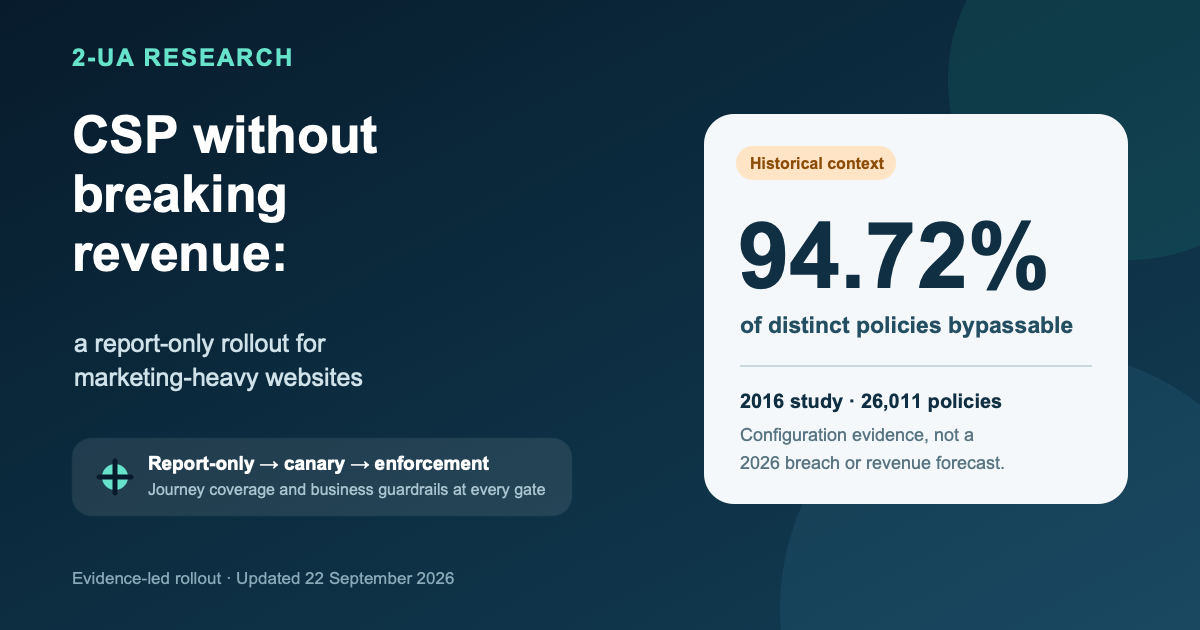
This guide gives marketing, security, analytics, advertising, and checkout owners one rollout contract. It starts from a nonce- or hash-based strict policy, observes the candidate in production, reduces violations by changing code and tag governance, and then enforces through reversible canaries. It also keeps the evidence honest: a 2016 study found 94.72% of 26,011 distinct policies bypassable under its method, but that number is historical configuration evidence, not a 2026 breach or revenue forecast.3
The answer in one minute
- Target an effective policy. For scripts, prefer per-response nonces or build-time hashes with
'strict-dynamic', rather than growing a host allowlist until everything works. - Use an HTTP header. Report-only cannot be delivered through a CSP
metaelement. Configure a reporting endpoint and support both modernreport-toand the deprecated compatibility pathreport-uri. - Inventory journeys, not just domains. Map each tag, loader, frame, beacon, worker, and creative to consent, acquisition, checkout, analytics, or advertising value.
- Treat reports as leads. Deduplicate by policy, directive, blocked target, source, route family, release, and browser. Browser extensions, malware, stale tabs, and unsupported delivery create noise and gaps.
- Promote by evidence. A route enters enforcement only after critical paths are exercised, unexplained first-party violations are closed, owners accept remaining exceptions, and business guardrails hold.
- Canary and reverse. Start with employees, synthetic sessions, a hostname, or a small traffic cohort. Keep the last known-good header ready and define rollback triggers before the first enforcing response.
The operating principle is simple: report-only discovers incompatibility; a strict design creates protection; business and technical guardrails decide when to enforce. If the candidate policy is just a permissive list of every observed host, the rollout can be stable and still produce little XSS resistance.
Why a CSP can exist and still fail
CSP is browser-enforced defense in depth. It can restrict what a document may load or execute and can constrain framing, form destinations, plugins, base URLs, and other behaviors. It does not remove the injection bug that made an attack possible. OWASP and current web.dev guidance both make that boundary explicit: sanitize and encode data, fix XSS, and use CSP as an additional layer.58
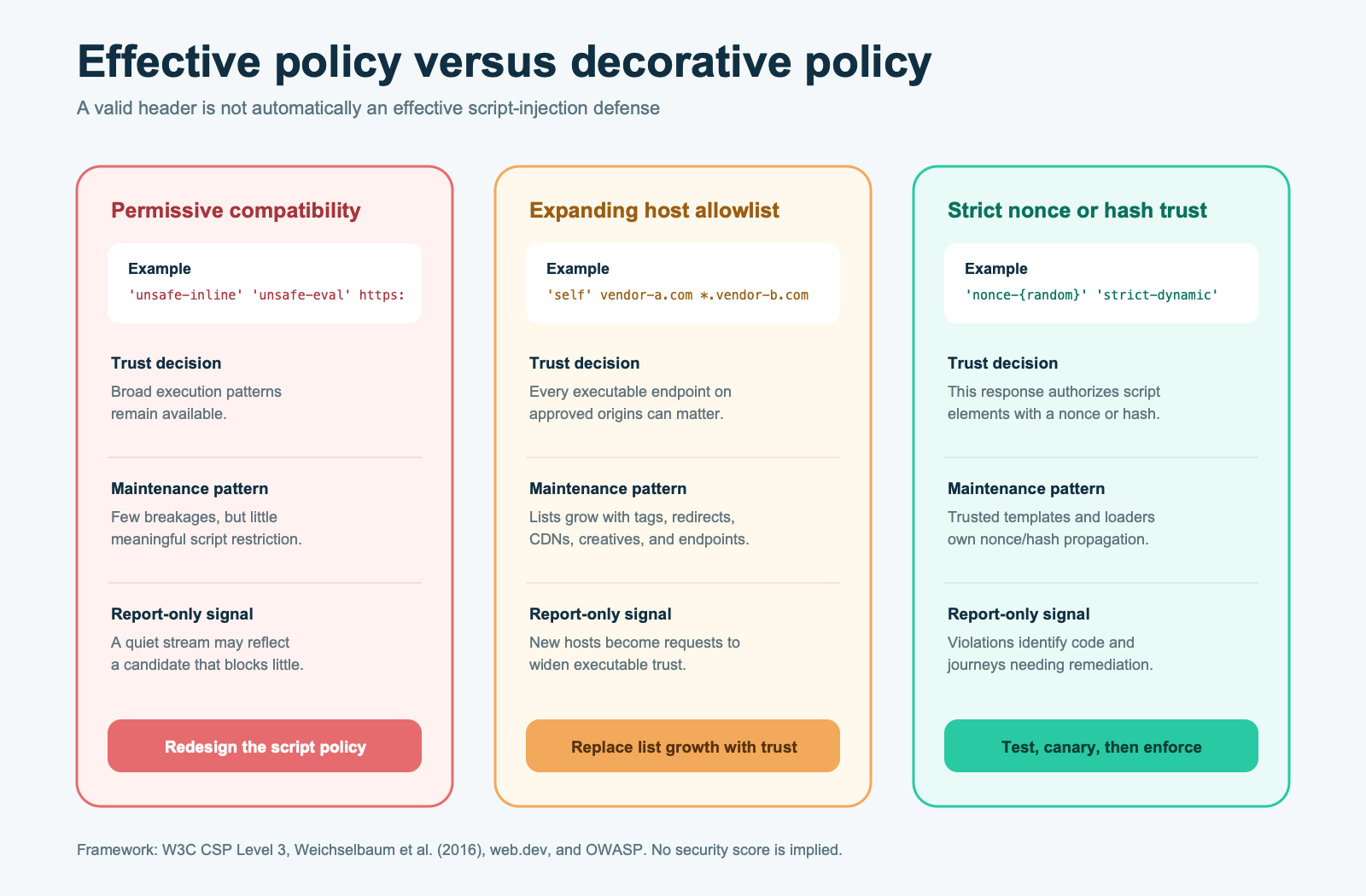
The hard part is not sending a header. It is expressing trust without trusting an origin that also hosts JSONP callbacks, user uploads, redirects, outdated libraries, or another executable endpoint. The 2016 Google study analyzed policies extracted from a search-index corpus of roughly 106 billion URLs. After normalization it found 26,011 distinct policies; 24,637, or 94.72%, offered no XSS protection under the authors’ automated configuration and allowlist bypass checks. Even 51.05% of the 2,437 policies they classified as strict were still bypassable.3
Those results do not describe today’s browser support or your application. They do reveal a durable failure mode: presence is not effectiveness.
A policy such as script-src 'self' https: 'unsafe-inline' 'unsafe-eval' may make integration easy while preserving several execution paths an attacker
can abuse. A long list of approved marketing origins can also transfer the security boundary to every executable endpoint on those origins.
The later longitudinal evidence explains why teams stop. Roth and colleagues reconstructed seven years of CSP headers for 10,000 highly ranked domains. Of 449 sites that tested content-restricting policies in report-only mode, 251 (56%) never later enforced any CSP during the authors’ observation window; only 130 (29% of 449) later enforced content restriction. The paper also found 50 of 373 host-allowlist deployments trusted an expired, typo, or private-address domain under its method.4
This is not evidence that report-only causes failure. It is evidence that observation without an ownership and remediation process can become a permanent holding pattern. Marketing-heavy sites continuously add tags, pixels, consent vendors, A/B testing, chat, fraud controls, payment frames, and advertising creatives. A report stream grows faster than a security team can classify it unless the deployment changes how third parties enter the page.
Strict CSP changes the trust question
A host allowlist asks, “Which origins may provide script?” A strict CSP asks, “Which script elements did this response explicitly authorize?” A server-rendered
page can generate a new unpredictable nonce for every response, place it in the policy, and add the same nonce only to intended script elements. Static pages
can authorize stable inline loaders by cryptographic hash. The 'strict-dynamic' expression lets a nonce- or hash-authorized script load non-parser-inserted
descendants without enumerating every host.15
That trust propagation is powerful, not magical. If trusted code builds a script URL from attacker-controlled input, 'strict-dynamic' may authorize the
resulting load. If middleware blindly adds a nonce to every script after rendering, it may bless attacker-injected markup. The W3C draft recommends a unique,
cryptographically secure value of at least 128 bits before encoding; OWASP warns that nonce placement belongs in the template’s trusted rendering path,
not a blanket string replacement.18
What report-only measures—and what it cannot
The CSP Level 3 Working Draft defines Content-Security-Policy-Report-Only so a user agent can monitor a candidate policy without enforcing it. A request or
inline execution that would have been blocked continues, while the browser can expose a violation locally and send a report to the configured endpoint.
This makes production compatibility visible without intentionally interrupting customers.1
The word can matters. The Reporting API draft allows a user agent to defer or attempt delivery for only a subset of reports. Users must be able to disable
reporting. Reports can be batched, duplicated across navigation patterns, lost when a page closes, filtered by privacy behavior, or overwhelmed by extension
and malware injections. Current guidance also spans two mechanisms: report-to selects a named endpoint declared in Reporting-Endpoints, while the
deprecated report-uri sends a different payload. MDN recommends supplying both during the compatibility transition.29
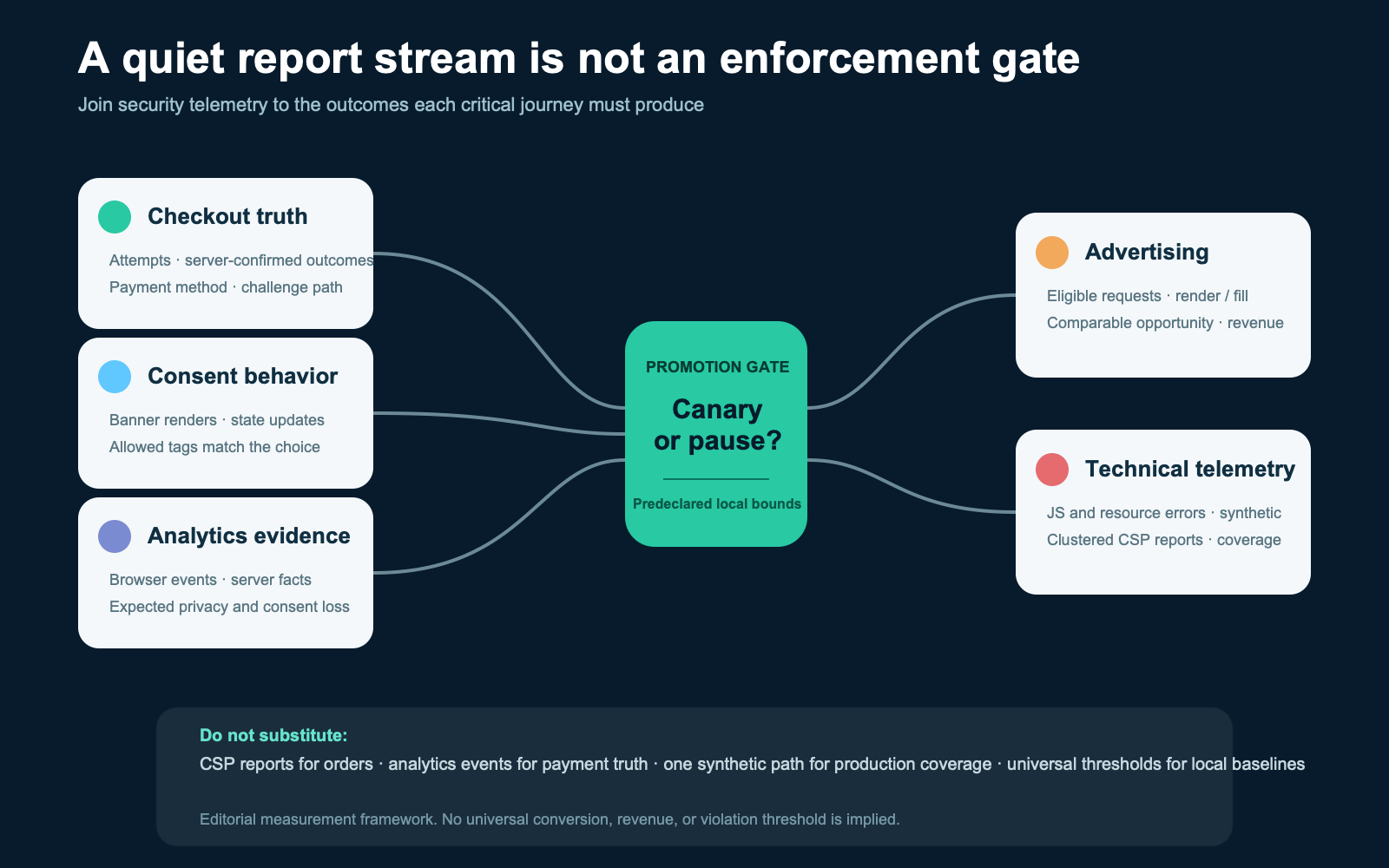
Therefore, a CSP report is an observation, not a transaction log. Ten reports do not mean ten lost orders. Zero reports do not mean every browser, route, consent state, locale, campaign, or creative would survive enforcement. The correct unit is a violation cluster attached to an exercised journey and a known candidate policy version.
| Evidence | It can answer | It cannot prove |
|---|---|---|
| CSP violation report | Which candidate directive a browser says the observed action violated | That the action was legitimate, malicious, user-visible, or complete |
| Synthetic journey | Whether a controlled path completes under a known enforcing policy | Coverage of every campaign, vendor response, consent state, or browser |
| Analytics event | Whether the measurement pipeline received an event under its own rules | That the checkout succeeded or the event count is unbiased |
| Order / payment result | Whether the commercial outcome completed | Which script or policy caused a failure without joined diagnostics |
| Ad delivery and revenue data | Whether eligible slots requested, rendered, and monetized | That every creative path is compatible with future enforcement |
Design the policy before collecting reports
Starting with default-src 'none' and adding every reported origin sounds disciplined, but it lets current implementation accidents design the policy.
Starting with the desired trust model produces better questions: which response creates the nonce, which templates receive it, which bootstrap scripts are
authorized, which loaders may create descendants, and which data destinations are genuinely required?
A server-rendered candidate might begin conceptually like this. It is a teaching example, not a copy-paste policy for an unknown stack:
Reporting-Endpoints: csp="https://reports.example/csp"
Content-Security-Policy-Report-Only:
  default-src 'self';
  script-src 'nonce-{PER_RESPONSE_NONCE}' 'strict-dynamic';
  object-src 'none';
  base-uri 'none';
  frame-ancestors 'self';
  form-action 'self' https://payments.example;
  img-src 'self' data: https://measurement.example;
  connect-src 'self' https://measurement.example;
  frame-src https://payments.example;
  report-to csp;
  report-uri /csp-report
Generate the nonce once per response, place it in the header, and pass it through a trusted template variable to intended script elements. Never log the nonce as a reusable credential and never cache personalized HTML in a way that reuses it across responses. If an HTML response must be static or broadly cached, a hash-authorized bootstrap may fit better. Choose from rendering architecture, not fashion.
Keep script authorization separate from resource destinations. A nonce may allow a trusted analytics bootstrap to run, but that script still needs the
correct connect-src, img-src, frame-src, worker-src, or other channels. Conversely, adding a measurement hostname to
connect-src does not authorize its JavaScript. Classify each violation by effective directive before making a change.
Run old enforcement and new observation together
If the site already enforces a weaker known-good CSP, keep it during migration. Browsers can apply an enforcing policy and a separate report-only candidate at the same time. The enforced header continues to protect according to its rules; the report-only header describes what the stricter candidate would do. Do not replace a useful enforced policy with report-only merely to simplify the experiment.89
Multiple enforcing policies intersect; they do not merge into a more permissive union. Test the exact response headers at the CDN edge and origin, because an application header plus a proxy header can create a combined restriction neither owner intended. Give every policy a version that can be joined to a release, route group, and report cluster.
Map the third-party execution graph
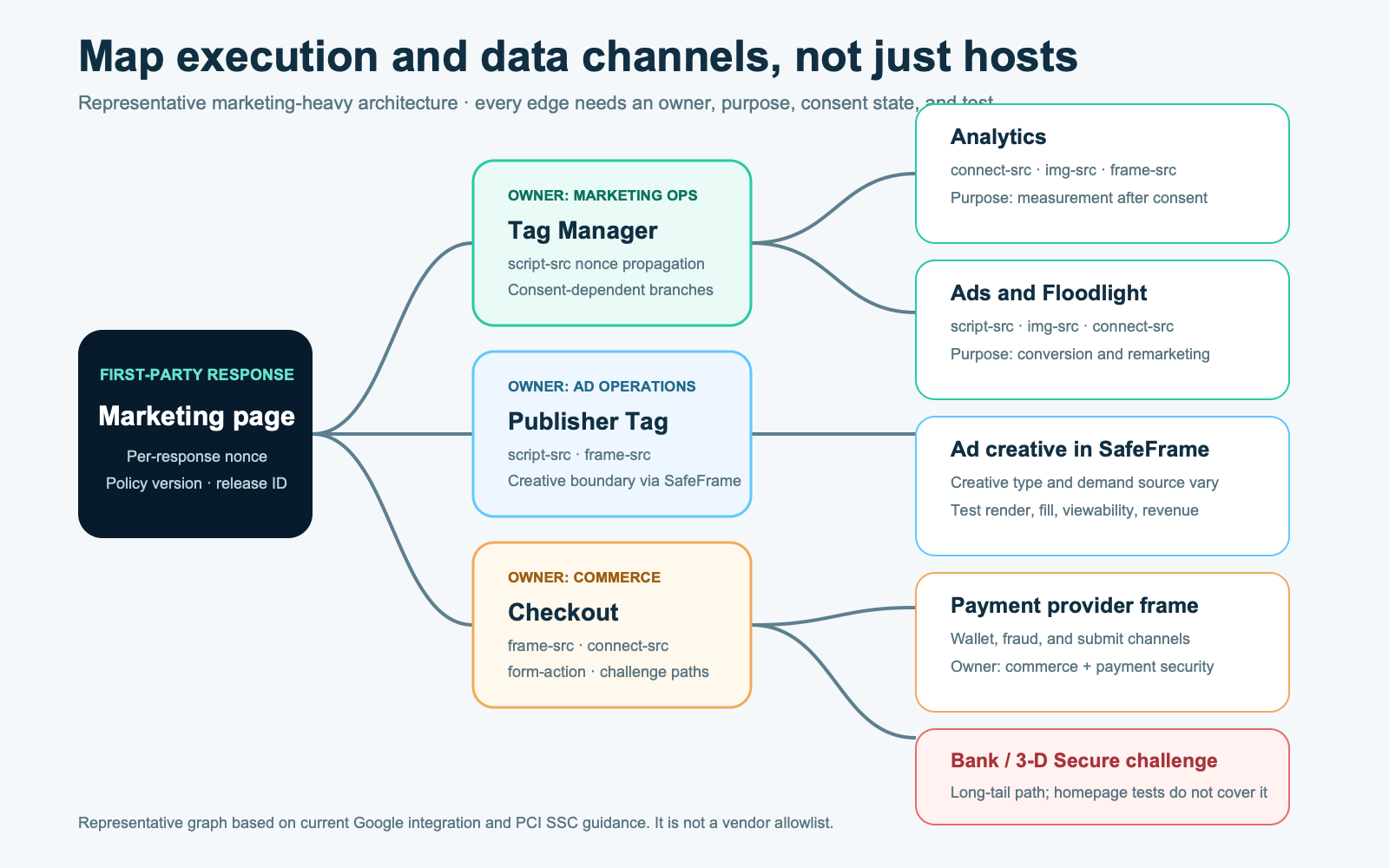
A spreadsheet of hostnames is not a dependency inventory. The initial tag manager can create analytics, advertising, experimentation, personalization, chat, and affiliate scripts. Those scripts open frames, create workers, send beacons, and fetch configuration from additional origins. Consent state changes which branches execute. A campaign parameter or audience can select a path absent from the homepage test.
Build the graph from four sources: template and bundle search, tag-manager export, observed browser network/DOM behavior across journeys, and accountable vendor documentation. For each node record the owner, business purpose, triggering consent state, routes, data channels, fallback behavior, and removal date. A violation report can confirm an observed edge. It cannot discover an edge that no test or customer triggered.
Google Tag Manager is a loader, not one dependency
Google documents a nonce-aware GTM snippet and says Tag Manager propagates the nonce to scripts it inserts. That helps a strict script policy authorize a
trusted bootstrap and its descendants. It does not make every container configuration CSP-compatible. Google’s current guide lists different sources for
Analytics, Ads, Floodlight, Merchant Center, Preview Mode, and other features. Custom JavaScript variables require 'unsafe-eval'; Google recommends
Custom Templates when possible to avoid that allowance.7
Treat 'unsafe-eval' as a named risk acceptance, not an invisible compatibility switch. Identify which container item requires it, whether that item
runs in production, whether a custom template or application code can replace it, who owns the exception, and when it will be retested. The same discipline
applies to 'unsafe-inline', scheme sources, wildcards, data:, and broad subdomain patterns.
Publisher Tag changes the creative boundary
Google Publisher Tag supports nonce-based strict CSP and recommends report-only testing. Its integration guide says GPT domains change over time, so GPT supports the strict approach instead of a rolling domain allowlist. The guide also requires cross-domain rendering through SafeFrame for the documented CSP setup and warns that some reservation creatives may depend on same-domain behavior and fail under a global SafeFrame setting.6
That caveat belongs in the rollout plan. Test creative types and demand channels, not just whether gpt.js loads. Measure slot requests, render rate,
viewability where appropriate, and revenue using the publisher’s normal denominators. A blank ad slot with no CSP report can still be a creative or auction
issue; a CSP report with stable revenue can still reveal an unexercised inventory branch.
Checkout deserves a separate route group
Payment pages combine the highest consequence with vendor-controlled frames, fraud scripts, 3-D Secure flows, wallets, address lookup, and consent choices. PCI SSC guidance for in-scope environments emphasizes authorizing, inventorying, and justifying payment-page scripts, assuring integrity, and detecting unauthorized changes to scripts and security-impacting headers. CSP can contribute to that control set, but it is not a compliance certificate and does not replace the merchant’s scope decision or assessor guidance.1011
Give checkout its own candidate, synthetic suite, canary, alert budget, and rollback authority. Exercise success, decline, challenge, wallet, saved-payment, guest, signed-in, regional, and recovery paths that actually exist. A homepage report stream is not evidence that a bank challenge inside a payment frame will work.
Build a decision-grade measurement stream
The collector is an internet-facing ingestion service receiving attacker-controlled JSON. Limit request size and rate, accept only expected content types, parse both Reporting API and legacy CSP shapes, validate fields, and store normalized values rather than trusting raw text. Do not render report fields as HTML. Exclude secrets and high-cardinality query strings from normal analytics; the CSP draft strips some URL details, but document and blocked URLs can still carry customer or campaign information.
A practical normalized record contains: received time, policy version, disposition, effective directive, blocked target class, document route family, source file origin/path, line and column when present, browser family/version, release ID, consent state or journey ID when safely available, and a stable cluster key. Keep the raw payload only under a short, justified security retention policy if it is genuinely needed.
Cluster before counting
Counting raw reports rewards noise. One blocked inline handler on a popular page can emit millions of copies. A browser extension can inject random URLs. A stale tab can report code that no current release serves. Cluster first, then rank by affected sessions, routes, journeys, release recency, and business consequence. Separate at least these classes:
- First-party defect: a template, bundle, inline handler,
javascript:URL, or dynamic loader the team owns. - Approved vendor dependency: documented and necessary, but missing a nonce propagation or destination directive.
- Tag-governance debt: an old pixel, duplicate tag, custom JavaScript variable, or unowned experiment that should be removed.
- Environmental noise: extension, malware, proxy, browser feature, or development tooling unrelated to intended production behavior.
- Unknown: evidence is insufficient; keep it out of enforcement approval until reproduced or explicitly risk-accepted.
Track the numerator and denominator together. “Two checkout clusters” means little without tested routes, device/browser coverage, consent states, and checkout attempts. A promotion packet should show which journey matrix was exercised and which traffic slice the data represents.
Define guardrails before seeing the result
For checkout, use attempts and server-confirmed outcomes, segmented by route, browser, device, market, payment method, and experiment. For analytics, compare browser events with server-side facts where a legitimate join exists; do not declare the browser count “wrong” merely because privacy and consent reduce it. For advertising, use eligible requests, render/fill measures, and revenue per comparable opportunity. For the page itself, track JavaScript errors, resource failures, latency, and synthetic journey completion.
Predeclare what triggers pause, investigation, or rollback. A small site may use a manual rule such as “any reproducible checkout failure blocks promotion.” A high-volume platform may use an experiment guardrail with a power calculation and sequential monitoring owned by its experimentation team. The article cannot supply a universal 0.5% or 1% tolerance: baseline variance, traffic, margin, and consequence differ.
The 30-day rollout
Thirty days is an operating example, not a standards-mandated soak. Extend it when traffic is low, campaigns are seasonal, ad inventory is sparse, or payment methods rotate. Shorten a phase only when the next gate has stronger evidence, not because a deadline arrived.
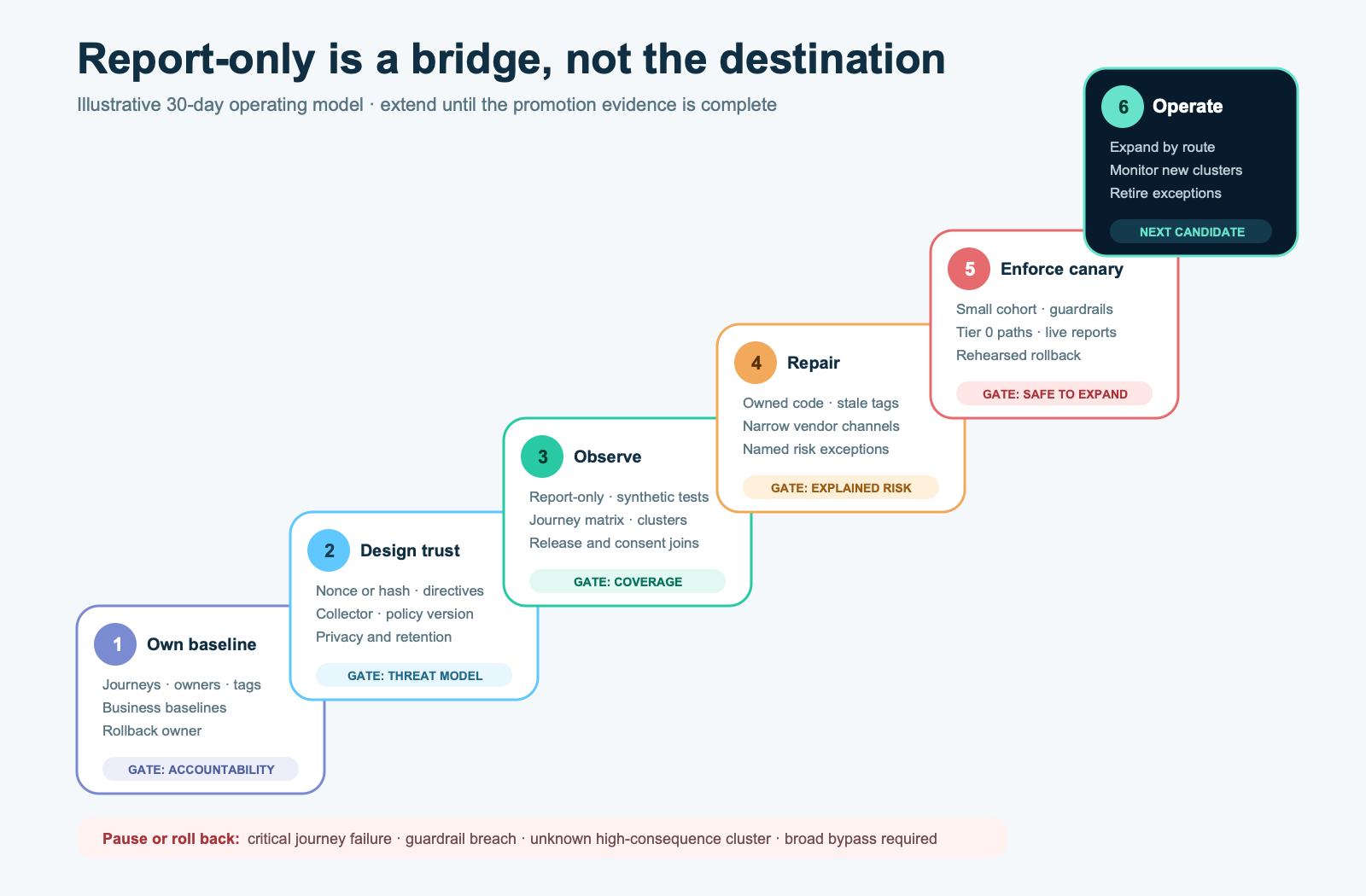
Days 0-3: establish ownership and baseline
- Name one rollout owner and owners for application templates, tag management, consent, analytics, ads, checkout, CDN/headers, security reporting, and incident response.
- Freeze a versioned export of production tags and list script-bearing templates, inline handlers, JavaScript URLs, eval-like behavior, workers, frames, forms, and beacon destinations.
- Define critical journeys and the business/technical baseline for each. Capture normal variation before any enforcing change.
- Choose policy architecture: per-response nonce for dynamic HTML, hashes for stable static loaders, or a documented combination.
- Build the collector, retention rules, sampling plan, and cluster taxonomy. Test malformed and oversized payloads.
Gate: no report-only launch until every critical journey and every exception category has an owner. Unowned third-party code is a governance failure, not a source to add automatically.
Days 4-10: observe the strict candidate
- Send the candidate through
Content-Security-Policy-Report-Onlyon representative HTML responses. Keep an existing enforced policy if present. - Verify the edge and origin return the intended policy version and reporting headers. Confirm report-only is not attempted through a meta element.
- Run synthetic journeys with normal consent states, devices, locales, campaign parameters, and payment/ad variants.
- Join reports to the policy version and release. Cluster and label first-party, vendor, debt, environmental, and unknown causes.
- Confirm the reporting endpoint itself does not become a latency dependency; report delivery must not gate page behavior.
Gate: every Tier 0 journey has been exercised; every first-party script violation has a ticket or fix; unknown checkout and consent clusters block promotion. Report volume alone is not a gate.
Days 11-20: remove debt instead of widening policy
- Move inline event handlers into nonce- or hash-authorized scripts. Remove
javascript:URLs and avoid string-to-code APIs. - Use the nonce-aware tag-manager bootstrap and replace Custom JavaScript variables where feasible before accepting
'unsafe-eval'. - Delete dormant pixels, duplicate analytics, expired experiments, and unowned vendors. Removal is often safer than an exception.
- For each remaining destination, add the narrowest directive/source required and link it to vendor documentation and an owner.
- Re-run the entire journey matrix after every meaningful policy or container change. A fixed homepage does not clear checkout.
Gate: the policy evaluator and code review find no unexplained broad script bypass; remaining allowances are named, justified, time-bounded where possible, and covered by journeys.
Days 21-25: enforce a reversible canary
- Start with employees or synthetic traffic if it represents production behavior, then use a dedicated hostname, route group, or small randomized cohort.
- Keep report collection active for the enforcing policy and a separate report-only candidate when testing the next restriction.
- Watch order outcomes, consent, analytics, ads, JavaScript errors, resource errors, and CSP clusters together.
- Have an authorized operator and one-command/config rollback to the last known-good enforcing header. Record the reason for every rollback.
Gate: the canary completes all critical journeys, guardrails remain within their predeclared local bounds, no critical unknown cluster remains, and rollback has been rehearsed.
Days 26-30 and after: expand, then operate
- Expand by route and traffic cohort, not one irreversible global switch. Checkout can trail lower-risk marketing routes.
- Keep policy version, tag-container version, application release, and vendor-change evidence joinable.
- Alert on new high-consequence clusters and unauthorized header changes, not every duplicate report.
- Review exceptions and third-party inventory on a fixed cadence and after tag, consent, checkout, ad-stack, or template changes.
- Test the next stricter candidate in report-only while the known-good policy remains enforced.
Change-course trigger: pause expansion when a reproducible critical journey fails, a business guardrail breaches its declared boundary, report coverage cannot be explained, or the policy requires a broad script bypass that defeats the threat model. Narrow the route, replace the vendor pattern, or redesign the bootstrap before continuing.
Worked example: a campaign checkout
Consider an illustrative retailer launching a paid campaign. The marketing page runs a consent manager and GTM. The container loads Analytics and an Ads conversion tag after consent. Product pages run GPT. Checkout embeds a payment-provider frame and may open a bank challenge. The site has no enforced CSP. The following numbers demonstrate analysis mechanics only; they are not a benchmark.
During seven report-only days, 1,200 campaign sessions produce 22,400 raw reports. Clustering collapses them to 412 combinations of policy version, route family, effective directive, blocked target, and source. The team labels 330 as extension or stale-tab noise, 48 as duplicate tag debt, 21 as first-party inline handlers, eight as documented vendor destinations, and five as unknown. There are 318 checkout starts and 201 server-confirmed purchases in the illustrative dataset.
A naive response adds every blocked origin and calls 22,400 “violations fixed.” The decision-grade response is different:
- Remove the duplicate tags, reducing both data duplication and policy surface.
- Refactor the 21 owned handlers into the nonce-authorized bundle.
- Map the eight vendor destinations to specific Analytics, Ads, consent, ad, and payment behavior; add only the necessary directive channels.
- Reproduce the five unknown clusters. Two come from a deprecated campaign template, one from a payment challenge, and two remain environmental noise.
- Block enforcement on checkout until the challenge flow passes under an enforcing synthetic test and a canary.
The team first enforces on content and product routes for a small cohort. It keeps checkout in report-only. After the payment provider confirms the frame and connection requirements, the challenge path passes in staging and production synthetic tests. Checkout then enters a separate small canary with an immediate rollback rule for any reproducible payment-path failure. The campaign does not supply enough data to claim that CSP changed conversion; it supplies enough evidence to avoid approving an untested payment dependency.
The strongest counterposition
That criticism survives. Report-only is not protection, and a program with no promotion deadline, owner, threat model, or exception budget can become security theater. The 2020 longitudinal evidence shows many observed sites did not progress to content restriction. An organization unwilling to remove unsafe tag patterns or accept an enforcement canary should not describe its report-only header as XSS mitigation.4
The conclusion still holds, but narrowly: report-only is justified as a temporary compatibility instrument inside an enforcement program. It is not
the program. Enforce independently useful, understood controls where appropriate; retain an existing policy; and put time, ownership, and evidence gates
around the stricter script policy. If the strict candidate requires indefinite 'unsafe-inline', 'unsafe-eval', broad schemes, and wildcard
vendors, state that limitation rather than declaring success.
There is also a security counterweight to revenue protection. A compromised marketing or payment-page script can itself cause revenue, privacy, and payment risk. PCI SSC’s payment-page guidance reflects that browser-side code is part of the commercial risk surface. The rollout should minimize both expected breakage and unauthorized execution; it should not optimize one to zero while ignoring the other.10
Small-site, platform, and product boundaries
For a small marketing site
Keep the machinery proportionate. One owner can maintain a versioned vendor table, a short critical-journey checklist, a managed report collector, and a manual promotion review. Low traffic makes statistical guardrails weak, so use deterministic evidence: every real checkout method and consent path must pass, every first-party violation must be resolved, and any critical regression stops rollout. A static site may prefer hashes; a server-rendered shop may prefer nonces.
For a large platform
Route families, regional stacks, browser cohorts, experiments, and vendor ownership need automation. Use policy-as-code review, container governance, typed exception records, privacy-reviewed report pipelines, sampled raw retention, release joins, synthetic coverage, randomized canaries, and on-call rollback. A global violation rate hides the route that matters; approve at the smallest operational boundary that can be safely rolled back.
What 2-UA can and cannot do
2-UA can inspect delivered security headers during audits and monitor tracked pages for header changes. That is useful for confirming whether a route exposes the intended CSP header and whether a release unexpectedly changes it. It does not design the policy, generate or validate per-response nonces, receive CSP reports, inspect a private tag-manager container, execute every consent/ad/payment state, or measure conversion and ad revenue. Those steps require application, browser, analytics, advertising, payment, and reporting systems owned by the site.
What the evidence does not show
- No revenue effect: none of the cited studies estimates the causal effect of CSP or report-only rollout on conversion, orders, analytics loss, fill rate, or advertising revenue.
- No current 94.72% prevalence: that value belongs to a 2016 dataset of distinct policies and an automated bypass method. It must not be applied to 2026 sites.
- No causal report-only failure rate: the 56% result is longitudinal observation of selected popular sites and archive-visible headers, not proof that report-only caused abandonment.
- No complete reporting guarantee: the Reporting API permits delayed or partial attempts, and users may disable reporting. Noise and missingness remain visible uncertainties.
- No universal soak or threshold: 30 days, the worked counts, route tiers, and promotion gates are editorial frameworks. Traffic, seasonality, risk, and vendor rotation determine adequate coverage.
- No universal vendor policy: Google’s GTM and GPT instructions apply to those products. Other analytics, ad, consent, chat, experimentation, and payment vendors need their own current documentation and tests.
- No XSS cure: strict CSP is defense in depth. Trusted loaders, DOM injection, nonce misuse, unsafe evaluation, browser bugs, and application vulnerabilities can preserve attack paths.
- No compliance conclusion: PCI SSC guidance does not make CSP alone sufficient. The merchant’s assessor or compliance-accepting entity determines scope and validation.
Implementation checklist
What to do this week
- Name the rollout, tag, consent, analytics, ads, checkout, CDN, security, and incident owners.
- Export the tag container and map loaders, frames, workers, beacons, form actions, and consent-dependent branches.
- Choose nonce or hash architecture and build a strict candidate; do not let observed hosts define script trust.
- Stand up a bounded collector for both Reporting API and legacy report shapes, with privacy review and cluster keys.
- Declare critical journeys and local business/technical guardrails before reading rollout results.
- Send the candidate in
Content-Security-Policy-Report-Only, preserving any useful existing enforcement.
What to observe for 30 days
- Tier 0 journey coverage by route, browser, device, locale, consent state, payment method, campaign, and creative class.
- New first-party, approved-vendor, debt, environmental, and unknown violation clusters by policy and release.
- Checkout attempts and server-confirmed outcomes, consent behavior, analytics reconciliation, ad delivery/revenue, JavaScript errors, and synthetic completion.
- Changes to the header, nonce propagation, tag container, vendor endpoints, broad allowances, and expired exceptions.
- Canary results and rollback readiness for each route group moving into enforcement.
What justifies changing course
- Proceed: critical journeys are exercised, unexplained first-party/checkout violations are closed, exceptions have owners, guardrails hold, and rollback is ready.
- Narrow: one route, vendor, creative, browser, or payment method remains uncertain; keep that boundary in report-only while enforcing proven routes.
- Redesign: compatibility requires broad script trust, nonces are reused or indiscriminately attached, the collector cannot provide privacy-safe evidence, or tag governance cannot identify owners.
- Rollback: a reproducible critical journey fails, a predeclared business guardrail breaches, or a high-consequence unknown appears after enforcement.
A useful CSP rollout ends in enforcement, narrower executable trust, and an operating process that notices regressions. It does not end when the report inbox becomes quiet. Protect revenue by testing the journeys that earn it; protect users by refusing to turn every dependency into permanent script authority.
References
- W3C, Content Security Policy Level 3. Working Draft, 13 August 2026; policy delivery, reporting, nonces,
strict-dynamic, and strict CSP authoring considerations. - W3C, Reporting API. Working Draft, 11 June 2025; endpoint configuration, delivery, buffering, and privacy constraints.
- Weichselbaum et al., CSP Is Dead, Long Live CSP!. ACM CCS 2016; 26,011 distinct policies from a Google search-index corpus.
- Roth et al., Complex Security Policy? A longitudinal analysis of deployed Content Security Policies. NDSS 2020; 10,000 highly ranked domains, 2012-2018.
- web.dev, Mitigate cross-site scripting with a strict Content Security Policy. Nonce/hash design, deployment, and limitations.
- Google Publisher Tag, Integrate with a Content Security Policy. Strict CSP, nonce, SafeFrame, and testing guidance.
- Google Tag Platform, Use Tag Manager with a Content Security Policy. Nonce propagation and product-specific directives.
- OWASP, Content Security Policy Cheat Sheet. Defense-in-depth, delivery, strict CSP, and nonce guidance.
- MDN, Content Security Policy guide and report-only header reference. Reporting configuration and compatibility guidance.
- PCI Security Standards Council, Payment page security and preventing e-skimming. Guidance for PCI DSS Requirements 6.4.3 and 11.6.1, March 2025.
- PCI Security Standards Council, FAQ 1588. SAQ A eligibility criteria and script-attack protection clarification, February 2025.