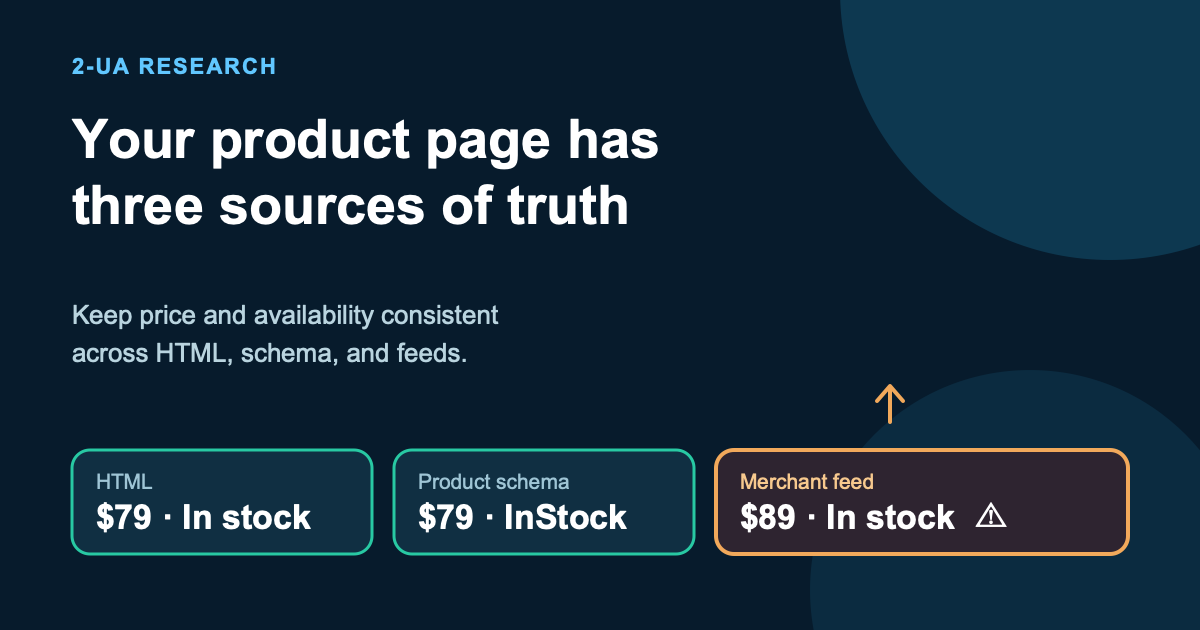
At 09:00, a promotion changes a shoe from $89 to $79. The product database is correct. The product page shows $79. Its JSON-LD still says $89 because a separate template cache was not purged. A nightly feed will not send $79 until 02:00. At 09:07, a shopper arrives from a listing that still advertises $89, sees $79 on the page, chooses size 10, and discovers at checkout that size 10 is sold out. Marketing calls it a feed delay. Engineering calls it a cache issue. Merchandising calls it an inventory race. The customer sees one store contradicting itself.
Google documents the same failure in platform terms. Search can use product structured data, Merchant Center data, or both. When Google combines website and Merchant Center data, update lag can create pricing and stock inconsistencies. Merchant Center requires submitted price and availability to match the landing page, structured data, and checkout; a mismatch may disapprove the affected product or trigger an automatic correction. 134
This is not fundamentally a markup problem. Valid JSON-LD can be wrong. A successfully accepted API request can still produce a processed product that is not approved. A green page monitor can fetch a cached region that differs from checkout. The operational problem is that one offer has been copied into several representations without a contract for identity, precedence, latency, or verification.
One commercial fact, three representations
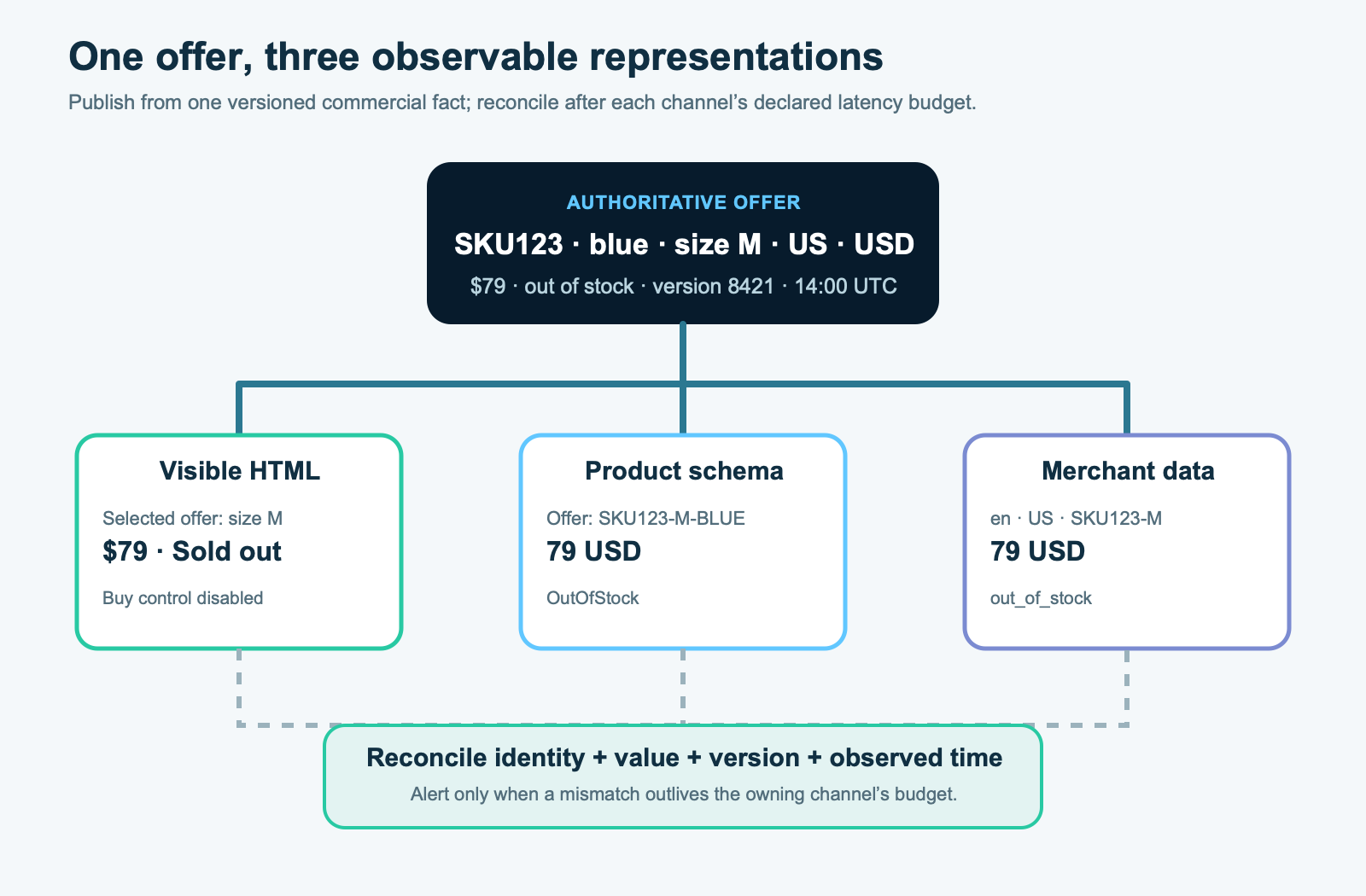
The headline deliberately calls HTML, schema, and feeds “sources of truth” because teams often operate them that way. The design target is the opposite: one authoritative offer state and three independently observable representations.
- Customer-visible HTML is the offer a shopper can inspect and act on: selected variant, active price, currency, stock message, and buy control.
- Product structured data is a machine-readable description embedded in the page, normally a Schema.org
Productcontaining one or moreOffernodes. - Merchant data is the product information submitted through a file, scheduled fetch, platform integration, or Merchant API and then processed by Merchant Center.
Those representations serve different consumers and update on different clocks. They do not need byte-for-byte equality, and some fields legitimately exist in only one channel. They do need semantic agreement on the purchasable offer. Google’s product-data specification is explicit: availability should match the landing page, checkout, and structured data; price and currency should match the landing page, structured data, and checkout. 4
Define the offer before comparing values
“The product costs $79” is incomplete. A comparison becomes meaningful only when both sides describe the same product offer. At minimum, bind each observation to a product identifier, variant, target market, currency, purchase condition, and effective time. Member pricing, regional inventory, minimum order quantities, subscriptions, taxes, and sale periods may require additional dimensions.
A useful internal key might be offer-123 / blue / size-10 / US / USD / public. HTML must preselect or clearly expose that offer. JSON-LD must
describe that offer rather than a different default variant. The Merchant Center identity uses an offer ID together with content language and feed label;
the Merchant API documentation describes that combination as the unique product identity. If the join key is wrong, a comparison can report a mismatch
where none exists—or miss a real one by comparing the sale price for one variant with the regular price for another.
6
The field-ownership contract
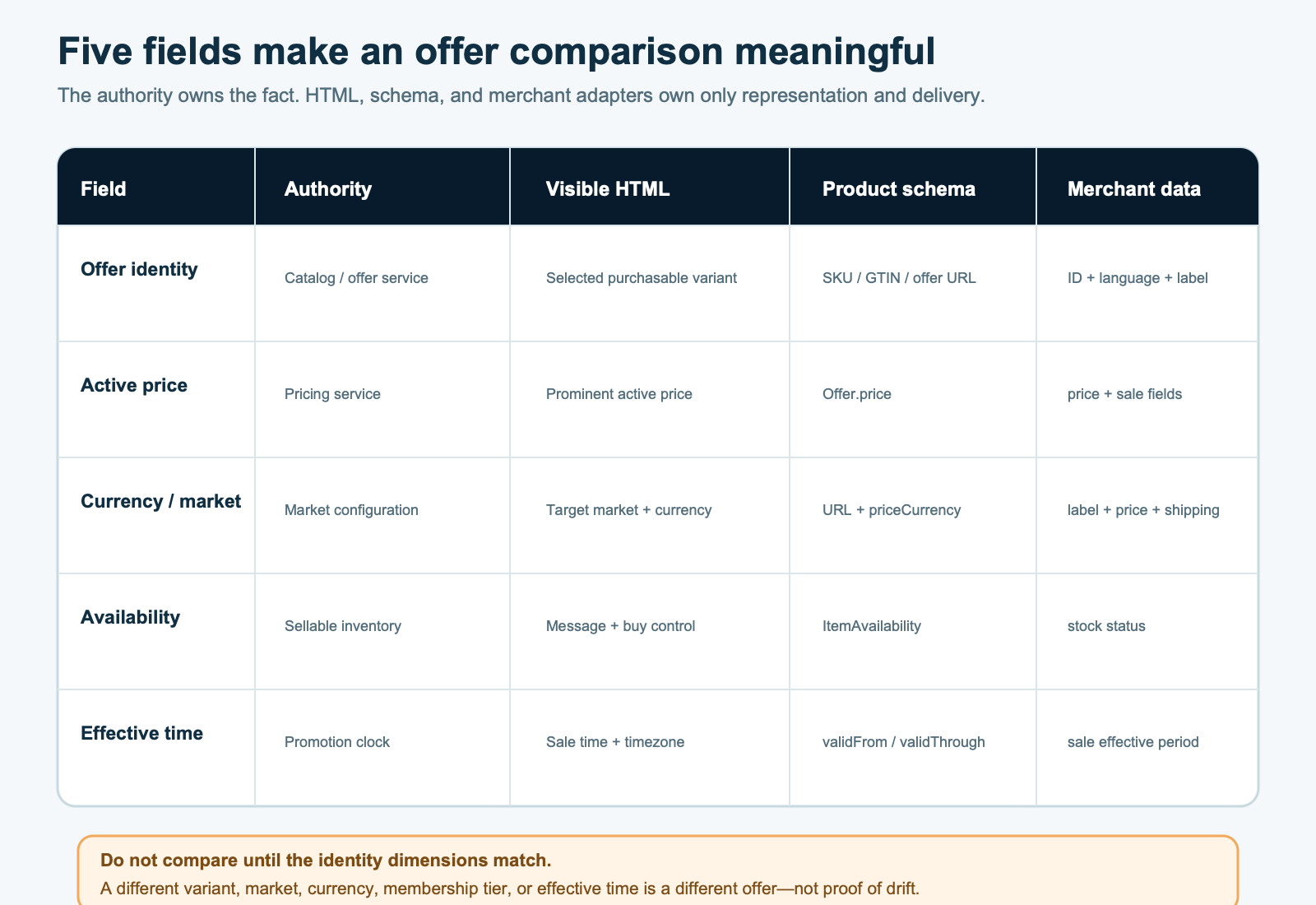
Consistency starts with ownership, not a crawler. For each consequential field, name the system allowed to decide it, the systems allowed to transform it, and the event that makes a new value effective. “The feed team owns price” is too vague if checkout calculates price from a promotion service and the page reads a catalog cache. The owner must be a data boundary or service, not an organizational label.
| Field | Authority | HTML rule | Schema rule | Merchant rule |
|---|---|---|---|---|
| Offer identity | Catalog / offer service | Selected purchasable variant | Same variant’s sku, gtin, or offer URL |
Stable offer ID, language, and feed label |
| Active price | Pricing service | Prominent price available to the user | Offer.price with matching currency |
price; separate sale fields when applicable |
| Availability | Sellable-inventory service | Stock message and purchase control agree | Matching ItemAvailability value |
Matching in-stock, out-of-stock, preorder, or backorder state |
| Effective period | Promotion / catalog service | Sale language uses the intended local time | validFrom, validThrough, or priceValidUntil where supported |
Sale-price effective dates and target timezone |
| Market and currency | Commerce market configuration | Target country can buy in the displayed currency | Offer URL and priceCurrency match that experience |
Feed label, language, shipping, price, and currency agree |
Generate HTML and schema in the same render transaction
The simplest reliability improvement is also the least glamorous: build visible offer content and JSON-LD from the same immutable offer object during the same server render. Do not query the price service once for the page and again for schema. Do not let a tag manager manufacture offer markup hours after the page template shipped. Do not maintain a second CMS field called “schema price.”
Google recommends placing Product markup in the initial HTML for merchants optimizing for shopping results. Its landing-page guidance warns that dynamically generated markup can make Shopping crawls less frequent and less reliable for fast-changing price and availability. This is a platform recommendation, not proof that every client-rendered implementation fails. It is still a strong reason to keep high-volatility commercial facts in the first response when the architecture allows it.27
Server rendering does not solve a stale input. Capture an offer_version or updated_at beside the values used for both outputs. It need
not be public markup, but it should appear in logs, page snapshots, or response diagnostics so an incident can distinguish “the template split values”
from “both outputs rendered the same stale record.”
Consistency is a latency budget, not a simultaneous instant
HTML, caches, crawlers, Merchant Center processing, and search presentation cannot commit in one distributed transaction. A useful service-level objective therefore has two parts: a maximum propagation delay for each channel and a maximum unexplained mismatch duration after that delay.
Set the budget from the cost and volatility of the field. A flash-sale price or last-unit availability may require event-driven API updates and minute-scale checks. A stable product title can tolerate a daily feed. Google publishes requirements and some processing caveats, but it does not publish a universal safe delay for every merchant, market, or update method. The numbers below are a worked operating example, not a Google guarantee.
| Channel | Example internal budget | Start clock | Stop clock | Evidence |
|---|---|---|---|---|
| Origin HTML + schema | 60 seconds | Offer event committed | Uncached origin renders new version | Response snapshot and parsed offer |
| Public edge | 5 minutes | Origin version available | Representative edge regions serve it | Age, cache status, body hash, parsed offer |
| Merchant input | 5 minutes for volatile fields | Offer event committed | API or feed delivery accepted | Request ID, source, input resource |
| Processed merchant product | Observed, not assumed | Input accepted | Processed product exposes expected value and status | Merchant Center or Merchant API product status |
An alert at second zero creates noise because temporary divergence is expected. An alert after the budget expires creates accountability. Keep both values: time to consistency measures propagation; time in unexplained mismatch measures failure. Report the denominator as observed offers or offer changes, not total catalog size unless every item was actually checked.
Caches are part of product data
A template can render the correct offer while a CDN serves yesterday’s response. RFC 9111 defines a response’s Age as the estimated seconds
since the origin generated or validated it, accumulated through caches. It also defines when stored responses may be reused and how directives such as
max-age, must-revalidate, and s-maxage constrain reuse. The standard does not choose a product-page TTL for you.
9
Cache keys must include every dimension that changes the commercial representation. If currency, country, selected variant, or member state changes the price, a cache that ignores that dimension can serve a valid response to the wrong audience. Purge by offer or surrogate key when volatile facts change; then probe the public edge with the same locale, currency, device profile, and cookies used by the affected experience. Origin correctness is not customer correctness.
Worked incident: an item sells out
Consider a limited-run jacket with one unit left in size medium. At 14:00:00, checkout reserves the final unit. The sellable-inventory service emits
version 8421 with out_of_stock. The page cache has a five-minute TTL. JSON-LD is server-rendered with the page. Merchant data is updated by an
hourly file. Automatic item updates are enabled.
For five minutes, HTML and schema may remain consistently stale at InStock. The hourly feed remains stale longer. That is not acceptable merely
because all published surfaces agree with each other: checkout is the commercial authority and already refuses the purchase. The incident window begins
when the authoritative offer changes, not when a crawler notices disagreement.
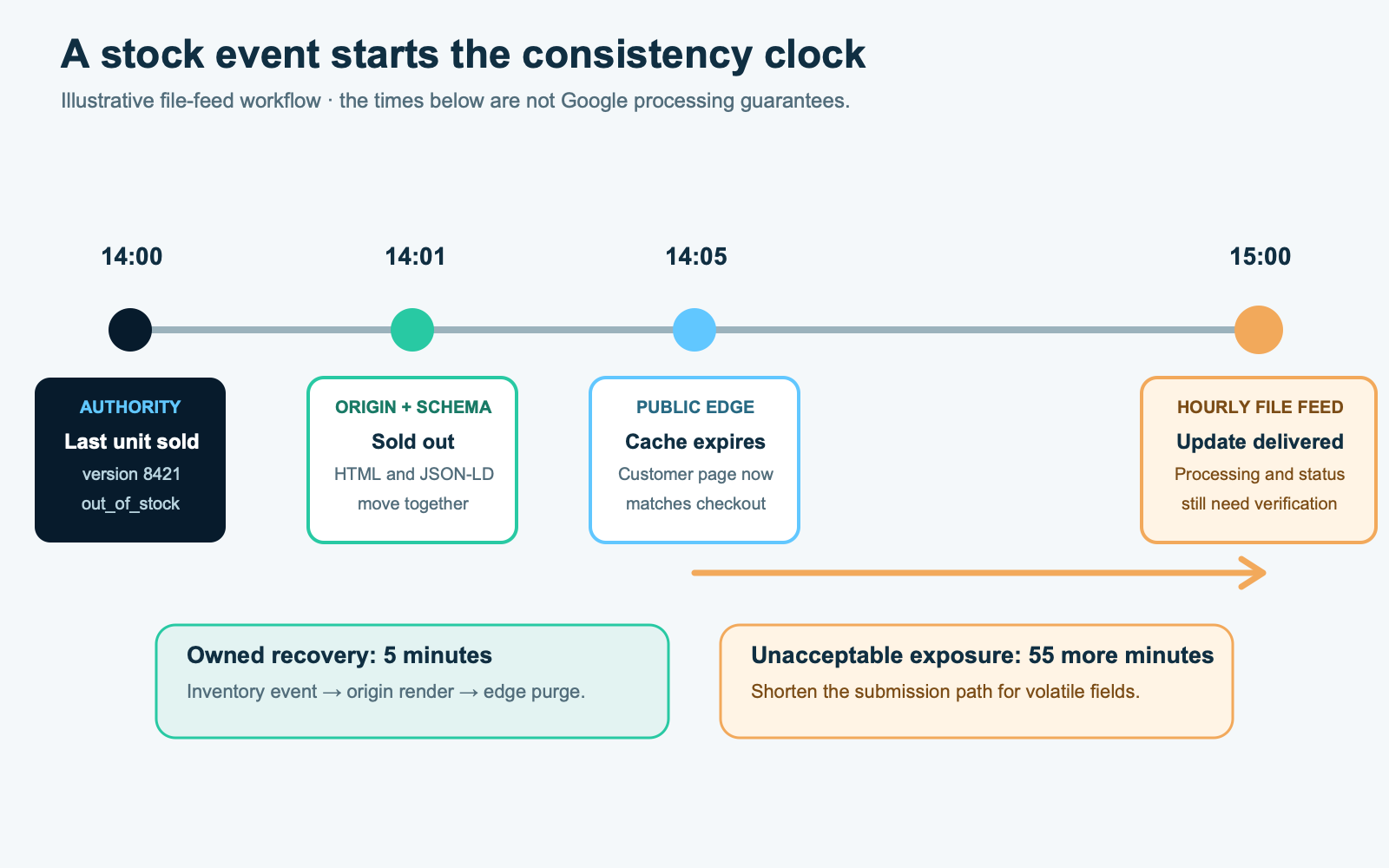
The first fix is to connect the inventory event to page-cache invalidation so HTML and schema move together. The second is to route volatile price and availability changes through a more frequent feed or Merchant API update. Google’s Merchant API guidance positions partial updates for quick, frequent changes such as price and availability. It also warns that supplemental sources and feed rules can override an update; using multiple mechanisms for the same field can create unpredictable outcomes.6
The final check reads the processed product and its status. Merchant API documentation distinguishes accepted input from the resulting product: a successful insertion does not mean the product is approved, and processed values may differ from input values. An HTTP success code proves delivery to an API boundary, not marketplace eligibility or end-to-end consistency.6
Automatic updates are a circuit breaker, not your data pipeline
Merchant Center automations can use structured data and other extraction methods to update price, availability, or condition when Google observes a mismatch. That is valuable damage control. Google says these automations are enabled by default in the current interface and can help avoid mismatches. It also says merchants must continue submitting product data regularly and should not use automatic item updates as their main update method. 511
The boundary matters for incident response. Automation depends on Google finding and interpreting a product page. It may not cover every domain or every extraction case, and inaccurate structured annotations can be disabled. It cannot repair checkout, purge your CDN, reconcile two internal services, or guarantee when a corrected value will appear in a search experience. Treat an automatic correction as evidence that your owned pipeline drifted, not as successful normal operation.
Six failure modes a schema test will not catch
Most production incidents are valid values attached to the wrong offer, version, or delivery path. Add these cases to release and monitoring coverage rather than relying on one manually checked product page.
- Split render inputs. The visible template reads the live pricing API while JSON-LD reads a denormalized catalog table. Both outputs are syntactically correct, but one trails the other until the next replication job. Give one render request one immutable offer snapshot.
-
Partial cache purge. The HTML fragment is invalidated while a full-page cache, mobile cache, or regional edge keeps the old document.
Record the cache key and
Agebeside every observation, and invalidate all representations from the same offer event. - Default-variant drift. The feed links to a blue size-medium offer, but the landing page defaults to black size-small and marks up that selection. A human can change the selector; an automated comparison may never discover the advertised state. Deep-link or deterministically preselect the submitted variant.
- Promotion boundary errors. The page activates a sale in local store time while the feed uses UTC, or the sale price ends without removing a stale strikethrough value. Test one minute before, at, and after both boundaries using the target market’s timezone.
- Override resurrection. An API patch sends the right price, then a scheduled full feed or supplemental rule restores the old one. Merchant API documentation shows that rules can take precedence over submitted fields. Inventory every writer and decide which mechanism may own each volatile attribute.6
- Checkout-only truth. The page and schema agree on “in stock,” but allocation fails after the add-to-cart request because sellable inventory is scoped by warehouse, postcode, or quantity. Page consistency is necessary, not sufficient; a controlled purchase-path assertion is the final owned check for high-risk offers.
These failures also explain why a single catalog-wide mismatch percentage can mislead. A thousand observations from one cached template are one systemic incident, while one wrong price on a high-spend campaign can be commercially urgent. Preserve both the affected-offer count and the underlying failure episode, then prioritize by exposure and elapsed time beyond budget.
Variants, regions, currencies, and membership break naive comparisons
Many apparent mismatches are comparison bugs. A product family page can expose several sizes and colors, each with different stock. A location may change tax treatment, currency, shipping eligibility, or regional inventory. A loyalty tier may change the price a signed-in shopper sees. A crawler that records the first number on the page and compares it with every offer will generate confident nonsense.
Variant identity
Compare the variant named by the landing URL and merchant offer. If the page changes price or availability when a selector changes, test the default selection and the deep-linked selected state separately. Google’s requirements say the availability for a submitted variant should match the same variant on the landing page. Product markup supports variant relationships, but the vocabulary does not decide which variant the merchant advertised. 48
Currency and target market
Normalize numeric formatting only after verifying currency. 79.00 USD and 79.00 CAD are not a match. Google requires the landing
page to show the submitted currency and generally the same price across the target country unless regional pricing is supported. If multiple currencies
are sold, give each experience a stable URL or other supported market mapping so Google and your monitor can reproduce it.
7
Public, sale, and member prices
Decide which price is the active public price and label strikethrough, sale, unit, and member prices explicitly. Google’s merchant-listing documentation defines how active and strikethrough prices can be represented, while Merchant Center has separate price and sale-price attributes. A hidden member price should not silently replace the generally purchasable submitted price. Effective timestamps need timezone-aware tests at both promotion boundaries. 24
A validation protocol that finds the failing boundary
A syntax validator answers whether markup can be parsed and whether required properties are present. It does not prove that a value matches visible content, checkout, Merchant Center, the selected variant, or the authoritative commerce record. End-to-end validation needs evidence from each boundary.
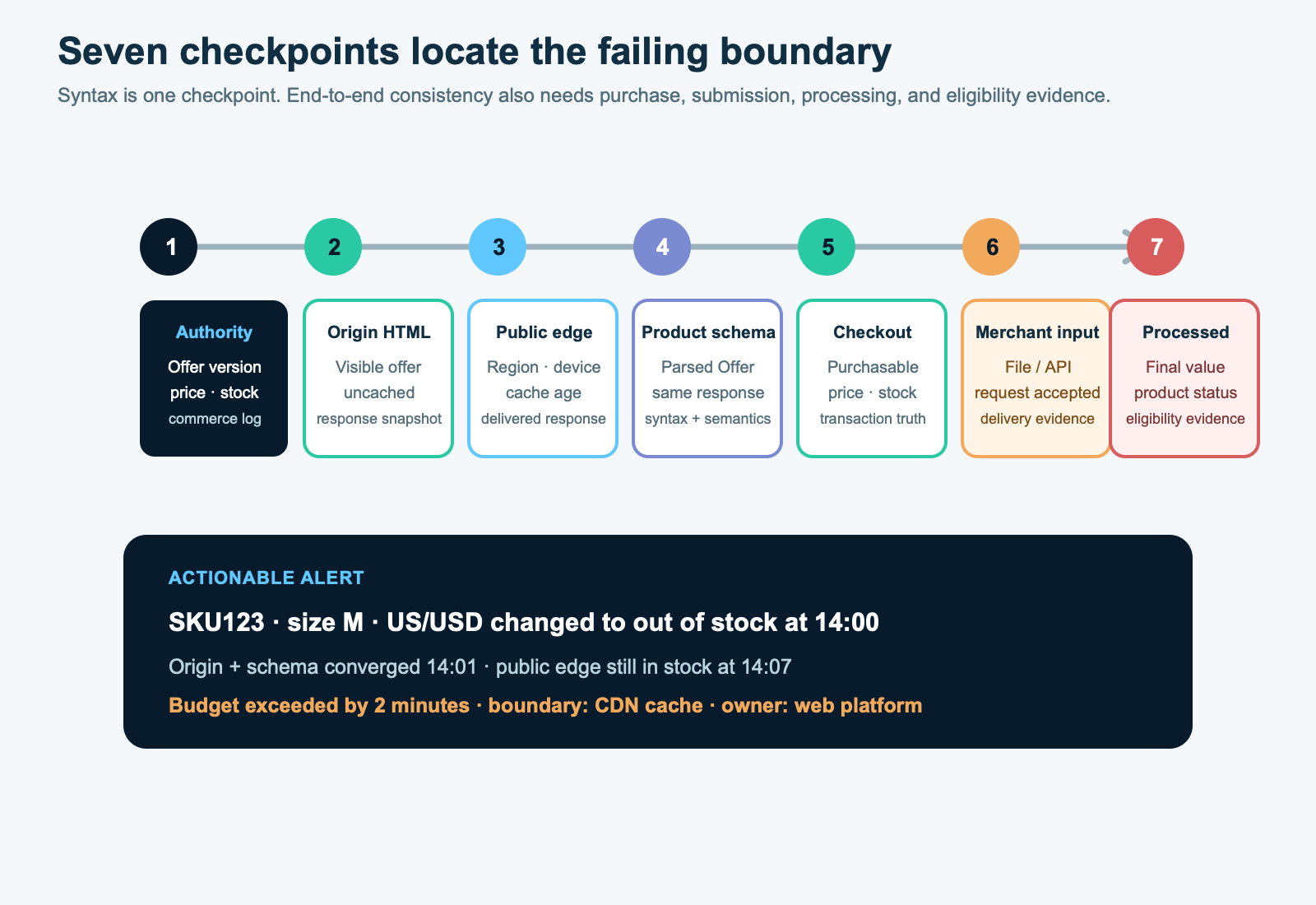
- Capture authority. Record offer ID, variant, market, currency, price, availability, effective time, and version from the owning commerce service.
- Fetch the uncached origin. Parse visible price and availability from the same HTML response as the JSON-LD. Confirm both describe the intended offer.
- Fetch the public edge. Repeat with production hostname, representative region, desktop and mobile profiles, and the cookies or headers that select the market.
- Test purchase truth. Confirm the selected variant can be added at the displayed price, or that an unavailable state disables purchase consistently.
- Inspect merchant input. Record what the file or API actually sent, including data source, request time, and any rules that can override it.
- Inspect the processed product. Read the value and product status after processing; do not infer it from an accepted request.
- Evaluate the budget. Suppress expected propagation, then alert on expired mismatches with both values, versions, timestamps, and owners.
Alert on state transitions, not every sample
A good alert says: “Offer SKU123, size M, US/USD changed to out of stock at 14:00; origin and schema converged at 14:01; public edge still says in stock at 14:07, two minutes beyond its budget.” A weak alert says: “Availability mismatch.” The first identifies the boundary and owner. The second creates a meeting.
Track recurrence by template, cache route, data source, market, and release. Deduplicate repeated observations of the same mismatch episode. Page teams need a deployment identifier; commerce teams need the offer event; feed teams need the source and processing status. A shared incident ID is more useful than copying screenshots into three queues.
Small store and large-platform implementations
For a small catalog
A store with a few hundred stable products does not need a streaming platform. Render visible content and JSON-LD from the same server-side object, use a scheduled Merchant Center source, enable automatic updates as a backstop, and run a daily sample plus checks immediately after price or stock imports. Include every high-value product, every active promotion, one product per major template, and deliberate in-stock/out-of-stock controls. Escalate only if observed time to consistency exceeds the business’s budget.
For a large or volatile catalog
A marketplace, flash-sale retailer, or grocery catalog needs change-driven coverage. Emit versioned offer events, invalidate caches by offer, update volatile merchant fields through a suitable frequent channel, and reconcile a risk-weighted cohort continuously. Weight checks toward recent changes, paid traffic, low inventory, promotion boundaries, high revenue, and historically unreliable templates. Keep a random control sample so the risk model does not blind the team to a new failure class.
The Walmart pricing-system paper is useful here as an engineering case, not a universal benchmark. Its authors describe supervised and unsupervised anomaly detection deployed in a large-scale pricing system and motivate early automated detection. The preprint does not publish a general conversion-loss estimate for page/feed mismatch, so this article uses it only to support anomaly detection as a plausible large-scale control.10
What to do this week
- Name the authority. For identity, price, currency, availability, and effective time, document the service and field that can make the decision.
- Choose five control offers. Include an in-stock item, out-of-stock item, active sale, variant-specific offer, and market- or currency-specific offer.
- Build the join key. Map internal offer identity to page URL and selected variant, schema Offer, and Merchant Center offer ID, language, and feed label.
- Measure current propagation. Change a safe test offer, timestamp every boundary, and observe origin, edge, schema, checkout, merchant input, and processed product.
- Set budgets from evidence. Use the measured path and commercial risk; do not copy the illustrative 60-second or five-minute values blindly.
- Remove duplicate ownership. Generate HTML and schema together, and stop supplemental rules or manual edits from overriding volatile fields without an explicit contract.
- Add one actionable alert. Include both values, offer key, version, elapsed mismatch time, failing boundary, and responsible owner.
A 30-day measurement plan
Days 0–7: establish the denominator and clocks
- Inventory every mechanism that can change price or availability: catalog imports, promotion jobs, inventory reservations, CMS overrides, caches, feed rules, and automatic updates.
- Create a fixed control cohort across templates, variants, markets, currencies, sale states, and availability states.
- Record offer changes as the denominator. For each observed change, capture time to origin, edge, schema, checkout, merchant input, and processed product.
- Separate desktop and mobile profiles wherever rendering, market selection, or cache keys can differ.
Days 8–21: fix the dominant failure path
- Rank incidents by expired mismatch minutes multiplied by commercial exposure, not raw alert count.
- Fix one boundary at a time: duplicate template query, missing purge, slow file cadence, wrong feed rule, variant mapping, or timezone boundary.
- Re-run the same control change after each fix and retain the before/after timeline.
- Review Merchant Center Needs attention and processed product status separately from Search Console structured-data reports.
Days 22–30: decide whether to change course
Keep the design when at least 99% of observed high-risk changes converge inside the team’s declared budget, no control offer is persistently mismatched, and recurrence falls after releases. That 99% is an editorial example of a team-set SLO, not a platform requirement. Choose a threshold appropriate to volume, margin, and harm.
Change course when a large share of mismatch time comes from the delivery method itself: replace a nightly file with more frequent submission for volatile fields, shorten or event-invalidate page caches, or remove a supplemental rule that reintroduces stale data. If Merchant Center reports a mismatch while owned evidence agrees, preserve the crawl timestamp, reproduce mobile and desktop landing experiences, inspect regional selection, and use the platform’s review path. Do not overwrite correct store data merely to silence an unexplained observation.
The strongest counterposition: the feed is the real source of truth
A reasonable commerce team may argue that Merchant Center should be authoritative because it controls the listing and disapproval state. For advertising operations, the processed merchant product is indeed the authoritative record of what Google currently holds and whether that item is eligible. That makes it essential evidence.
The broader conclusion survives because the feed cannot make a price purchasable. Google’s own requirements compare product data against the landing page, checkout, and structured data. Automatic updates move merchant data toward the site, not the reverse. A processed product can also be transformed by rules, policy, and platform processing. The store’s commerce system must remain authoritative for what it will sell; Merchant Center remains authoritative for what Google processed and can show. Reconciliation connects those truths without pretending they are the same system.
What the evidence does not show
- It does not provide a universal safe propagation delay, mismatch SLO, crawl frequency, approval time, or recovery time for Google surfaces.
- It does not show that valid structured data guarantees a rich result, listing, impression, click, or sale. Google explicitly says eligibility is not a display guarantee.
- It does not prove that every temporary mismatch causes disapproval. The Merchant Center documents describe possible enforcement and correction behavior, not a published mismatch threshold.
- It does not make automatic updates complete or immediate. Their coverage and timing depend on Google’s crawl and extraction systems.
- It does not establish a universal conversion-loss percentage or customer-trust effect from a price mismatch. The Walmart paper is a deployment case and motivation, not a causal estimate for other retailers.
- It does not mean HTML, schema, and merchant data must be textually identical. They must describe the same eligible offer after accounting for variant, market, currency, membership, and effective time.
- It does not let a third-party crawler reconstruct what Google or a specific customer received earlier. That requires timestamped Merchant Center evidence, checkout records, and CDN or origin logs.
Where 2-UA fits—and where it stops
2-UA can audit public Product schema, capture page changes, monitor availability language and HTTP behavior, and compare public desktop and mobile pages over time. That makes it useful for detecting a stale page, broken schema, missing offer, or template change at the public delivery layer. It does not read a merchant’s private Merchant Center account, confirm processed-product approval, observe checkout reservations, prove CDN request history, or replace the commerce system’s offer event log. Those boundaries require Merchant Center or Merchant API access, checkout telemetry, and CDN or origin logs owned by the merchant.
Implementation checklist
- Define one authoritative offer record and a stable cross-channel join key.
- Include variant, market, currency, membership state, and effective time before declaring a mismatch.
- Render visible offer content and JSON-LD from the same immutable object in the initial HTML where feasible.
- Invalidate page and schema caches from the same price or inventory event.
- Choose merchant submission cadence by field volatility and business harm.
- Record input acceptance, processed value, and product status as separate states.
- Keep automatic item updates enabled when appropriate, but investigate every correction as pipeline drift.
- Test promotion start and end timestamps, timezones, sale and strikethrough prices, variants, and regional offers.
- Run desktop and mobile checks against the public edge and include the device profile beside every reported URL.
- Alert after the declared latency budget with value, version, timestamp, boundary, and owner.
- Measure time to consistency and expired mismatch minutes against observed offer changes.
- Keep page, checkout, cache, Merchant Center, and Google Search evidence in separate columns.
References
- Google Search Central, Introduction to Product structured data. Product data sources and combined eligibility; updated December 10, 2025.
- Google Search Central, Merchant listing Product and Offer structured data. Active price, availability, sale timing, deployment, and monitoring guidance.
- Google Search Central, Share your product data with Google. Structured-data and Merchant Center roles, including documented update-lag conflicts.
- Google Merchant Center Help, Product data specification. Price and availability matching requirements for landing pages, structured data, and checkout.
- Google Merchant Center Help, Allow Merchant Center to update product information automatically. Automation scope, extraction, and limitations.
- Google Merchant API, Add and manage products and Make frequent updates to products. Offer identity, input processing, status, partial updates, and rule precedence.
- Google Merchant Center Help, About landing page requirements. Currency, price, availability, purchase controls, and JavaScript caveats.
- Schema.org, Offer and Product. Community vocabulary for offer price, currency, availability, validity, identifiers, and variants.
- IETF, RFC 9111: HTTP caching. Internet Standard, June 2022; cache reuse, freshness, validation, and response age.
- Ramakrishnan et al., Anomaly detection for an e-commerce pricing system. Walmart deployment case; arXiv preprint, February 2019.
- Google Merchant Center Help, Tips to help your products stay approved. Automatic updates as a backstop and event guidance for frequent price and availability changes.